Top 6 Reinforcement Techniques for CMU Walls
Discover the top 6 reinforcement techniques for CMU walls to improve strength, durability, and safety in residential, commercial, and industrial construction.
Follow your curiosity. Find your next engineering insight.

Discover the top 6 reinforcement techniques for CMU walls to improve strength, durability, and safety in residential, commercial, and industrial construction.
Discover 6 fiber types used in concrete reinforcement, their advantages, applications, and global standards for stronger, more durable concrete.

Wire mesh vs. rebar: which is better for your construction project? Learn the pros, cons, and best use cases in this ultimate guide!
Discover why skin reinforcement matters for deep beams. Learn its purpose, importance, and expert tips for structural stability. Dive into this comprehensive guide now!
Learn how to protect reinforcement from corrosion with proven methods, coatings, and design strategies for durable concrete structures.
Learn how to install steel rebar correctly with our comprehensive guide on structural reinforcement. Improve your construction skills today!
Mivan Shuttering Interview Questions and Answers: 25 Technical Questions Quick Answer Mivan shuttering is a reusable aluminium formwork system used to cast reinforced-concrete walls, slabs, beams, columns, stairs, and other repetitive building elements with high dimensional consistency. It is especially effective for apartment towers and other projects with repeated floor plans. A strong site engineer…
Quick Answer: Concrete PSI is a measure of compressive strength expressed in pounds per square inch. It is established by testing properly sampled, molded, cured, and crushed specimens at the age specified by the project, commonly 28 days. A PSI value should always be interpreted with its specimen type, test age, acceptance criteria, and governing…
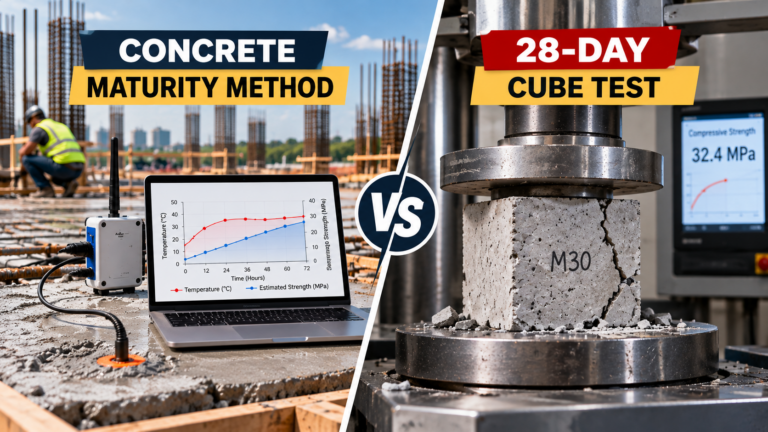
The 28-day concrete cube test is more reliable for standardized compressive strength testing and code-based concrete acceptance, while the concrete maturity method is generally more useful for estimating in-place strength during early-age construction. Cube testing directly measures the compressive strength of representative specimens using a calibrated testing machine, whereas the maturity method estimates strength from…
QQnAEngine.ENGINEERING UNBOUNDED ExploreGuidesLearning pathsFind an answer ↗ A clearer perspective on the built world Engineering.Made clearer. Practical civil engineering knowledge for curious students and working professionals. Explore the materials, methods, and ideas behind the built world. Search ↗ Try concrete technology, soil stabilization, or rebar. THE KNOWLEDGE COLLECTION Ideas thatbuild understanding. From the ground beneath…
Site guide · Quizzes use a built-in question bank.