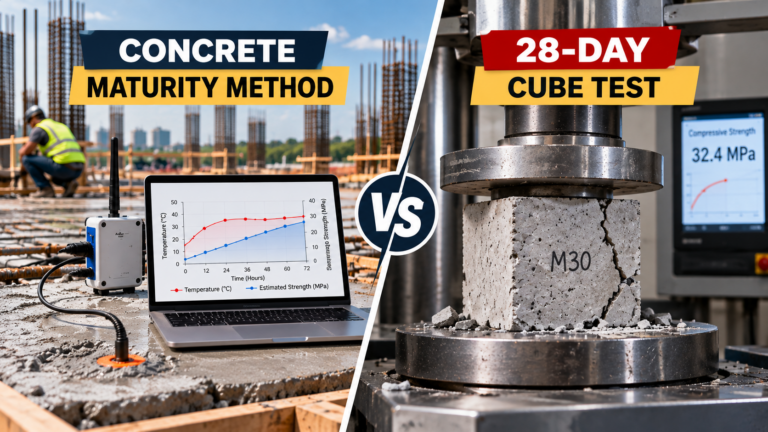
Quick Answer: Concrete PSI is a measure of compressive strength expressed in pounds per square inch. It is established by testing properly sampled, molded, cured, and crushed specimens at the age specified by the project, commonly 28 days. A PSI value should always be interpreted with its specimen type, test age, acceptance criteria, and governing standard; a cube result, cylinder result, core result, and rebound-hammer reading are not automatically interchangeable. In practice, reliable concrete-strength decisions depend as much on sampling, curing, testing, and documentation as on the final number.
What does concrete PSI mean?
Concrete PSI describes how much compressive stress a concrete specimen can resist before failure. Concrete is usually strong in compression, so compressive-strength testing is one of the main ways engineers verify whether a mix is suitable for a structural or non-structural application. The number is not a complete description of the concrete. A specification may also control water-cement ratio, cement type, exposure class, permeability, slump, air content, temperature, durability, and early-age strength.
For example, a specification calling for 4,000 PSI concrete normally means that the concrete is expected to achieve a specified compressive strength at a stated age under the project’s acceptance rules. It does not mean that every small piece of concrete will test at exactly 4,000 PSI, and it does not mean that adding water on site is harmless. Concrete strength is a statistical and quality-control property, not a visual impression.
PSI, MPa, and concrete grade
PSI is common in North American specifications, while MPa is widely used in metric systems. The conversion is:
MPa = PSI × 0.00689476
Therefore, 3,000 PSI is approximately 20.7 MPa, 4,000 PSI is approximately 27.6 MPa, and 5,000 PSI is approximately 34.5 MPa. These are unit conversions only. They do not convert one code’s test method or acceptance rule into another code’s rule.
In many projects, a grade such as C25/30 or M25 is tied to a particular standard and specimen convention. The first number may refer to cylinder strength and the second to cube strength, or the meaning may depend on the adopted code. Always read the project specification instead of assuming that a grade label has the same meaning everywhere.
Why compressive strength matters
Strength verification protects several decisions. The structural engineer uses design strength to proportion members and reinforcement. The contractor uses test results to support formwork striking, loading, and construction sequencing. The quality team uses results to identify batch variation, curing problems, or process failures. The owner uses the records to demonstrate that the intended material was supplied and placed.
Strength also affects durability indirectly. A well-controlled, low-permeability mix may resist ingress better than a poorly controlled mix with a similar nominal strength. Conversely, a high PSI number does not excuse inadequate cover, poor curing, cracks, honeycombing, or exposure conditions beyond the design assumptions.
Cube testing versus cylinder testing
| Item | Cube test | Cylinder test |
|---|---|---|
| Specimen | Usually a square prism | Usually a round cylindrical specimen |
| Result | Cube compressive strength | Cylinder compressive strength |
| Use | Common in projects using relevant metric standards | Common in projects using ASTM-style practice |
| Comparison | Not directly interchangeable with cylinder strength | Not directly interchangeable with cube strength |
| Decision rule | Use the specified code and acceptance criteria | Use the specified code and acceptance criteria |
Cube and cylinder results differ because specimen geometry, friction at the platens, slenderness, capping, and failure behavior differ. It is unsafe to apply a convenient conversion factor without confirming that it is appropriate for the concrete, specimen dimensions, and governing standard. When a report says only “concrete PSI” without identifying the specimen, test age, and method, the result is incomplete.
How a concrete compressive-strength test works
1. Confirm the approved mix
Before sampling, confirm the approved mix designation, specified strength, target slump or workability, exposure requirements, admixtures, aggregate size, and permitted delivery time. The delivery ticket should be associated with the sampling record. If water or admixture is added at the site, record the quantity and authorization rather than relying on memory.
2. Take a representative sample
A test sample should represent the concrete being placed, not just the first material discharged or a convenient bucket. Sampling procedures vary by standard, but the key principles are consistent: use clean equipment, take increments when required, remix the combined sample carefully, and protect it from contamination, evaporation, and temperature extremes.
3. Measure fresh-concrete properties
Record slump or another specified workability measure, temperature, air content where applicable, delivery time, batch number, location of placement, and any adjustments. Fresh-property results provide context for later strength results. A low-strength specimen with abnormal temperature or excessive site-added water should trigger a documented investigation.
4. Mold and compact specimens
Use clean molds of the correct dimensions. Fill and compact according to the applicable standard so that entrapped air and segregation are controlled. Strike the surface, label each specimen clearly, and record the technician, batch, location, and intended test age. A specimen without traceability is a weak basis for a structural decision.
5. Cure correctly
Initial protection matters. Specimens should not be left in direct sun, exposed to vibration, allowed to dry out, or placed in an uncontrolled vehicle. After demolding, laboratory or field curing must follow the specified method. Poor curing can reduce the measured result even when the delivered mix was acceptable.
6. Test in a calibrated machine
The compression machine applies load at the prescribed rate until the specimen fails. The laboratory records the maximum load, specimen dimensions, calculated strength, failure pattern, test age, and any unusual observations. Calibration, platen condition, alignment, capping or grinding, and technician competence all affect reliability.
Seven-day and 28-day concrete strength
Seven-day tests are often used as an early indicator. They can help the team plan construction, identify a developing problem, or compare the actual rate of strength gain with expectations. A seven-day result is not automatically a substitute for the specified acceptance age. Many ordinary structural specifications use 28 days, while some mixes and projects use another age.
At 28 days, a properly cured specimen commonly provides the principal acceptance result for conventional concrete, but the governing specification controls. Some mixes gain strength more slowly because of supplementary cementitious materials, while others are designed for rapid early strength. Do not reject or accept a mix from a generic rule of thumb when the approved mix design and project standard provide a more relevant basis.
What causes low PSI results?
- Excess water: Additional water can increase workability while reducing strength and increasing bleeding or shrinkage.
- Bad sampling: A non-representative or contaminated sample can mislead the project team.
- Poor compaction: Voids reduce the effective load-bearing area of the specimen.
- Improper curing: Drying, overheating, freezing, or delayed curing can reduce hydration and strength.
- Specimen damage: Cracks, chipped edges, poor capping, or rough surfaces can distort failure.
- Testing error: Misalignment, incorrect dimensions, wrong machine settings, or poor recording can affect the calculation.
- Actual mix variation: Incorrect batching, segregation, admixture error, aggregate moisture changes, or delivery delays can create a genuine problem.
- Wrong expectation: The reported grade, specimen type, or test age may not match the specification being used.
What to do when a test is below specification
A low result should be treated seriously but not interpreted in isolation. First verify the specimen identity, test age, dimensions, calculations, machine status, curing record, and laboratory report. Then review the batch ticket, fresh-concrete results, site-added water, delivery time, placement location, weather, and technician notes. Check whether the result is an individual low break or part of a confirmed strength trend under the project’s acceptance rules.
The engineer may request additional testing, review of nearby results, maturity monitoring, nondestructive testing, or cores. Core testing can provide information about in-place concrete, but cores have their own limitations and must be planned, located, extracted, conditioned, and interpreted properly. Structural evaluation should be performed by the responsible engineer; a website article cannot declare a building safe or unsafe from one number.
Concrete PSI and water-cement ratio
For many conventional mixes, lower water-cement ratio is associated with higher potential strength and lower permeability, provided the concrete can still be placed and compacted properly. Reducing water without redesigning the mix can create a stiff mixture that is difficult to consolidate. The correct solution may involve aggregate grading, admixtures, paste volume, placement method, or a revised approved mix rather than an uncontrolled water reduction.
Site personnel should never use water as an informal cure for delayed delivery, poor workability, or inadequate planning. If an adjustment is permitted, it should be made within the approved procedure and recorded on the delivery documentation. Unrecorded additions undermine both quality and later investigation.
Strength, durability, and construction quality
Compressive strength is important, but it is not the entire quality picture. Concrete can achieve its target PSI and still perform poorly if it is inadequately cured, cracked, segregated, poorly compacted, or exposed to an environment not considered in design. Conversely, a modest variation in a test result may not indicate a structural failure when the complete statistical acceptance criteria are satisfied.
Pay attention to cover, joints, curing duration, surface protection, drainage, reinforcement congestion, vibration access, and finishing operations. In a heavily reinforced column, for example, a nominally strong mix that cannot flow around bars is not a good practical mix. In a slab, excessive finishing water and early drying can damage the surface even if interior specimens later meet strength requirements.
Cube and cylinder sampling checklist
- Confirm the latest approved mix design and specified test age.
- Prepare clean, correctly dimensioned molds and tools.
- Record truck, batch, delivery, location, time, weather, and technician.
- Take a representative sample using the applicable standard.
- Perform slump, temperature, air, or other specified fresh tests.
- Compact and finish specimens consistently.
- Label specimens so the identity cannot be lost.
- Protect specimens during initial curing and transport.
- Verify laboratory calibration and report calculations.
- Review trends, not only isolated results.
Worked example: interpreting a 4,000 PSI specification
Assume a project specifies 4,000 PSI concrete at 28 days using cylinders. The site team receives three batches for a suspended slab. The delivery tickets show the mix designation, no unauthorized water addition is recorded, slump and temperature are within the approved range, and specimens are molded and cured correctly. One individual result is 3,850 PSI, while the other results are 4,150 and 4,280 PSI.
The correct response is not to label the slab safe or unsafe from the first number alone. The engineer and quality team should apply the project’s acceptance criteria to the complete set, check the specimen and laboratory records, examine the trend, and determine whether additional action is required. If the result is part of a wider decline, the team should stop repeating the same process and investigate batching, aggregate moisture, curing, placement, and testing. This is why a test report must be read as part of a quality system.
Common mistakes to avoid
Assuming a higher slump always means better concrete
Workability is useful only when it is achieved by an approved mix and the concrete can be placed and compacted without segregation.
Comparing unrelated reports
A 28-day cube cannot be casually compared with a 7-day cylinder. Confirm specimen, age, dimensions, standard, and acceptance rule first.
Using a rebound hammer as a replacement for specified tests
Nondestructive readings can help identify variation, but surface moisture, carbonation, aggregate, orientation, and calibration affect them. Use the method as approved by the engineer.
Ignoring curing records
Two identical mixes can produce different results when one group of specimens is protected and the other dries out or overheats.
Repairing a structural concern cosmetically
Surface patching may improve appearance but cannot substitute for engineering assessment of inadequate in-place strength or deep defects.
Applicable standards and professional responsibility
Projects may reference ASTM practices such as concrete sampling, molding and curing, cylinder compression testing, or core testing, or they may use relevant provisions of Indian Standards such as IS 516. The exact edition and adopted procedure matter. Laboratories, contractors, consultants, and owners should use the documents named in the contract rather than combining fragments from different systems.
Standards also evolve. Before relying on a test form, acceptance formula, specimen size, or curing requirement, confirm the current edition specified for the project and the laboratory’s accreditation scope. Where a jurisdiction, client, or authority has additional requirements, those requirements control.
Frequently Asked Questions
1. Is 4,000 PSI concrete always stronger than 3,000 PSI concrete?
As a specified compressive-strength class, 4,000 PSI represents a higher target than 3,000 PSI under comparable test conditions. Actual acceptance still depends on specimen type, age, variability, and the governing specification.
2. How much is 5,000 PSI in MPa?
Using the standard unit conversion, 5,000 PSI is approximately 34.5 MPa. This conversion does not change the test method or the code requirements.
3. Is 28-day strength more important than 7-day strength?
It depends on the project specification. Seven-day strength is often an early indicator, while 28-day strength is commonly used for acceptance, but some mixes specify another age.
4. Can cube and cylinder results be compared directly?
No. They use different geometries and failure behavior. Compare them only through an accepted method appropriate to the governing standard and concrete.
5. Can I estimate PSI from a rebound hammer?
A rebound hammer can indicate relative uniformity when calibrated and used correctly. It should not replace specified compressive testing unless the engineer approves the investigation procedure.
6. What should I do if one cylinder is low?
Verify identification, dimensions, curing, capping, machine condition, and calculations, then apply the project’s acceptance criteria to the complete test set. Do not make a structural conclusion from one number alone.
7. Does adding water always reduce strength?
Uncontrolled water addition usually changes the designed water-cement ratio and can reduce strength and durability. Any permitted adjustment must follow the approved mix procedure and be recorded.
8. Can low cube strength be caused by poor curing?
Yes. Drying, temperature extremes, delayed curing, vibration, or damage can reduce a specimen result even when the delivered concrete was acceptable.
9. When are cores required?
Cores may be considered when test results are disputed, in-place strength needs investigation, or the engineer needs evidence from the structure. Their number, location, extraction, conditioning, and interpretation must be approved.
10. Does high PSI guarantee durability?
No. Durability also depends on permeability, curing, cover, cracking, exposure, detailing, drainage, and workmanship. Strength is one important performance measure, not a guarantee.
11. Who decides whether a low result is acceptable?
The responsible design or structural engineer, applying the contract documents and governing standard, should make that decision. A general article cannot replace project-specific engineering judgment.
12. What information should appear on a test report?
At minimum, the report should identify the project, mix, batch, specimen type and dimensions, sampling and test dates, test age, maximum load, calculated strength, curing details, failure observations, technician or laboratory, and any deviations.
Conclusion
Concrete PSI is meaningful only when the number is connected to a defined specimen, test age, sampling process, curing history, laboratory method, and acceptance rule. Reliable construction teams control the entire chain from approved mix design to final report. They record site adjustments, investigate trends, use the correct standard, and involve the responsible engineer when results are low or inconsistent.
From an engineering perspective, the best concrete-strength decision is rarely the fastest guess. It is the conclusion supported by traceable records, technically appropriate testing, and an understanding of the structure’s design and exposure. That approach protects safety, reduces unnecessary demolition or delay, and produces quality records that remain useful long after the pour is complete.