
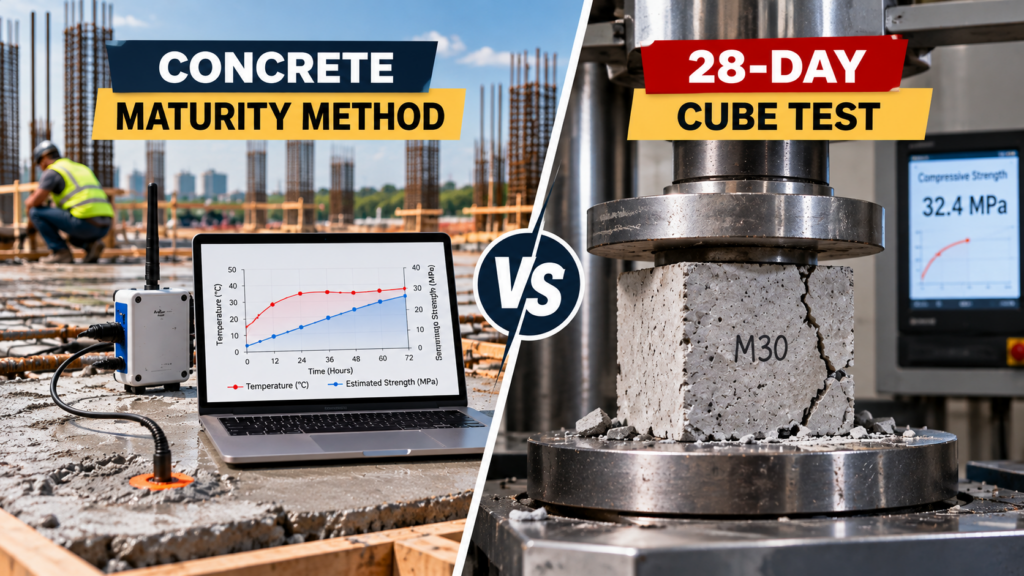
The 28-day concrete cube test is more reliable for standardized compressive strength testing and code-based concrete acceptance, while the concrete maturity method is generally more useful for estimating in-place strength during early-age construction. Cube testing directly measures the compressive strength of representative specimens using a calibrated testing machine, whereas the maturity method estimates strength from the concrete’s time-temperature history using a mix-specific calibration relationship. A properly calibrated maturity system can provide valuable information for decisions such as formwork removal, post-tensioning, and pavement opening without waiting for fixed-age test results. For most construction projects, the most technically reliable approach is to use standard-cured cube testing for specified-strength compliance and validated maturity monitoring for construction-stage strength decisions, subject to the applicable codes and project specifications.
Do Engineers Really Need to Wait 28 Days to Know Concrete Strength?
Concrete strength testing is one of the most important quality-control activities in civil and structural engineering.
On conventional construction projects, engineers collect concrete samples during placement, prepare standard cubes or cylinders, cure them under prescribed conditions, and test their compressive strength at specified ages.
The 28-day concrete cube test is particularly familiar in countries following Indian Standards.
However, modern construction projects operate under increasingly demanding schedules.
Consider a typical reinforced concrete building project.
The contractor completes a slab pour and wants to proceed with the next construction activities. The planning team is concerned about maintaining the floor cycle, while the structural engineer needs confirmation that the concrete has developed sufficient strength for the proposed operations.
Waiting for a 28-day cube test result is not always necessary for every construction-stage decision.
The concrete may develop sufficient early-age strength much sooner, depending on its mixture proportions, temperature, curing conditions, and other factors. Related reading: temperature effects on concrete setting time.
This creates an important question:
Can engineers determine the actual strength development of concrete inside a structure without waiting for laboratory specimens to reach a specified testing age?
The concrete maturity method provides one way to estimate that strength.
By recording concrete temperature and relating the accumulated time-temperature history to an experimentally established strength-maturity curve, engineers can estimate strength development at different locations within the structure.
However, maturity monitoring has important limitations. Related reading: superplasticizers in concrete.
It does not directly measure compressive strength, and an inaccurate calibration can produce misleading results.
The conventional cube test also has limitations because a laboratory-cured cube does not necessarily experience the same temperature and moisture conditions as the concrete inside the structure.
These methods therefore answer different engineering questions.
This article examines the concrete maturity method versus the 28-day cube test, including their working principles, accuracy, calculations, relevant standards, calibration requirements, applications, limitations, construction cost implications, and practical use on real projects. Related reading: concrete technology.
What Is the 28-Day Concrete Cube Test?
The 28-day concrete cube test is a standardized laboratory procedure used to determine the compressive strength of hardened concrete specimens.
Fresh concrete is sampled during production or placement and cast into standardized cube moulds.
The specimens are consolidated, protected, demoulded, and cured according to the applicable testing standard.
At the specified testing age, each cube is placed in a calibrated compression testing machine and loaded until failure.
The maximum applied load is recorded.
Compressive strength is calculated by dividing the failure load by the loaded cross-sectional area.
Why Is Concrete Tested at 28 Days?
Concrete gains strength as cementitious materials react with water through hydration and related reactions.
Strength development depends on several factors, including: Related reading: concrete mix design.
- Type and quantity of cementitious materials.
- Water-cementitious material ratio.
- Chemical admixtures.
- Supplementary cementitious materials.
- Concrete temperature.
- Moisture availability.
- Curing conditions.
- Mixture proportions.
For conventional concrete, 28 days has long served as a standardized reference age for specifying and evaluating compressive strength.
It provides a consistent basis for comparing different concrete batches and evaluating compliance with project specifications.
However, 28 days is not the age at which concrete suddenly reaches its maximum strength or stops gaining strength.
Strength development can continue beyond 28 days when sufficient moisture and suitable conditions are available.
Concrete containing certain supplementary cementitious materials may develop a substantial portion of its strength after this reference age. Related reading: fiber-reinforced concrete.
Conversely, some specialized high-early-strength mixtures may achieve their specified requirements considerably earlier.
The 28-day test remains valuable because it establishes a standardized assessment point.
Concrete Cube Testing Procedure
In Indian construction practice, a common compressive strength specimen is a 150 mm concrete cube.
The applicable procedures are addressed through standards including IS 1199 (Part 5): 2018 for making and curing specimens and IS 516 (Part 1/Sec 1): 2021 for strength testing. Related reading: concrete workability tests.
A typical procedure involves:
- Collecting a representative fresh-concrete sample.
- Preparing and identifying the cube moulds.
- Filling and consolidating the moulds using the specified method.
- Protecting specimens during initial curing.
- Demoulding the cubes at the appropriate time.
- Continuing curing under specified conditions.
- Removing the specimens for testing at the required age.
- Inspecting and positioning each specimen in the compression testing machine.
- Applying the compressive load at the prescribed loading rate.
- Recording the maximum load and calculating compressive strength.
The results are then evaluated using the acceptance requirements of the applicable design code and project specification.
Example: Calculating 28-Day Concrete Cube Strength
Suppose a concrete cube has the following dimensions:
- Length = 150 mm
- Width = 150 mm
- Height = 150 mm
- Maximum failure load = 720 kN
The loaded area is:
A = 150 × 150 = 22,500 mm²
Convert the applied load into newtons:
P = 720 × 1,000 = 720,000 N
The compressive strength is:
Compressive strength = Failure load / Loaded area
f = 720,000 / 22,500
f = 32 N/mm² = 32 MPa
Therefore, the measured compressive strength of this particular cube is 32 MPa.
For a concrete grade designated M25 under Indian practice, this individual result exceeds the nominal characteristic compressive strength of 25 MPa.
However, this does not automatically establish that the concrete lot satisfies every acceptance criterion.
IS 456 requires evaluation using specified sampling and statistical acceptance provisions, including requirements for individual test results and groups of test results.
A single successful cube does not independently prove that an entire concrete placement complies with the code.
Expert Insight: The 28-day cube test measures the compressive strength of the tested specimen. It does not directly measure the strength at every location within the structure from which the sample was collected.
What Is the Concrete Maturity Method?
The concrete maturity method is a technique used to estimate concrete strength development from its temperature history over time. Related reading: concrete properties affecting durability.
It is based on the principle that the rate of cement hydration, and consequently strength development, depends strongly on temperature.
Concrete cured at a relatively high temperature generally develops early strength faster than the same mixture cured at a lower temperature, provided other conditions remain suitable. Related reading: concrete surface quality.
The maturity method quantifies the combined influence of time and temperature. Related reading: concrete shrinkage.
Instead of relying only on the number of days after concrete placement, it calculates a maturity index representing the concrete’s accumulated temperature exposure over time.
That index is then compared with an experimentally determined strength-maturity relationship for the particular concrete mixture.
How the Concrete Maturity Method Works
The process has two essential components.
First, a strength-maturity calibration relationship must be developed.
Representative concrete specimens are prepared using the proposed concrete mixture. Their temperatures are monitored, and their compressive strengths are measured at different ages.
The resulting measurements establish a relationship between maturity index and concrete strength.
Second, concrete temperature must be monitored in the actual structure.
Sensors embedded in the placed concrete record temperature over time.
The corresponding maturity index is calculated and converted into estimated compressive strength using the established calibration curve.
For example, a sensor may record the temperature history of a newly cast reinforced concrete slab.
The monitoring system calculates the accumulated maturity.
If the calibrated relationship indicates that the measured maturity corresponds to an estimated strength of 18 MPa, that information may support an early-age construction decision.
However, the result remains an estimate rather than a direct compressive strength test.
The calibration must be valid, and the proposed decision must satisfy the project’s engineering and verification requirements. Related reading: slipform construction.
Is the Maturity Method a Nondestructive Test?
The maturity method is generally described as a nondestructive strength-estimation technique.
Temperature sensors collect data without requiring the structural concrete to be crushed or damaged during routine monitoring.
However, the technique is not independent of destructive testing.
Laboratory specimens must be tested to establish the original strength-maturity relationship.
Periodic verification may also require additional concrete strength testing.
This distinction matters because maturity monitoring does not eliminate the need for conventional concrete testing.
Concrete Maturity Method vs. 28-Day Cube Test: Key Differences
The comparison becomes clearer when the methods are evaluated against their actual functions.
| Parameter | Concrete Maturity Method | 28-Day Cube Test |
|---|---|---|
| Primary purpose | Estimate in-place concrete strength development | Measure standardized specimen compressive strength |
| Measurement principle | Time-temperature history correlated with strength | Maximum compressive failure load |
| Type of result | Estimated compressive strength | Directly measured specimen strength |
| Testing location | Sensors embedded in the structure | Laboratory compression testing machine |
| Testing age | Multiple times throughout strength development | Conventionally 28 days, with other ages as specified |
| Specimen destruction | Not required for routine embedded monitoring | Concrete cube is crushed during testing |
| Calibration | Requires a mix-specific strength-maturity relationship | Requires calibrated test equipment and standardized procedures |
| Temperature influence | Explicitly included in maturity calculation | Controlled through specimen curing requirements |
| In-place temperature representation | Good at properly selected sensor locations | Standard-cured cubes do not necessarily represent structural temperatures |
| Concrete acceptance | Only where specifically permitted by governing requirements | Established method for standardized strength acceptance |
| Early-age decisions | Highly useful when properly validated | Requires separately scheduled early-age tests |
| Main limitation | Strength is inferred, not directly measured | Specimens may not represent actual in-place curing conditions |
| Common applications | Formwork decisions, post-tensioning, pavement opening, temperature monitoring | Grade verification, quality control, contractual acceptance |
Which Method Is More Accurate?
There is no technically meaningful universal answer without first identifying what is being evaluated.
If the objective is to determine the compressive strength of a standard-cured specimen at 28 days, the cube test is the appropriate direct measurement.
If the objective is to estimate the strength of concrete inside a slab at 36 or 48 hours, a properly calibrated maturity system may provide more representative information about its actual temperature-dependent strength development.
However, the maturity system’s accuracy depends on calibration quality, sensor location, mixture consistency, and suitable curing conditions.
It is therefore incorrect to claim that maturity monitoring is always more accurate than cube testing.
Key Takeaway: The cube test answers, “What compressive strength did the specimen achieve?” The maturity method answers, “What strength is the in-place concrete estimated to have reached under its recorded temperature history?”
The Science Behind the Concrete Maturity Method
To understand maturity monitoring properly, engineers need to distinguish concrete age from concrete maturity.
Concrete Age vs. Concrete Maturity
Concrete age simply measures the elapsed time since mixing or placement, depending on the testing definition.
Maturity accounts for both elapsed time and concrete temperature.
Consider two concrete slabs produced using the same mixture.
Slab A remains at an average temperature of approximately 30°C during the first day.
Slab B remains at approximately 10°C during the same period.
Both slabs are 24 hours old.
However, their rates of cement hydration are unlikely to be identical.
Under otherwise suitable and comparable conditions, the warmer concrete will generally develop early-age strength more rapidly.
The maturity method attempts to account for this difference mathematically.
Two commonly used approaches are the Nurse-Saul method and the Arrhenius equivalent-age method.
Nurse-Saul Maturity Method
The Nurse-Saul method calculates a temperature-time factor using the temperature history of concrete.
The general equation is:
M(t) = Σ (T − T₀) × Δt
Where:
- M(t) = Maturity index at time t.
- T = Average concrete temperature during the time interval, in °C.
- T₀ = Datum temperature, in °C.
- Δt = Duration of the time interval.
- Σ = Summation across the measurement intervals.
When hours are used, the resulting maturity index is commonly expressed in °C·h.
The datum temperature represents a reference temperature used in the maturity model.
A value of −10°C is sometimes used in illustrative calculations, but it should not be assumed to be universally appropriate.
The actual datum temperature must be selected or determined according to the relevant procedure and concrete mixture.
Worked Example: Nurse-Saul Maturity Calculation
Suppose a newly placed concrete slab has been monitored for 24 hours.
For this simplified example, assume:
- Datum temperature = −10°C.
- Four monitoring intervals.
- Each interval = 6 hours.
- Recorded temperatures are representative averages for their respective intervals.
| Time Interval | Average Temperature | T − T₀ | Interval Maturity |
|---|---|---|---|
| 0–6 hours | 15°C | 25°C | 150°C·h |
| 6–12 hours | 20°C | 30°C | 180°C·h |
| 12–18 hours | 25°C | 35°C | 210°C·h |
| 18–24 hours | 30°C | 40°C | 240°C·h |
| Total | 780°C·h |
The accumulated maturity is:
M = 150 + 180 + 210 + 240
M = 780°C·h
This result describes the accumulated time-temperature factor.
It does not independently establish concrete compressive strength.
A valid calibration relationship is required before the maturity index can be converted into an estimated strength.
Arrhenius Equivalent-Age Method
The Arrhenius approach recognizes that the temperature sensitivity of chemical reactions is not necessarily linear.
It converts the actual temperature history into an equivalent curing age at a selected reference temperature.
The equivalent-age relationship can be expressed as:
tₑ = Σ {exp[−Eₐ/R × (1/T − 1/Tᵣ)] × Δt}
Where:
- tₑ = Equivalent age at the reference temperature.
- Eₐ = Apparent activation energy.
- R = Universal gas constant.
- T = Absolute concrete temperature during the interval, in kelvin.
- Tᵣ = Absolute reference temperature, in kelvin.
- Δt = Time interval.
The Arrhenius method is potentially useful when the concrete experiences significant temperature variation or when a more appropriate representation of the mixture’s temperature sensitivity is required.
However, it introduces additional calibration parameters.
The activation-energy parameter must be suitable for the particular concrete mixture.
An improperly selected value can produce inaccurate maturity estimates.
Nurse-Saul vs. Arrhenius: Which Should Engineers Use?
| Factor | Nurse-Saul | Arrhenius |
|---|---|---|
| Temperature relationship | Linear approximation | Exponential temperature dependence |
| Main output | Temperature-time factor | Equivalent age |
| Calculation complexity | Relatively simple | More complex |
| Important calibration parameter | Datum temperature | Apparent activation energy or corresponding temperature-sensitivity parameter |
| Suitability | Useful for many conventional applications | Potentially advantageous where temperature sensitivity requires more detailed modeling |
| Limitation | Linear assumption may be inadequate over wide temperature ranges | Incorrect parameters can significantly affect results |
Neither calculation should be selected merely because it produces a higher estimated strength.
The method must be appropriate for the concrete mixture and applied consistently during calibration and field monitoring.
Practical Tip: For large projects, ask the testing agency to document not just the reported maturity value but also the maturity function, selected parameters, calibration curve, and method used to verify the strength estimate.
How Is a Concrete Strength-Maturity Calibration Curve Developed?
A strength-maturity calibration curve is the foundation of a reliable maturity-monitoring program.
Without an appropriate calibration, recording temperature alone does not provide a defensible compressive strength estimate.
ASTM C1074 establishes procedures for estimating concrete strength using the maturity method.
Step 1: Identify the Approved Concrete Mixture
The calibration should represent the concrete intended for the project.
Relevant characteristics include:
- Cement type and source.
- Cementitious material proportions.
- Fly ash, ground granulated blast-furnace slag, silica fume, or other supplementary materials.
- Water-cementitious ratio.
- Chemical admixtures.
- Aggregate type and proportions.
- Other factors influencing hydration and strength development.
A different concrete grade or material composition cannot automatically use the same calibration curve.
Step 2: Prepare Representative Test Specimens
Concrete specimens are prepared using the representative mixture.
The laboratory follows the applicable maturity calibration procedure for specimen numbers, dimensions, curing, and test intervals.
ASTM C1074 describes a procedure involving temperature-instrumented specimens and strength testing over multiple ages.
For projects using cubes, the relevant edition of the standard permits a cube-based strength-maturity relationship when the applicable specimen testing procedure is followed.
This is particularly important for projects operating under Indian concrete-testing practices.
Step 3: Monitor Specimen Temperature
Temperature sensors are installed in designated calibration specimens.
Their temperatures are recorded throughout curing.
The temperature history is converted into a maturity index using the selected Nurse-Saul or Arrhenius approach.
Step 4: Test Compressive Strength at Different Ages
The specimens are tested at selected ages covering the strength range of interest.
An illustrative calibration program might include tests at:
- 1 day.
- 3 days.
- 7 days.
- 14 days.
- 28 days.
The actual testing schedule, specimen count, and acceptance of calibration data must satisfy the applicable procedure.
For projects focused on early formwork operations, the calibration should include sufficient observations around the anticipated early-age target strengths.
Step 5: Establish the Strength-Maturity Relationship
The test results are plotted with maturity index on the horizontal axis and compressive strength on the vertical axis.
An appropriate mathematical relationship is fitted to the data.
For illustration only, consider the following hypothetical calibration values:
| Maturity Index (°C·h) | Measured Compressive Strength |
|---|---|
| 400 | 5 MPa |
| 800 | 9 MPa |
| 1,600 | 16 MPa |
| 4,000 | 25 MPa |
| 8,000 | 32 MPa |
These values are deliberately illustrative. They are not laboratory results, a universal concrete strength-development table, or a substitute for an approved calibration.
Returning to the earlier example, the field sensor recorded a maturity of 780°C·h.
Using a simple local interpolation between the illustrative 400 and 800°C·h data points:
Estimated strength = 5 + [(780 − 400) / (800 − 400)] × (9 − 5)
Estimated strength = 5 + 3.8
Estimated strength ≈ 8.8 MPa
A real project would use its approved fitted calibration relationship and any prescribed validation and uncertainty provisions rather than substituting a simple two-point interpolation.
Step 6: Validate the Calibration During Construction
After calibration, engineers must verify that the relationship remains suitable for the concrete being supplied.
One approach involves testing representative field specimens and comparing their measured strengths with maturity-based estimates.
Other verification methods may be permitted under the governing procedure.
If discrepancies are significant or systematic, the calibration and concrete production process require investigation.
A maturity curve should not be treated as permanently valid simply because it was developed before construction started.
Step 7: Reassess the Curve When the Mixture Changes
Important changes in concrete materials or proportions can invalidate the original relationship.
For example, if the concrete supplier changes the cementitious material source or adjusts the mixture proportions, the rate of hydration and strength development may change.
The calibration must be reassessed, and a new relationship developed when required.
Common Mistake: Using the maturity calibration developed for M30 concrete to estimate the strength of M35 or M40 concrete without demonstrating that the relationship is valid.
Can Concrete Maturity Testing Replace the 28-Day Cube Test?
This is the most important practical question.
For conventional projects, maturity testing should not be assumed to replace 28-day cube testing for concrete acceptance.
The distinction comes from the purpose of each method.
Standard-Cured Cube Testing Evaluates Specified Concrete Strength
Under conventional Indian practice, concrete acceptance is based on prescribed sampling, standardized specimen testing, and the relevant provisions of IS 456.
The test results establish whether the supplied concrete satisfies the specified strength requirements.
The results must be evaluated using the code’s acceptance framework rather than simply checking whether an isolated cube exceeds the grade designation.
Maturity Testing Evaluates Estimated In-Place Strength Development
Maturity monitoring estimates the strength of concrete that has experienced a measured temperature history.
This may help determine whether the concrete is sufficiently strong for a particular construction activity.
For example, an engineer may need to assess strength development before removing a formwork system.
This does not necessarily require waiting until 28 days.
However, the decision also depends on structural loading, temporary works, support conditions, and the approved construction methodology.
Why Both Results Can Be Different
Imagine that laboratory-cured cubes reach 30 MPa at 28 days.
Meanwhile, embedded sensors indicate that the concrete inside a structure developed strength at a different rate because of higher or lower curing temperatures.
Both findings may be reasonable.
The standard-cured specimens and the actual structure have experienced different conditions.
Neither test automatically proves that the other result is incorrect.
What Does ASTM C1074 Actually Establish?
ASTM C1074 provides a methodology for estimating concrete strength using a maturity index and a calibrated strength relationship.
It identifies construction applications including formwork removal, post-tensioning, termination of cold-weather protection, and opening concrete pavements to traffic.
However, the standard also recognizes important limitations.
Maturity estimates depend on suitable hydration conditions, appropriate calibration parameters, and additional indications of concrete strength potential.
It is therefore not a universal authorization to replace the acceptance-testing provisions of a construction contract.
If a project proposes alternative acceptance procedures, those procedures require explicit authorization under the applicable codes and specifications.
Expert Insight: A construction team should distinguish concrete acceptance strength, estimated in-place strength, and the strength required for a particular construction operation. These three values may serve different engineering purposes.
Standard-Cured Cubes vs. Field-Cured Cubes vs. Maturity Sensors
Concrete testing discussions sometimes create unnecessary confusion by comparing maturity monitoring only with standard-cured laboratory specimens.
In reality, field-cured specimens provide another important option.
Standard-Cured Specimens
Standard-cured specimens are prepared and cured according to prescribed laboratory conditions.
Their primary function is evaluating the strength potential and quality of the supplied concrete under controlled conditions.
They support standardized acceptance testing.
However, they do not directly represent the temperature history inside the structural element.
Field-Cured Specimens
Field-cured specimens are maintained under conditions intended to approximate those experienced by the actual construction.
They can provide useful information about early-age strength and the adequacy of protection and curing.
However, a small cube or cylinder may not experience the same temperature history as a large foundation, column, or thick slab.
Its thermal mass and environmental exposure differ from those of the structure.
Therefore, field curing is an approximation rather than a guarantee of identical in-place strength development.
Embedded Maturity Sensors
Embedded sensors measure temperature at specific locations within the concrete element.
This gives them an important advantage for tracking local strength development through a valid calibration.
However, the estimated strength remains dependent on that calibration and on the assumption that other influential conditions remain appropriate.
| Method | Best Engineering Use | Important Limitation |
|---|---|---|
| Standard-cured cubes | Concrete acceptance and quality control | Do not directly indicate actual in-place strength |
| Field-cured cubes | Early-age construction strength and curing assessment | May not reproduce the element’s temperature and moisture conditions |
| Embedded maturity sensors | Continuous estimation of local in-place strength development | Requires valid calibration and verification |
| Concrete core testing | Investigation of hardened concrete in the structure | Invasive, localized, and requires engineering interpretation |
The most suitable method depends on the decision being made.
Which Method Is More Reliable for Formwork Removal?
Formwork removal is one of the applications where maturity monitoring can provide significant value.
However, it is essential to separate the strength of the concrete from the stability of the entire temporary support system.
Conventional Approach
A contractor may prepare additional early-age concrete cubes for testing at a planned formwork removal age.
These tests provide information about strength development at the testing time.
The drawback is that the results are available only when the specimens are tested.
If the concrete has already achieved sufficient strength earlier, the project may not recognize that opportunity immediately.
Maturity-Based Approach
A calibrated maturity system continuously tracks the concrete’s temperature history.
It estimates strength development without waiting for a scheduled laboratory test.
This enables the engineering team to identify when the concrete may have reached a specified early-age strength.
However, the system does not decide whether the formwork can be removed.
Example: Early Formwork Assessment
Suppose a concrete slab has a specified 28-day compressive strength of 30 MPa.
For a particular temporary-works arrangement, the responsible structural engineer establishes a required concrete strength of 20 MPa for a specific proposed operation.
This 20 MPa requirement is hypothetical and must not be treated as a universal formwork-removal rule.
At 48 hours, the validated maturity system estimates an in-place strength of 18 MPa.
The strength criterion has not been demonstrated.
At 60 hours, the system estimates 21 MPa.
The estimated value now exceeds the illustrative strength threshold.
However, formwork removal is still subject to verification of the maturity result, the temporary support arrangement, construction loading, member behavior, and the engineer’s authorization.
A maturity reading above the target strength does not, by itself, authorize stripping or reshoring changes.
For suspended slabs, premature removal of supports can lead to excessive deflection, cracking, or progressive structural problems.
IS 456 includes formwork removal provisions, and project-specific structural and temporary-works requirements must also be followed.
The maturity method should support these decisions rather than replace engineering assessment.
Can Maturity Testing Accelerate Construction Schedules?
Yes, maturity monitoring can help optimize construction schedules when early-age strength development controls the work sequence.
However, it does not physically make concrete gain strength faster.
It provides better information about the strength that the concrete is estimated to have already developed.
Residential and Commercial High-Rise Projects
In multistorey reinforced concrete construction, the floor cycle can be affected by:
- Concrete strength development.
- Formwork and reshoring arrangements.
- Reinforcement installation.
- Material handling and lifting.
- Construction loading.
- Inspection and approval requirements.
If the contractor relies exclusively on fixed testing intervals, opportunities to make strength-based decisions may be missed.
Continuous maturity monitoring can help the team assess early-age strength development more frequently.
For example, rather than waiting for a scheduled three-day result, the team may receive updated strength estimates throughout the curing period.
These estimates can support engineering decisions when the required strength threshold is reached.
Post-Tensioned Concrete Construction
Post-tensioning introduces significant forces into the concrete.
The required concrete strength before stressing must be established by the structural design, approved stressing sequence, anchorage system requirements, and governing specification.
Maturity monitoring may provide useful estimates of strength development at relevant locations.
However, stressing operations must not proceed merely because a sensor dashboard shows an apparently satisfactory value.
The engineer must approve the operation based on verified strength and all other specified requirements.
Concrete Pavements
Concrete pavement construction frequently involves a requirement to open the pavement to traffic as early as practical.
Maturity monitoring can help estimate when the concrete has achieved the required opening strength.
This is especially useful where temperature conditions vary significantly.
For example, two pavement sections placed on different days may not develop strength at the same rate.
The second section might experience higher average curing temperatures and develop early strength faster.
A maturity-based approach evaluates their temperature histories rather than assuming that equal chronological age means equal strength.
For pavement applications governed by flexural strength requirements, an appropriate relationship with the relevant performance criterion may also be necessary.
A compressive strength estimate must not automatically be treated as proof of the specified flexural strength.
Practical Tip: The financial benefit of maturity monitoring should be calculated from actual construction activities governed by concrete strength—not from an assumption that every slab or foundation can be released earlier.
How Concrete Temperature Influences Strength Development
Temperature is one of the most important factors controlling the rate of early concrete hydration.
However, its influence is more complicated than simply saying that hotter concrete is stronger.
Concrete in Cold Weather
Low temperature slows cement hydration and consequently reduces the rate of early strength development.
A slab placed in cold conditions may require longer to reach the strength needed for formwork removal or construction loading.
Maturity monitoring can provide useful information about its actual temperature history.
However, concrete must be properly protected against freezing and excessive moisture loss.
A maturity model cannot be relied upon to correct damage caused by early freezing.
Concrete in Hot Weather
Higher curing temperatures often accelerate early-age strength gain.
Nevertheless, high early temperatures may adversely affect later-age strength development under some conditions.
ASTM C1074 explicitly recognizes that maturity calculations do not fully account for early-age temperature effects on long-term strength.
This means two specimens with the same calculated maturity can still develop different later-age properties if their temperature histories are substantially different.
Mass Concrete and Thick Structural Elements
Mass concrete elements can develop substantial internal heat because of cement hydration.
The core may remain significantly warmer than the surface.
A sensor placed near the core may show greater accumulated maturity than one near an exposed edge.
This does not necessarily mean the entire element has reached the same strength.
It also does not mean the warmer core is free from thermal cracking risks.
For mass concrete, temperature monitoring should serve both strength-development and thermal-control objectives, which are related but distinct.
The engineer may need to evaluate maximum temperatures, temperature differentials, thermal restraints, and cooling behavior separately.
Moisture Availability Still Matters
The maturity method is primarily based on time and temperature.
It does not directly measure cement hydration, water-cementitious ratio, internal moisture availability, or microstructural damage.
Concrete that experiences severe drying may not gain strength as expected from its temperature history.
Therefore, adequate curing remains essential.
Common Mistake: Assuming that a high maturity reading proves the concrete was correctly cured. Temperature history alone does not establish that sufficient moisture was maintained.
What Are the Main Limitations of the Concrete Maturity Method?
Although maturity monitoring is useful, several technical limitations must be understood before it is adopted for construction decisions.
Inaccurate Calibration
An inappropriate strength-maturity calibration can produce misleading estimates.
For example, using an old calibration after a major mixture change may result in apparent strength readings that do not reflect current concrete performance.
Incorrect Sensor Location
A sensor measures conditions at its installation point.
A thick slab or foundation may develop different temperatures at the surface, edges, corners, and core.
Sensor locations should be selected according to the construction decision and the critical conditions being evaluated.
Poor Moisture Curing
Maturity estimates assume that conditions permit hydration to progress appropriately.
Poor curing can undermine the assumed relationship between maturity and strength.
Early-Age Temperature Effects
A high early curing temperature may accelerate early strength development without producing the same long-term strength as a specimen cured under different conditions.
The maturity method is not a universal predictor of long-term strength under every thermal history.
Inadequate Field Verification
Even a carefully developed laboratory calibration may not perfectly represent every batch delivered to the site.
Changes in production, transportation, mixture proportions, or materials can affect the field concrete.
Periodic verification is therefore an important quality-control measure.
Sensor or Data Problems
Monitoring systems can experience practical problems such as:
- Damaged sensor cables.
- Lost data.
- Incorrect timestamps.
- Incomplete temperature records.
- Wrong calibration selection.
- Incorrect sensor identification.
- Instrument configuration errors.
A digital dashboard should not be trusted without confirming the quality and continuity of the underlying measurements.
Inability to Detect Every Concrete Defect
A maturity sensor cannot reliably identify honeycombing, reinforcement congestion, segregation, poor consolidation, or every other construction defect.
For example, a concrete column may have a satisfactory maturity estimate while still containing localized honeycombing due to inadequate vibration.
Temperature monitoring cannot replace workmanship inspection.
Limited Extrapolation
A strength-maturity relationship should be applied within the range and conditions for which it has been adequately established.
Using the relationship to predict far beyond the available calibration data may introduce significant uncertainty.
When the required target strength falls outside the validated range, additional calibration or testing may be necessary.
What Are the Limitations of the 28-Day Cube Test?
The cube test is an established method, but it should not be treated as a perfect representation of actual structural concrete.
Specimen Curing May Differ From Structural Curing
A standard-cured cube experiences prescribed conditions.
The actual structure may experience different temperatures, moisture conditions, and environmental exposure.
Therefore, the cube’s measured strength and the in-place strength may differ.
Sampling Errors
Poor sampling procedures can result in specimens that are not representative of the concrete supplied.
Examples include sampling from an unsuitable portion of the batch or mishandling the sample during specimen preparation.
Inadequate Specimen Compaction
Improper consolidation during cube casting can introduce voids.
This can reduce the measured strength even when the actual mixture has adequate strength potential.
Improper Specimen Curing
Incorrect curing temperature, moisture conditions, or handling can affect the test result.
For acceptance testing, the specimens must receive the prescribed curing treatment.
Testing Machine and Loading Errors
A cube test depends on correct specimen positioning, calibrated equipment, appropriate loading, and standardized testing procedures.
Poor bearing surfaces, unsuitable loading rates, or equipment problems can influence results.
Limited Information About the Actual Structure
A successful cube test does not prove that concrete was placed or consolidated correctly everywhere in the structure.
A poorly consolidated column can contain significant defects despite satisfactory cube strength results from the same concrete batch.
Delayed Information for Construction Decisions
The 28-day cube test provides information at a fixed reference age.
It cannot directly show how in-place concrete strength evolved during the first 24, 48, or 72 hours.
Additional early-age tests or other approved evaluation methods are required when that information matters.
Expert Insight: The weakness of cube testing is not that it is unreliable. Its limitation is that standardized specimen strength and in-place structural strength are not identical measurements.
Applicable Standards for Maturity Testing and Concrete Cube Testing
Applicable requirements depend on the project location, design code, contract documents, and intended use of the results.
The standards below are particularly relevant.
| Standard or Guidance | Main Relevance |
|---|---|
| ASTM C1074 | Estimation of concrete strength using the maturity method |
| ACI 228.1R | In-place methods for estimating concrete strength |
| ACI 301 | Specifications for concrete construction, where adopted |
| ASTM C31/C31M | Making and curing concrete test specimens in the field |
| ASTM C39/C39M | Compressive strength testing of cylindrical concrete specimens |
| ASTM C42/C42M | Testing cores and sawed beams from hardened concrete |
| IS 456:2000 | Plain and reinforced concrete code of practice, including strength acceptance requirements |
| IS 516 (Part 1/Sec 1):2021 | Compressive, flexural, and split tensile strength testing of hardened concrete |
| IS 1199 (Part 5):2018 | Making and curing fresh concrete test specimens |
| IS 516 (Part 4):2018 | Sampling, preparing, and testing concrete cores |
The specific editions and amendments adopted by the project should always be checked.
Important Difference Between ASTM and Indian Testing Practices
In much of North America, cylindrical concrete specimens are commonly used for specified compressive strength testing.
In Indian practice, standard concrete cubes are commonly used.
Cylinder and cube strengths are not automatically interchangeable.
Their results can differ because of specimen geometry, dimensional effects, restraint conditions, and concrete strength level.
Therefore, a maturity calibration developed using cylinder compressive strength should not automatically be used as a cube-strength calibration.
The calibration strength basis must match the evaluation method and the project requirements.
Can ASTM C1074 Be Used on an Indian Project?
ASTM C1074 can provide a technical framework for maturity-based strength estimation when appropriately incorporated into project procedures.
However, its use does not automatically override Indian code provisions or contractual cube-testing requirements.
The project specifications should clearly identify the maturity procedure, calibration requirements, verification method, permitted decisions, and approval responsibilities.
For projects governed by IS 456, conventional strength acceptance requirements continue to apply unless an alternative procedure is expressly permitted by the governing authority and contract.
Practical Site Scenario: Maturity Monitoring on a Multistorey Building
Consider a hypothetical commercial building under construction.
The project uses M30 concrete for a particular reinforced concrete slab.
The contractor wants to improve the floor cycle without compromising structural safety.
The structural engineer establishes construction-stage strength requirements based on the actual design, loading, support arrangement, and proposed sequence.
Project Requirements
Assume:
- Specified concrete grade: M30.
- Conventional strength acceptance: As required by the governing project specification and IS 456.
- Maturity method: Used for approved early-age assessment.
- Sensors: Installed at representative and critical slab locations.
- Calibration: Developed and validated for the approved concrete mixture.
The following readings are hypothetical and are not actual site measurements.
| Elapsed Time | Illustrative Estimated In-Place Strength | Engineering Interpretation |
|---|---|---|
| 24 hours | 9 MPa | Early strength development underway |
| 36 hours | 13 MPa | Continued hydration and strength gain |
| 48 hours | 18 MPa | Assess against any approved operational requirement |
| 60 hours | 21 MPa | Potentially suitable for an operation requiring 20 MPa, subject to verification and approval |
| 72 hours | 23 MPa | Continued development |
Suppose the structural engineer’s approved temporary-works assessment requires at least 20 MPa for a specific operation.
At 48 hours, the maturity estimate is below the target.
The operation should not proceed on the basis of that reading.
At 60 hours, the estimated strength exceeds the threshold.
The contractor submits the maturity data, verification results, and proposed construction procedure for review.
The engineer then evaluates:
- Whether the calibration is valid.
- Whether critical sensor locations meet the required strength.
- Whether field verification is satisfactory.
- Whether concrete curing has been adequate.
- Whether the temporary support system is correctly installed.
- Whether the proposed construction loads are acceptable.
- Whether the operation complies with the approved methodology.
Only after the necessary requirements are satisfied should the operation be authorized.
What Happens to the 28-Day Cubes?
The conventional cube-testing program continues.
Specimens are cured and tested at their specified ages, and the test results are evaluated under the applicable code acceptance criteria.
The early-age maturity data and the 28-day cube results are retained for their respective purposes.
This combined process provides information about both construction-stage strength development and specified concrete quality.
What Is the Real Benefit?
The benefit is not a guaranteed reduction in the floor cycle.
Instead, maturity monitoring provides more timely information for strength-dependent construction activities.
If the concrete gains strength faster than anticipated, the engineer may have additional flexibility.
If strength development is slower than expected, the system can reveal that condition early and help prevent premature operations.
In both cases, the quality of the construction decision improves when the data are reliable.
Concrete Maturity Method vs. Cube Testing: Cost Comparison
The economic comparison should consider the complete testing and monitoring program.
Cost of Conventional Cube Testing
Typical cost components include:
- Sampling labor.
- Cube moulds and preparation.
- Identification and handling.
- Curing facilities.
- Transportation to the laboratory.
- Compression testing.
- Reporting and documentation.
- Additional tests when required.
For small projects, conventional cube testing may be the most practical and economical solution.
The cost is relatively predictable, and testing laboratories are widely available.
Cost of Maturity Monitoring
A maturity-monitoring system may require:
- Temperature sensors or thermocouples.
- Data loggers or wireless monitoring equipment.
- Software or data-processing tools.
- Calibration specimen preparation.
- Laboratory compressive strength tests.
- Installation and protection of sensors.
- Field verification testing.
- Engineering review.
- Monitoring and record management.
The first implementation may be relatively expensive because of the calibration and equipment requirements.
However, for repeated concrete placements using consistent mixtures, the calibration effort may be distributed across many pours.
Where Can Maturity Monitoring Save Money?
Potential savings may arise from:
- Better scheduling of strength-dependent operations.
- Reduced unnecessary waiting where early strength has already been verified.
- Earlier identification of slow strength development.
- Improved management of cold-weather protection.
- More efficient timing of approved pavement opening.
- Reduced uncertainty in formwork planning.
These benefits are project-specific.
A maturity system may provide little economic advantage where construction operations are governed primarily by reinforcement availability, labor shortages, inspections, or other activities unrelated to concrete strength.
Cost Comparison by Project Type
| Project Type | Economic Suitability of Maturity Monitoring |
|---|---|
| Small residential house | Often limited unless a particular strength decision justifies it |
| Repetitive multistorey construction | Potentially useful where floor-cycle decisions depend on strength |
| Post-tensioned building | Valuable where verified stressing strength governs operations |
| Precast concrete production | Potentially valuable for repeated production and handling decisions |
| Highway pavement | Useful where traffic opening depends on verified early strength |
| Large industrial foundation | Useful for strength and temperature monitoring, with separate thermal-control requirements |
| Minor nonstructural concrete works | Conventional testing may be sufficient |
My recommendation: Evaluate maturity monitoring using the value of improved decisions, not simply by comparing sensor prices against the cost of crushing a few cubes.
How Digital Sensors and BIM Can Improve Concrete Strength Monitoring
Concrete maturity monitoring has become more practical because temperature sensors and data-processing systems can collect and organize field measurements automatically.
Modern monitoring workflows may use embedded wired or wireless sensors, digital data loggers, cloud-connected platforms, and dashboards.
However, the engineering value comes from reliable measurements and traceable decisions rather than the technology itself.
Digital Monitoring Workflow
A structured digital workflow can follow these steps:
- Register the approved concrete mixture and maturity calibration.
- Identify the structural element and planned pour.
- Assign a unique identifier to each sensor.
- Record the sensor’s intended location.
- Install and verify the sensors before concrete placement.
- Record the placement date and time.
- Collect temperature measurements.
- Calculate maturity using the approved method.
- Apply the valid calibration relationship.
- Compare estimated strength against the specified construction-stage requirement.
- Record verification results and engineering approvals.
- Preserve the monitoring records for future reference.
Integrating Maturity Information With BIM
For projects using Building Information Modeling, sensor records can be associated with modeled structural elements.
For example, each monitored slab or foundation may include the following information:
| BIM or Digital Register Field | Example Information |
|---|---|
| Element ID | SLAB-L05-ZONE-B |
| Concrete grade | M30 |
| Pour reference | POUR-052 |
| Pour date and time | Recorded actual placement timestamp |
| Mix design ID | Approved mixture identifier |
| Sensor IDs | Unique monitoring identifiers |
| Sensor locations | Core, edge, or other defined positions |
| Calibration reference | Approved curve and revision |
| Latest maturity index | Calculated from sensor measurements |
| Estimated strength | Value from validated calibration |
| Required operational strength | Engineer-approved threshold |
| Verification status | Pending, accepted, or under review |
| Release authorization | Documented decision by the responsible engineer |
This information can be presented through a project dashboard.
Connecting the Data With Construction Schedules
A further development is to associate strength-monitoring information with the construction schedule.
For example:
Concrete placement → Temperature monitoring → Maturity calculation → Strength verification → Engineering approval → Construction activity release
This creates a traceable workflow connecting concrete quality information to construction planning.
However, a schedule activity should not be automatically released solely because the calculated maturity strength exceeds a threshold.
The system should treat maturity data as one input into an approved decision process.
Common Digital Implementation Risks
A digital platform can still produce incorrect information if the underlying records are inaccurate.
Potential risks include:
- Assigning a sensor to the wrong concrete element.
- Selecting the wrong calibration curve.
- Missing early temperature readings.
- Incorrect time-zone or timestamp handling.
- Using outdated mixture information.
- Assuming that one sensor represents a large placement.
- Treating estimated strength as final engineering approval.
A technically sound digital workflow should retain calibration revisions, source measurement records, validation results, and the identity of the person approving each decision.
Expert Insight: BIM integration is useful when it improves traceability. A dashboard displaying hundreds of concrete strength values is not necessarily valuable unless every value can be linked to the correct element, mixture, sensor, calibration, and decision.
Common Mistakes Engineers and Contractors Should Avoid
Mistake 1: Treating Maturity Strength as Directly Measured Strength
The maturity method calculates an estimate from an empirical correlation.
It does not directly apply a compressive load to the structure.
The reported value must be interpreted as a calibrated estimate.
Mistake 2: Replacing 28-Day Acceptance Tests Without Authorization
Maturity monitoring does not automatically remove contractual or code-based requirements for standard-cured specimen testing.
Any permitted alternative acceptance procedure must be explicitly established.
Mistake 3: Using One Calibration for Every Concrete Grade
Different mixtures can have different rates of hydration and strength development.
A universal calibration curve should not be assumed.
Mistake 4: Placing Sensors Only at the Warmest Location
A sensor in a warm internal region may indicate faster strength development than concrete at a colder exposed edge.
Sensor placement must reflect the critical construction conditions.
Mistake 5: Ignoring Water and Curing Conditions
Temperature history does not prove adequate moisture curing.
Poor curing can affect strength and durability even when maturity calculations appear satisfactory.
Mistake 6: Assuming Every 28-Day Result Must Independently Exceed the Grade Number
Concrete acceptance may involve groups of results, individual result limits, and statistical requirements.
The applicable code’s acceptance criteria must be used.
Mistake 7: Treating Cube and Cylinder Strength as Identical
Cube and cylinder results may differ.
They should not be interchanged without an appropriate technical basis.
Mistake 8: Using Maturity Monitoring to Ignore Formwork Safety
Concrete strength is only one consideration in formwork and reshoring decisions.
Temporary structural stability and construction loading remain essential.
Mistake 9: Continuing With an Outdated Calibration After a Mix Change
Changes in cementitious materials, admixtures, or mixture proportions may affect the strength-maturity relationship.
Calibration validity must be reassessed.
Mistake 10: Believing That a Digital Dashboard Eliminates Engineering Judgment
Automated calculations can support engineering decisions.
They cannot replace the structural engineer’s responsibility to evaluate safety, applicable requirements, and the proposed construction activity.
Which Testing Method Should You Choose for Your Project?
I would select the method according to the engineering decision rather than applying one testing approach to every situation.
| Engineering Requirement | Preferred Approach |
|---|---|
| Verify specified 28-day compressive strength under Indian practice | Standard-cured cube testing |
| Evaluate conventional concrete acceptance | Code-prescribed specimen testing and acceptance procedures |
| Estimate strength inside a slab at 48 hours | Validated maturity monitoring, potentially supported by field testing |
| Determine readiness for post-tensioning | Engineer-approved procedure using verified early-age strength |
| Assess formwork removal readiness | Required strength evidence plus temporary-works and structural assessment |
| Monitor cold-weather strength development | Maturity monitoring with appropriate curing and protection checks |
| Investigate unexpectedly low cube results | Engineering assessment and suitable additional testing |
| Investigate suspected weak or defective in-place concrete | Appropriate in-place investigation, potentially including cores |
| Monitor repetitive precast production | Validated maturity monitoring combined with specified quality testing |
| Confirm conventional strength compliance at the specified age | Standardized acceptance testing |
For Small Construction Projects
Conventional cube testing is generally sufficient when the objective is routine concrete strength acceptance.
A maturity system may not justify its calibration and monitoring cost unless the project has a specific early-age requirement.
For Medium and Large Building Projects
A combined approach can be valuable.
Continue the code-required strength testing while using validated maturity monitoring for selected operations where timing is important.
For Infrastructure and Fast-Track Construction
Maturity monitoring may be especially useful for pavement opening, precast operations, cold-weather construction, and other repetitive strength-dependent activities.
However, the procedure must be incorporated into project specifications and quality plans before the results are used for critical decisions.
For Existing Structures
Neither conventional newly cast cubes nor a maturity system introduced after construction can independently establish the current strength of an existing concrete member.
For existing structures, the investigation may involve cores, appropriate nondestructive or partially destructive tests, construction records, and structural analysis.
The selected testing program must address the actual engineering concern.
Frequently Asked Questions About Concrete Maturity and 28-Day Cube Testing
1. Is the concrete maturity method more accurate than the 28-day cube test?
Not universally. The two methods evaluate different aspects of concrete performance. The cube test directly measures the compressive strength of a standardized specimen, while the maturity method estimates the strength of in-place concrete from its temperature history and a calibrated relationship. Maturity monitoring can provide more relevant information for early-age in-place strength decisions, but its reliability depends on calibration, verification, and appropriate sensor positioning. For conventional specified-strength acceptance, code-prescribed cube testing remains the established approach in Indian practice.
2. Can maturity testing completely replace concrete cube testing?
Generally, no. Maturity testing requires compressive strength measurements to establish and verify its strength-maturity relationship. It also does not automatically satisfy the testing and acceptance requirements of concrete design codes or construction contracts. Some projects may permit alternative strength-evaluation procedures, but those arrangements must be explicitly authorized. For most projects, maturity monitoring should complement rather than automatically replace the conventional testing program.
3. Why is concrete tested at 28 days instead of 7 days?
Twenty-eight days is a standardized reference age traditionally used to evaluate specified concrete compressive strength. Seven-day results are useful indicators of early strength development but do not necessarily establish the required 28-day strength. Concrete mixtures containing different cementitious materials can develop strength at different rates. Therefore, a seven-day test result should not be converted into a 28-day result using an assumed universal percentage.
4. Can concrete achieve its required strength before 28 days?
Yes. Some concrete mixtures can reach a particular required strength much earlier than 28 days, depending on their composition and curing conditions. However, achieving an early construction-stage strength is not necessarily the same as satisfying the specified 28-day acceptance requirements. The required early strength must be defined for the intended construction activity and verified using an approved procedure. Engineers should not assume that early strength development automatically eliminates later testing obligations.
5. What is the Nurse-Saul maturity method?
The Nurse-Saul method calculates a concrete maturity index from the accumulated time-temperature history. For each measurement interval, the difference between the average concrete temperature and a selected datum temperature is multiplied by the interval duration. The results are summed to obtain a temperature-time factor, commonly expressed in °C·h. This maturity value must then be compared with a valid strength-maturity calibration curve before it can be used to estimate concrete strength.
6. What is the difference between the Nurse-Saul and Arrhenius methods?
The Nurse-Saul method uses a linear approximation of temperature influence, while the Arrhenius equivalent-age method represents temperature-dependent reaction behavior using an exponential relationship. The Arrhenius approach can offer advantages where the concrete’s temperature sensitivity requires more detailed modeling. However, it also requires suitable activation-energy or related temperature-sensitivity parameters. Neither method is automatically more reliable in every application; calibration quality and the relevant temperature conditions are essential.
7. How many sensors are needed for concrete maturity monitoring?
There is no universal sensor count suitable for every concrete structure. The required number depends on member geometry, temperature variation, exposure conditions, concrete mixture, construction sequence, and the engineering decision. A large foundation may require sensors at multiple depths or locations, while a smaller element may require fewer measurement points. Sensors should be positioned to represent critical conditions rather than simply installed where they are easiest to access.
8. Can maturity sensors determine when formwork should be removed?
Maturity sensors can help estimate whether concrete has reached a specified early-age strength, but they cannot independently authorize formwork removal. The responsible engineer must also assess structural loads, member behavior, temporary supports, reshoring arrangements, and project requirements. A satisfactory estimated strength does not guarantee the stability of the construction system. Formwork changes should proceed only under the approved method and authorization process.
9. Does concrete maturity testing work for M25, M30, M40, and M50 concrete?
Yes, the maturity principle can be applied to different concrete strength grades when appropriate calibration relationships are developed and validated. However, the strength-maturity relationship for one mixture should not be assumed to apply to another grade. Even two mixtures designated M30 may have different strength-development behavior if their cementitious materials, admixtures, or other proportions differ. Calibration must represent the specific concrete mixture used in the project.
10. What happens if the 28-day cube strength is lower than the required grade?
A low cube result requires evaluation against the applicable code’s acceptance criteria, not an immediate assumption that the entire structure has failed. Engineers should review sampling records, specimen curing, testing procedures, other strength results, and the relevant acceptance requirements. If the concrete does not satisfy the specified criteria, an engineering investigation may be necessary. Additional testing, including properly planned core testing, may be considered. Maturity readings alone should not be used to dismiss an unsatisfactory acceptance result.
11. Can maturity testing predict the final strength of concrete?
Maturity monitoring can estimate strength within a valid calibrated range, but it is not an unrestricted predictor of ultimate or long-term strength. Early-age temperature conditions, changes in moisture availability, mixture variations, and other factors can affect the relationship between maturity and later-age strength. Extrapolation beyond the established calibration range can introduce uncertainty. Long-term strength requirements should be evaluated using appropriate testing and specifications.
12. Is a wireless concrete maturity sensor better than a wired sensor?
Both wired and wireless systems can be suitable when they provide reliable temperature data and support the required maturity calculation. Wireless systems may simplify data collection and reduce exposed cabling, while wired systems may be useful where continuous logging and direct instrument connections are preferred. Selection should consider reliability, durability, coverage, access, cost, data retention, and project conditions. Wireless connectivity does not improve the underlying strength-maturity calibration.
13. Can concrete maturity monitoring be used in hot weather?
Yes, but the effects of high concrete temperatures must be interpreted carefully. Higher temperatures can accelerate early-age hydration and strength development, while excessive early temperatures may affect later-age properties. The maturity method does not fully account for every consequence of elevated curing temperature. Hot-weather concreting still requires suitable mixture selection, placement practices, curing, temperature control, and quality testing.
14. Is maturity testing recognized by ASTM and ACI?
Yes. ASTM C1074 provides a standardized practice for estimating concrete strength using the maturity method. ACI guidance, including ACI 228.1R, discusses in-place strength estimation and the maturity concept. Recognition of the method does not mean it can automatically replace conventional acceptance tests on every project. Its permitted uses depend on the adopted standards, project specifications, and approval requirements.
15. Can maturity monitoring be integrated with BIM or construction management software?
Yes. Sensor data can be associated with structural elements, concrete pour identifiers, mixture records, calibration references, and planned construction activities. A digital dashboard can display maturity trends, estimated strength, verification status, and operational thresholds. This can improve traceability and coordination between site engineers, quality-control teams, and construction planners. However, software-generated strength estimates should remain subject to the required verification and engineering approval procedures.
16. Is maturity testing economical for every construction project?
No. The economic benefit depends on project scale and how strongly the construction schedule depends on early concrete strength. For a small residential project, conventional cube testing may be more cost-effective. For repetitive high-rise construction, precast production, post-tensioned structures, or highway pavement work, maturity monitoring may justify its cost through improved scheduling and more informed strength decisions. A project-specific cost-benefit assessment is necessary.
Conclusion: Concrete Maturity Method or 28-Day Cube Test—Which Is Better?
Concrete maturity testing and the 28-day cube test should not be treated as competing methods with identical purposes.
Both provide valuable information, but they evaluate concrete strength from different perspectives.
The 28-day cube test directly measures the compressive strength of standardized specimens and remains a fundamental method for concrete quality control and acceptance under conventional Indian construction practice.
The concrete maturity method, on the other hand, estimates strength development within the actual structure using its time-temperature history and a validated calibration relationship.
This makes maturity monitoring particularly valuable for construction activities where early-age strength controls progress.
Applications such as formwork removal assessment, post-tensioning preparation, precast handling, cold-weather construction, and pavement opening may benefit from reliable maturity information.
However, the maturity method has limitations.
It cannot independently detect every concrete defect, compensate for inadequate curing, or guarantee the long-term strength of concrete exposed to unfavorable conditions.
Its estimates are only as defensible as the calibration, monitoring, verification, and engineering procedures supporting them.
For a typical reinforced concrete construction project, I would recommend the following principle:
Use standard-cured cube tests to establish compliance with specified concrete strength requirements, and use validated maturity monitoring when timely estimates of in-place strength are needed for approved construction operations.
The two approaches become most effective when they are integrated into a coordinated quality-management process.
Concrete cube testing establishes a standardized basis for evaluating material quality, while maturity monitoring provides additional visibility into the strength development of the structure.
Ultimately, reliable concrete construction is not about obtaining the earliest possible strength reading.
It is about ensuring that every construction decision is based on appropriate evidence, applicable standards, validated testing methods, and sound structural engineering judgment.