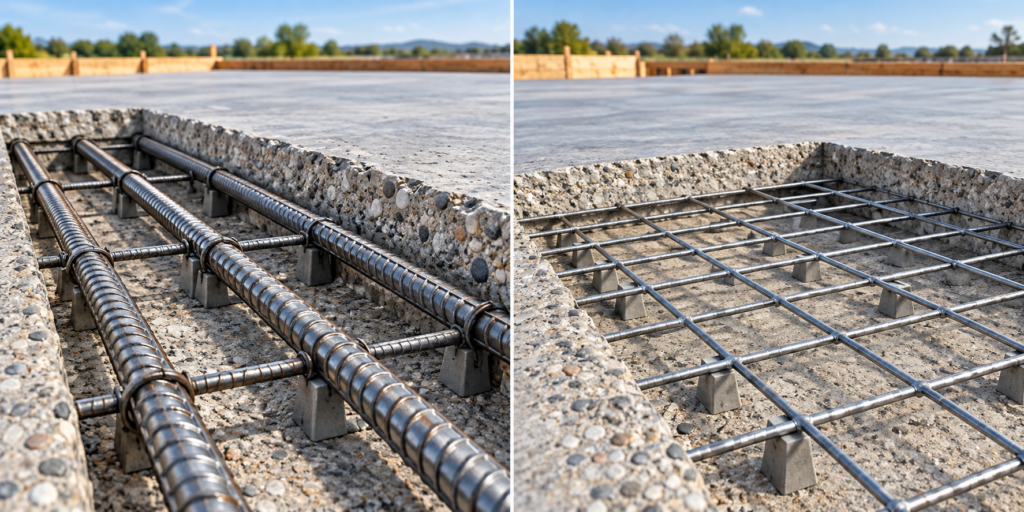
Neither wire mesh nor rebar is universally better for concrete reinforcement. In my experience, rebar is usually the better choice for structural members, heavy loads, foundations, beams, columns, and areas requiring concentrated reinforcement, while welded wire mesh works extremely well for uniformly reinforced slabs, crack distribution, and repetitive large floor areas. Related reading: slipform construction. Related reading: CMU wall reinforcement. Related reading: concrete setting time. Related reading: concrete durability. Related reading: using a rebar bender.
The correct choice should always depend on the required steel area, load condition, reinforcement spacing, crack-control requirement, constructability, and site execution—not simply on whether one option looks stronger than the other. Related reading: concrete surface quality. Related reading: concrete shrinkage.
Wire Mesh vs Rebar: The Comparison Is Often Oversimplified
I have seen this question discussed many times in construction:
“Which is stronger—wire mesh or rebar?”
The problem is that this is not really the right engineering question.
A lot of articles simply say:
- Rebar is stronger.
- Wire mesh only controls cracking.
- Rebar is for structural work.
- Mesh is for small slabs.
That explanation may sound convenient, but in real engineering and construction practice, the decision is much more nuanced.
One of the biggest mistakes I see is comparing a small-diameter residential wire mesh directly with a conventional reinforcing bar and then concluding that rebar is always superior.
That comparison is incomplete.
Wire mesh, technically referred to in many applications as welded wire reinforcement or WWR, can be produced in different wire diameters, strengths, and spacings.
Some WWR systems are lightweight.
Others are specifically engineered for structural reinforcement.
So instead of asking:
“Which material is stronger?”
I would ask:
“Which reinforcement system provides the required steel area, strength, spacing, anchorage, and structural performance for this particular concrete element?” Related reading: concrete strength testing.
That is the question that actually matters.
What Is Rebar?
Rebar is short for reinforcing bar.
It consists of steel bars embedded inside concrete to resist tensile stresses.
Concrete performs very well under compression, but it is relatively weak under tension. Reinforcement is therefore provided to carry tensile forces once cracking occurs. Related reading: fiber reinforced concrete.
Rebar is commonly used in:
- foundations;
- beams;
- columns;
- suspended slabs;
- raft foundations;
- retaining walls;
- pile caps;
- industrial floors;
- bridges;
- shear walls;
- equipment foundations.
Depending on the region, common standards may include ASTM specifications, ACI requirements, IS standards, BS/EN standards, and local structural design codes.
In India, high-strength deformed reinforcement is commonly specified under standards such as IS 1786, while structural concrete design is generally governed by the applicable reinforced-concrete design standard.
What Is Wire Mesh Reinforcement?
What people commonly call wire mesh can mean several different products.
That distinction is extremely important.
The most common terms are:
- welded wire mesh;
- welded wire reinforcement;
- WWR;
- welded wire fabric;
- steel mesh;
- reinforcing mesh.
It consists of longitudinal and transverse steel wires welded together at regular intervals.
The result is a prefabricated reinforcement grid.
In my experience, one reason mesh is often misunderstood is that people typically see lightweight rolled mesh used in patios, driveways, pathways, or small slabs.
They then assume all wire reinforcement is lightweight.
That is not correct.
Structural welded wire reinforcement can use much larger wires and engineered spacings. Properly designed WWR can be used in slabs, walls, precast construction, foundations, and other structural applications.
Wire Mesh vs Rebar: Quick Comparison
| Factor | Rebar | Welded Wire Mesh / WWR |
|---|---|---|
| Form | Individual bars | Factory-welded grid |
| Structural applications | Extremely common | Also possible when engineered |
| Heavy local loads | Excellent | Possible depending on design |
| Complex reinforcement zones | Excellent | Less flexible |
| Large repetitive slabs | Good but labor-intensive | Often highly efficient |
| Reinforcement spacing | Controlled on site | Factory-controlled |
| Local strengthening | Easy | Usually requires supplementary bars |
| Installation speed | Depends on bar density | Often faster over large areas |
| Crack distribution | Good when properly detailed | Excellent for distributed reinforcement |
| Field modifications | Easy | More difficult |
| Reinforcement around openings | Very flexible | Often requires additional detailing |
| Cost | Depends on steel and labor | Can reduce installation labor |
| Site handling | Flexible | Large mats may require planning |
Key Takeaway
The real difference is not simply bar versus mesh.
The real difference is how reinforcement is distributed, where it is required, how much steel is required, and how practical it is to install.
Is Rebar Stronger Than Wire Mesh?
This is one of the most common questions I hear.
The answer is:
Not automatically.
A typical individual reinforcing bar may be much larger than an individual wire inside lightweight mesh.
But comparing one bar with one wire does not tell you how the reinforcement system performs.
What matters is the total reinforcement provided over a given width.
The key factors include:
- steel cross-sectional area;
- yield strength;
- spacing;
- reinforcement direction;
- anchorage;
- lap length;
- concrete cover;
- position inside the slab.
A Simple Engineering Example
Suppose a concrete slab contains:
10 mm bars at 200 mm centers.
The cross-sectional area of one 10 mm diameter bar is approximately:
78.5 mm²
At 200 mm spacing, approximately five bars occur within one metre width.
Therefore:
Required reinforcement area ≈ 392.5 mm² per metre width
Now imagine someone replaces those bars with a light wire mesh simply because:
“Mesh is also steel reinforcement.”
That is not a valid engineering substitution.
The proposed mesh would need to provide equivalent or otherwise adequate reinforcement considering:
- steel area;
- strength;
- bond;
- spacing;
- anchorage;
- crack-control requirements;
- structural performance.
This is why, on actual projects, I never look only at whether the reinforcement is mesh or rebar.
I look at what the reinforcement is expected to do.
Where Rebar Performs Better
1. Heavy Structural Members
Rebar is generally the most practical solution when dealing with:
- beams;
- columns;
- raft foundations;
- pile caps;
- retaining walls;
- heavily loaded slabs;
- transfer structures.
These elements usually require reinforcement at specific locations rather than uniform reinforcement across the entire element.
Example: Reinforced Concrete Beam
Consider a beam.
You may require:
- bottom reinforcement at midspan;
- top reinforcement over supports;
- additional top bars;
- stirrups;
- torsional reinforcement;
- anchorage bars;
- lap locations.
Trying to achieve this arrangement using conventional flat wire mesh would be unnecessarily complicated.
Individual reinforcing bars are much easier to configure.
2. Areas With Concentrated Loads
This is another situation where I generally prefer rebar.
Imagine an industrial floor with heavy machinery.
Most of the slab may experience normal loading, but one machine foundation produces very high local forces.
Instead of increasing reinforcement everywhere, additional bars can be placed specifically around the heavily loaded zone.
This is much easier with individual rebar.
3. Complex Openings
In real construction, slabs are rarely perfect rectangles without interruptions.
You may have:
- stair openings;
- ducts;
- sleeves;
- pipe penetrations;
- shafts;
- trench drains;
- equipment foundations.
One thing I have repeatedly seen is that reinforcement around these areas requires local adjustment.
Rebar provides much more flexibility.
You can add:
- trimming bars;
- diagonal bars;
- edge reinforcement;
- additional top reinforcement.
With prefabricated mesh, these modifications can become more difficult.
4. Foundations
For most heavily loaded structural foundations, rebar remains the most practical reinforcement system.
For example:
- isolated footings;
- combined footings;
- raft foundations;
- pile caps;
- equipment foundations.
The reinforcement pattern may change significantly across different locations.
That flexibility strongly favors individual bars.
Where Wire Mesh Performs Better
Wire mesh has some very strong advantages that should not be ignored.
1. Large Repetitive Slabs
Imagine a warehouse floor covering 15,000 or 20,000 square metres.
If reinforcement is relatively uniform across the entire slab, individually placing thousands of bars can become labor-intensive.
Engineered welded wire reinforcement can potentially reduce:
- bar placement time;
- tying;
- manual spacing;
- installation labor.
This is one of the areas where I have seen prefabricated reinforcement concepts provide a significant constructability advantage.
2. Uniform Reinforcement Distribution
One of mesh’s biggest advantages is consistency.
With conventional rebar, spacing depends heavily on site workmanship.
A drawing may specify:
10 mm @ 200 mm c/c
But during installation, actual spacing can vary.
You may find:
- 190 mm;
- 215 mm;
- 205 mm;
- 185 mm.
With welded reinforcement, spacing is predetermined during manufacturing.
That makes reinforcement distribution much more consistent.
3. Crack Distribution
Wire reinforcement can be particularly effective where closely distributed reinforcement is beneficial.
This does not mean it prevents cracks.
Concrete will crack under certain conditions.
Reinforcement helps control:
- crack width;
- crack distribution;
- post-cracking behavior.
Closer reinforcement spacing can distribute cracking more evenly compared with fewer, widely spaced larger bars.
Expert Insight: Reinforcement Does Not Stop Concrete From Cracking
This is something I always emphasize.
Many people believe that adding enough reinforcement will prevent concrete cracking.
That is incorrect.
Concrete can crack because of:
- drying shrinkage;
- thermal movement;
- settlement;
- restraint;
- loading;
- poor curing;
- incorrect joint spacing;
- poor subgrade conditions.
Reinforcement controls cracking.
It does not magically eliminate it.
I have seen situations where people blame reinforcement when the actual problem was:
- poor curing;
- excessive water in concrete;
- badly prepared subgrade;
- inappropriate joint layout.
Reinforcement should never be viewed in isolation.
A Common Site Problem: Mesh Installed at the Wrong Level
This is one of the biggest practical problems with mesh.
The reinforcement may be correctly designed on the drawing but incorrectly installed in the field.
Consider a slab-on-ground.
The mesh is initially placed directly on the base.
Someone says:
“We will pull it up when pouring concrete.”
In theory, that sounds simple.
In practice, I do not like relying on this method.
Once concrete placement begins:
- workers walk over the mesh;
- concrete covers portions of it;
- mesh becomes difficult to lift uniformly;
- some areas remain close to the bottom.
The reinforcement may end up nowhere near the intended design level.
Practical Tip
Wire reinforcement should be supported properly using appropriate chairs or spacers so that it remains at its designed elevation during concreting.
Do not depend on workers manually lifting reinforcement during the pour.
Rebar Can Also Be Installed Incorrectly
This problem is not exclusive to mesh.
I have also seen many rebar-related installation issues.
Typical examples include:
- missing chairs;
- incorrect concrete cover;
- excessive cover;
- insufficient lap length;
- bars placed in the wrong layer;
- reinforcement shifting during concreting;
- incorrect spacing;
- missing additional reinforcement.
So the correct conclusion is not:
Rebar = good
and
Mesh = bad
Both systems depend heavily on installation quality.
Wire Mesh vs Rebar for Slabs
For slabs, the decision depends heavily on the type of slab.
Slab-on-Ground
For a slab-on-ground, I would consider:
- slab thickness;
- soil properties;
- subgrade preparation;
- joint spacing;
- expected wheel loads;
- rack loads;
- equipment loads;
- crack-control requirements;
- restraint.
Wire mesh can be highly effective for uniformly reinforced slabs.
Rebar may be preferred when heavier or more localized reinforcement is required.
Suspended Structural Slabs
For suspended structural slabs, reinforcement requirements usually vary.
You may need:
- top bars over supports;
- bottom reinforcement at midspan;
- reinforcement around columns;
- additional bars around openings.
This makes conventional rebar extremely practical.
Structural WWR can still be used in certain designs, but detailing must be carefully coordinated.
Wire Mesh vs Rebar for a Driveway
This is another common application.
People often ask:
“Should I use rebar or wire mesh in my driveway?”
My answer is:
First understand what the driveway has to carry.
Scenario 1: Light Residential Driveway
Suppose the driveway carries:
- passenger cars;
- SUVs;
- occasional light delivery vehicles.
The soil is well compacted and drainage is good.
A properly designed welded reinforcement system may be sufficient.
Scenario 2: Heavy Vehicle Driveway
Now imagine the same driveway regularly receives:
- trucks;
- garbage vehicles;
- heavy delivery vehicles.
That changes the design requirements significantly.
You now need to think about:
- wheel loads;
- slab thickness;
- edge loading;
- reinforcement;
- subgrade bearing conditions.
Rebar or heavier engineered reinforcement may be much more appropriate.
Key Takeaway
Two slabs can look identical from the surface while requiring completely different reinforcement systems.
Wire Mesh vs Rebar for Industrial Floors
Industrial floors are where this discussion becomes especially interesting.
I normally consider:
- forklift wheel loads;
- rack leg loads;
- dynamic loading;
- joint spacing;
- floor flatness;
- subgrade stiffness;
- machine loading;
- crack-width limitations.
If the reinforcement requirement is uniform across a very large area, engineered welded reinforcement can provide significant installation efficiency.
However, additional rebar may still be required around:
- columns;
- pits;
- openings;
- machine bases;
- dock edges.
A hybrid system is therefore often practical.
Can You Use Wire Mesh and Rebar Together?
Absolutely.
This is something many homeowners and even some contractors misunderstand.
There is no rule saying you must choose only one.
For example:
A warehouse slab might contain welded reinforcement throughout the main slab area.
Additional rebar could then be installed around:
- openings;
- columns;
- dock edges;
- trench drains;
- equipment foundations.
That combination can be very efficient.
Which Is Better for Crack Control?
Again, neither system automatically wins.
Crack control depends heavily on reinforcement distribution.
Imagine two reinforcement systems containing similar total steel areas.
System A
Larger diameter bars placed farther apart.
System B
Smaller reinforcement placed much closer together.
For certain crack-control applications, System B may provide better crack distribution because reinforcement is closer to potential cracks.
This is where mesh can offer a real advantage.
However, crack control also depends on:
- reinforcement ratio;
- spacing;
- concrete cover;
- steel stress;
- restraint;
- shrinkage;
- concrete quality.
Which Is Cheaper: Wire Mesh or Rebar?
This is another question that cannot be answered by comparing steel prices alone.
From a project perspective, I always prefer comparing installed cost.
Consider:
Material Cost
How much steel is required?
Fabrication
Does the reinforcement need cutting and bending?
Labor
How many workers are required?
Installation Time
How long will reinforcement installation take?
Handling
Can the mesh be manually handled, or will cranes be required?
Wastage
Will complex geometry create large offcuts?
Example of Installed Cost
Suppose:
Rebar Option
Material: $12,000
Labor: $7,000
Fabrication and wastage: $2,000
Total:
$21,000
WWR Option
Material: $14,000
Labor: $4,000
Handling: $1,500
Total:
$19,500
The mesh itself costs more.
But the total installed cost is lower.
I have seen this type of misconception many times.
People compare:
price per tonne
instead of:
total installed cost per square metre.
That can lead to poor decisions.
Construction Productivity
Labor availability has become an increasingly important factor.
For large projects, reinforcement systems that reduce:
- manual tying;
- individual bar handling;
- spacing work;
can have significant advantages.
This does not mean mesh is always faster.
Large mats also introduce challenges:
- transportation;
- lifting;
- storage;
- access;
- overlapping;
- handling around obstacles.
Constructability must be studied before finalizing the reinforcement system.
Standards and Engineering Requirements
The reinforcement system must comply with the applicable project standards.
Depending on jurisdiction, relevant standards may include:
United States
- ACI 318;
- ACI 301;
- ACI guidance for slabs-on-ground;
- ASTM A615 for reinforcing bars;
- ASTM A1064 for steel wire and welded wire reinforcement.
India
Typical references may include:
- IS 1786 for high-strength deformed reinforcement;
- IS 456 for reinforced-concrete design and construction;
- IS standards applicable to welded steel wire fabric.
Europe / UK
Relevant BS and EN standards may apply.
Expert Insight
Always verify the latest applicable standard and project specification.
Standards evolve, and requirements may differ depending on:
- country;
- local authority;
- project type;
- structural system.
Practical Site Checklist Before Choosing Reinforcement
Before deciding between rebar and wire mesh, I would check the following.
Structural
- What loads must the slab carry?
- Are loads uniformly distributed?
- Are concentrated loads present?
- Is the slab structural or nonstructural?
Reinforcement
- What steel area is required?
- What spacing is required?
- What reinforcement strength is required?
- Are multiple reinforcement layers required?
Detailing
- Are there many openings?
- Are there columns?
- Are there pits or trenches?
- Are local strengthening zones required?
Construction
- Can large reinforcement sheets be handled?
- Is adequate lifting equipment available?
- Can reinforcement be supported at correct elevation?
Economics
- What is the total installed cost?
- What is the labor requirement?
- What impact does reinforcement selection have on schedule?
Common Mistakes to Avoid
1. Assuming Rebar Is Automatically Better
Rebar is excellent reinforcement, but that does not make it automatically superior in every application.
2. Using Lightweight Mesh as a Replacement for Designed Rebar
Never replace reinforcement without checking steel area and structural requirements.
3. Leaving Mesh on the Ground
This is one of the worst execution practices I see.
Reinforcement should be supported properly.
4. Ignoring Concrete Cover
Correct cover is essential for durability and structural performance. Related reading: concrete reinforcement fiber types.
5. Ignoring Joints
No reinforcement system can compensate for an inappropriate joint strategy.
6. Ignoring Subgrade Conditions
Especially for slabs-on-ground, reinforcement is only one part of the system.
7. Looking Only at Material Price
Always compare installed cost.
Which One Should You Choose?
Here is the simplest decision framework.
Choose Rebar When:
- heavy structural loads are involved;
- reinforcement changes across the element;
- beams and columns are involved;
- complex foundations are involved;
- openings require additional reinforcement;
- concentrated loads exist;
- local strengthening is required.
Consider Welded Wire Reinforcement When:
- reinforcement is uniformly distributed;
- slab areas are large;
- reinforcement spacing must remain consistent;
- labor productivity is important;
- repetitive construction is involved;
- crack-control reinforcement is required.
Consider Both When:
- the main slab requires uniform reinforcement;
- local areas require additional reinforcement;
- complex openings or loads exist.
My Practical View
Based on the way these systems behave during actual project execution, I do not treat the decision as a competition between mesh and rebar.
I look at the project conditions first.
For a heavily loaded structural element with complicated reinforcement zones, I would normally lean toward rebar because of its detailing flexibility.
For a very large repetitive slab requiring uniformly distributed reinforcement, I would seriously evaluate welded reinforcement because of the installation and spacing advantages.
And where both requirements exist, I would not hesitate to use a combination.
That is often the most practical solution.
Final Verdict: Wire Mesh or Rebar?
There is no single winner.
Rebar is generally better for complex structural reinforcement, heavy local loads, foundations, beams, columns, and situations where reinforcement must be adjusted locally.
Welded wire reinforcement is particularly effective for large repetitive slabs, uniformly distributed steel, consistent spacing, and applications where construction productivity matters.
Most importantly, do not compare lightweight residential mesh with structural rebar and assume that represents the entire category.
Engineered welded wire reinforcement can be a genuine structural reinforcement system.
The correct sequence should always be:
Understand loads → Calculate required reinforcement → Determine distribution → Detail reinforcement → Evaluate constructability → Select the reinforcement format.
That approach produces much better engineering decisions than simply asking which material is stronger.
Frequently Asked Questions
1. Is wire mesh better than rebar?
Not universally. Wire mesh can be very efficient for uniformly reinforced slabs, while rebar is generally more flexible for complex structural applications and concentrated loading.
2. Is rebar stronger than wire mesh?
An individual rebar is often larger than an individual wire in lightweight mesh, but total reinforcement strength depends on steel area, yield strength, spacing, anchorage, and detailing.
3. Can wire mesh replace rebar?
Yes, in some applications, provided the replacement is properly engineered and satisfies the required reinforcement area, strength, spacing, anchorage, and code requirements.
4. Which is better for a concrete driveway?
The answer depends on vehicle loading, slab thickness, soil conditions, joint layout, and reinforcement requirements. Light residential driveways may use engineered mesh, while heavily loaded driveways may require more substantial reinforcement.
5. Which is better for a concrete slab?
For large repetitive slabs, welded wire reinforcement can be very efficient. For structural slabs with varying reinforcement requirements, rebar is often more practical.
6. Does wire mesh prevent concrete cracking?
No. Mesh helps control and distribute cracks but does not eliminate cracking caused by shrinkage, temperature change, loading, or settlement.
7. Does rebar prevent concrete cracking?
No. Rebar also primarily controls tensile behavior and crack widths. Concrete can still crack even when heavily reinforced.
8. Can rebar and wire mesh be used together?
Yes. This is common where uniform slab reinforcement is combined with additional bars around openings, columns, edges, or heavily loaded areas.
9. Where should wire mesh be positioned inside concrete?
It should be supported at the designed reinforcement elevation using suitable chairs or spacers. It should not simply be placed on the ground and pulled upward during concreting.
10. Which option is cheaper?
The answer depends on material cost, labor, fabrication, transportation, handling, wastage, and installation speed. Always compare total installed cost rather than steel price alone.
11. Is wire mesh suitable for structural concrete?
Yes, properly engineered welded wire reinforcement can be used structurally. Lightweight mesh and structural WWR should not be treated as the same product.
12. What is the biggest disadvantage of wire mesh?
Its main limitation is reduced flexibility around irregular geometry, openings, and localized reinforcement zones. Improper positioning during concrete placement is another common site issue.
Key Takeaway
If I had to summarize this comparison in one line:
Rebar gives you greater detailing flexibility; welded wire reinforcement gives you greater distribution and installation efficiency.
The better choice depends entirely on what the concrete element needs to do.