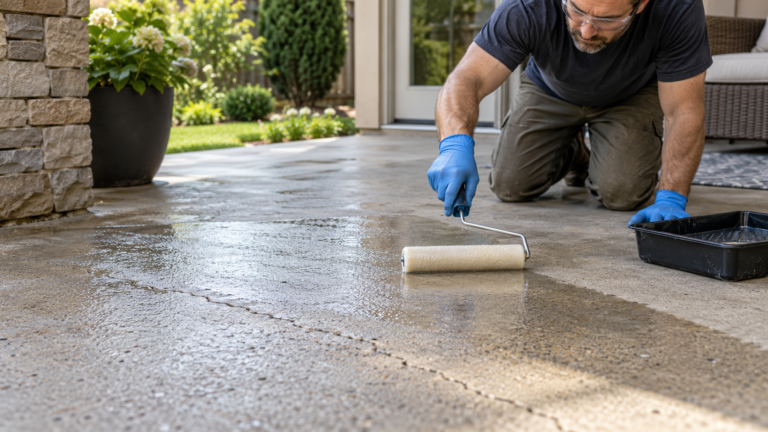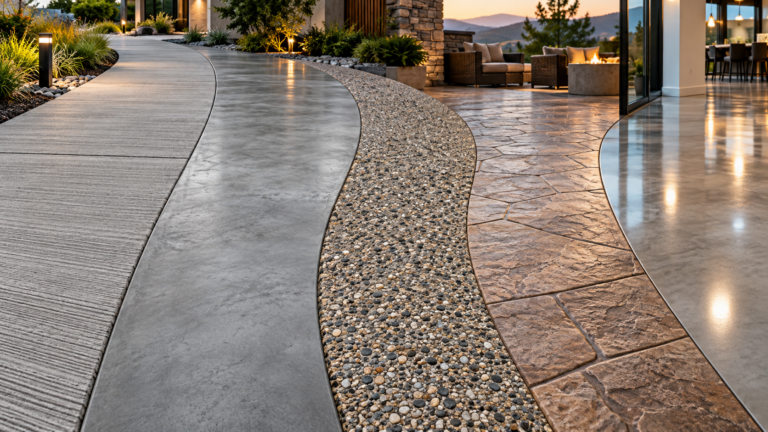
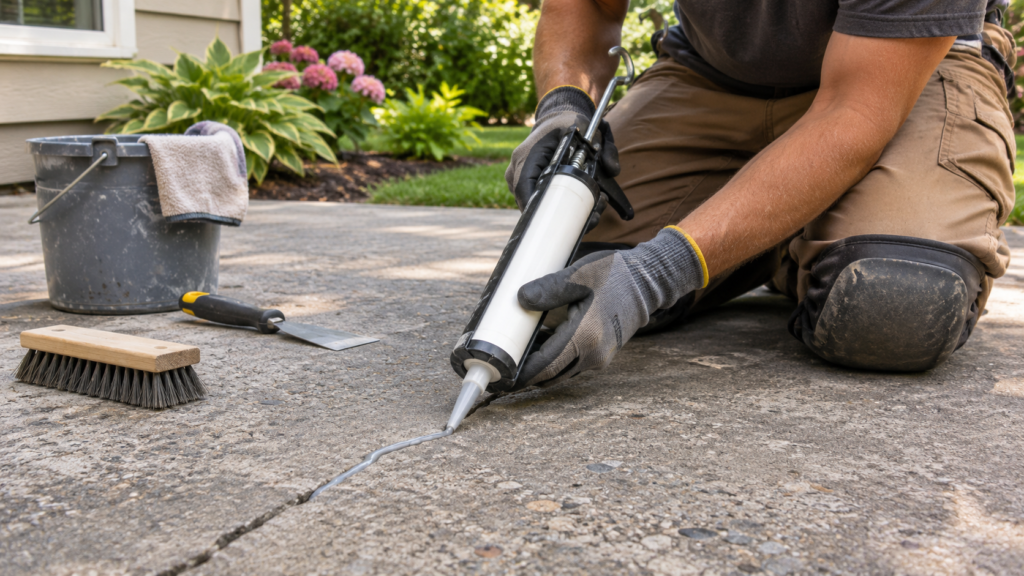
To repair cracks in a concrete patio, first determine whether the damage is caused by normal concrete shrinkage, temperature-related movement, or an underlying problem such as soil settlement. Small, stable cracks can often be repaired using a suitable concrete crack filler, flexible polyurethane sealant, or cement-based repair compound, depending on the crack’s condition and expected movement. A concrete coating or resurfacer may improve appearance and surface protection, but it cannot stabilize a moving slab, correct settlement, or restore structural capacity. If cracks are widening, creating uneven surfaces, or accompanied by significant sinking or heaving, the underlying cause must be addressed before applying any surface treatment.
Can a Cracked Concrete Patio Be Repaired Without Replacing It?
Yes. Many cracked concrete patios can be repaired without removing and replacing the entire slab. However, the appropriate solution depends on what caused the cracking, whether the concrete is still moving, and how much of the patio has deteriorated.
The most important rule is to repair the cause of the damage, not merely cover the visible crack.
Concrete is strong in compression but comparatively weak in tension. As it shrinks, experiences temperature changes, or responds to movement in the supporting soil, tensile stresses may develop and cause cracking.
Not every crack indicates a serious problem. Narrow shrinkage cracks in otherwise stable concrete may be largely cosmetic. Conversely, a crack accompanied by vertical displacement can indicate differential movement of the slab or its supporting ground.
From an engineering standpoint, three conditions should be examined before choosing a repair:
- Crack characteristics: Width, depth, pattern, location, and whether the edges remain level.
- Slab condition: Evidence of settlement, heaving, deterioration, or unsupported areas beneath the concrete.
- Exposure and performance: Water penetration, temperature changes, pedestrian traffic, and the intended surface finish.
If the patio remains level, the supporting ground is stable, and cracking is limited, localized repair is usually the first option worth considering.
If the patio has moved significantly or continues to deteriorate, a crack filler or coating may only conceal the problem temporarily.
Concrete Patio Crack Repair: Which Method Should You Choose?
| Patio condition | Recommended approach | Will a coating alone help? |
|---|---|---|
| Very fine, stable hairline cracks | Monitor; use a compatible fine-crack treatment if needed | Possibly for appearance or protection, but not structural repair |
| Narrow cracks with no vertical displacement | Suitable concrete crack filler or flexible sealant | Not a substitute for filling the crack |
| Cracks with seasonal opening and closing | Appropriately designed flexible sealant | Generally not without movement-joint detailing |
| Widened cracks with damaged edges | Remove unsound material, repair edges, and seal where movement is expected | No |
| Surface scaling or shallow deterioration | Local repair or cementitious resurfacing after evaluation | Sometimes, if the substrate is sound |
| Sunken patio section | Investigate drainage and subgrade; consider professional slab lifting or replacement | No |
| Heaved slab with a raised crack | Investigate root pressure, frost action, expansive soil, or other movement | No |
| Multiple cracks with progressive displacement | Professional assessment and possibly partial or full replacement | No |
| Existing control or isolation joint | Maintain the joint’s function using a compatible joint treatment | Do not simply bridge it with a rigid coating |
These are selection guidelines rather than engineering acceptance criteria. A narrow crack is not automatically harmless, and a wide crack does not automatically mean the patio must be demolished.
Why Do Concrete Patios Develop Cracks?
Understanding the cause is essential because different cracking mechanisms require different repair methods.
1. Drying Shrinkage
Concrete contains water needed for mixing, placement, and cement hydration. As excess moisture leaves the hardened material, the concrete undergoes drying shrinkage.
When this contraction is restrained by the subgrade, adjacent construction, or other factors, tensile stresses can develop.
If those stresses exceed the concrete’s tensile capacity, cracking occurs.
Typical indications include:
- Relatively narrow cracks across a slab.
- Cracking that develops during the early life of the patio.
- Limited or no vertical displacement between crack edges.
- Cracks appearing between or outside planned control joints.
Drying shrinkage cracks are common and do not necessarily indicate that the patio is structurally unsound.
Recommended approach: If the crack is stable, select a suitable crack filler or sealant based on its dimensions and anticipated movement.
2. Plastic Shrinkage
Plastic shrinkage cracking occurs before freshly placed concrete has fully hardened.
Hot weather, low humidity, wind, and rapid evaporation can cause the surface to lose moisture faster than water rises to replace it.
This creates tensile stress in the still-plastic concrete.
These cracks may be relatively shallow and often appear in irregular or roughly parallel patterns.
Some plastic shrinkage cracks remain primarily cosmetic, while others can extend deeper and permit moisture penetration.
Recommended approach: Examine the actual crack depth and condition after the concrete has hardened. Minor surface cracking may need only protection, while deeper cracks may require filling or sealing.
3. Temperature-Related Expansion and Contraction
Outdoor concrete experiences temperature changes throughout the day and across seasons.
As temperatures rise, concrete expands. As they fall, it contracts.
If the patio cannot accommodate this movement, cracks may develop or existing cracks may open and close.
These cracks can be particularly troublesome when repaired with rigid materials.
For example, filling a moving crack with ordinary cement mortar may create a hard plug that cannot accommodate the same movement as the surrounding slab.
The repair may separate, or another crack may form beside it.
Recommended approach: Use a flexible concrete sealant designed for the expected movement, and maintain properly functioning movement joints.
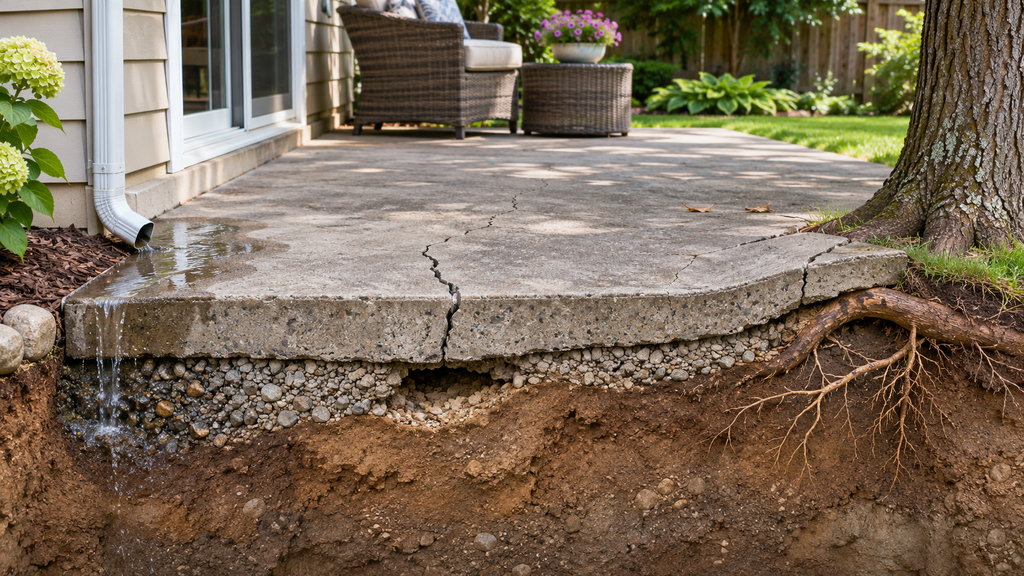
4. Poor Subgrade Preparation or Soil Settlement
Concrete patios depend on the supporting soil and base material beneath them.
If the subgrade was poorly compacted, becomes saturated, erodes, or loses support, sections of the patio may settle unevenly.
This can create bending stresses and cracking.
Common warning signs include:
- One side of a crack sitting lower than the other.
- Cracks becoming wider over time.
- Depressions forming near the crack.
- Water accumulating in previously level areas.
- Gaps appearing between the patio and adjacent construction.
These symptoms require more attention than an isolated surface crack.
Recommended approach: Investigate the subgrade and drainage. Depending on the condition, slab lifting, stabilization, or replacement may be appropriate.
5. Inadequate Control Joints
Control joints, also called contraction joints, are intentional grooves or weakened planes designed to help manage where shrinkage cracking occurs.
Without appropriate joints, cracks may form at unpredictable locations.
Poor joint layout, excessive spacing, insufficient saw-cut depth, or delayed cutting can contribute to uncontrolled cracking.
The American Concrete Institute (ACI) provides guidance on slab construction and joint design, including ACI 302.1R and its guidance for slabs-on-ground.
Control joints do not eliminate shrinkage or guarantee a crack-free slab. They help manage cracking at more predictable locations.
Recommended approach: Repair unintended cracks as appropriate, but preserve the function of existing control and movement joints. Do not indiscriminately fill every joint with rigid mortar.
6. Freeze-Thaw Damage and Moisture Penetration
In cold climates, water absorbed into concrete can contribute to damage during repeated freezing and thawing.
The resulting distress may include surface scaling, spalling, and progressive deterioration around existing cracks.
Deicing chemicals can contribute to certain forms of surface deterioration, particularly where the concrete is inadequately protected or poorly suited to the exposure.
Moisture entering through a crack can also affect the subgrade, potentially making existing settlement or erosion problems worse.
Recommended approach: Repair accessible cracks, improve drainage, remove unsound surface material, and consider a suitable breathable penetrating sealer where appropriate. Severely deteriorated concrete may require more extensive rehabilitation or replacement.
How to Tell Whether a Concrete Patio Crack Is Serious
Before purchasing repair materials, inspect the patio for indications of movement, moisture problems, and deterioration.
A useful assessment should consider more than crack width. A narrow crack with continuing displacement may be more concerning than a wider crack that has remained unchanged for years.
Measure the Crack Width
A crack-width gauge or comparator card is useful for recording the condition of the concrete.
For an initial visual assessment, the following categories can help describe the crack:
| Approximate crack width | Initial interpretation | Suggested next step |
|---|---|---|
| Less than 1/16 inch (1.6 mm) | Fine or hairline cracking | Inspect for movement; monitor or use a fine-crack treatment |
| 1/16–1/8 inch (1.6–3.2 mm) | Narrow visible crack | Determine whether it is stable before choosing a filler |
| 1/8–1/4 inch (3.2–6.4 mm) | More pronounced cracking | Examine depth, edge condition, water exposure, and movement |
| Greater than 1/4 inch (6.4 mm) | Substantial opening requiring closer investigation | Assess settlement, displacement, and the need for professional repair |
Important: These dimensions are descriptive inspection ranges, not universal structural safety limits. ACI guidance does not establish a single crack-width threshold that determines whether every residential patio is safe.
Check for Vertical Displacement
Place a straightedge across the crack.
If both sides remain approximately level, a localized crack repair may be feasible, provided the slab is otherwise stable.
If one side is noticeably higher, the condition may indicate settlement, heaving, or differential slab movement.
Vertical displacement is particularly important because it can create a tripping hazard.
Adding sealant to the crack will not restore the original surface elevation.
Determine Whether the Crack Is Active
An active crack changes in width, position, or condition over time.
A dormant crack has effectively stabilized, although no crack should be assumed permanently inactive without considering its environment.
To monitor a questionable crack, record its width at identified locations, photograph it with a scale, and repeat the measurements over time.
Where seasonal temperature or moisture changes are significant, monitoring across different environmental conditions can provide a better understanding than measurements taken only a few days apart.
Continued widening, vertical movement, or new cracking warrants further investigation.
Examine Drainage and Surface Deterioration
Inspect the patio during or after rainfall.
Check whether water drains away from the building, accumulates near cracks, or disappears into openings between the slab and adjacent construction.
Also inspect for loose fragments, surface delamination, exposed reinforcement, and crumbling concrete.
If the concrete around the crack is unsound, simply applying a sealant may produce poor adhesion or leave the underlying deterioration unresolved.
What Is the Best Material for Repairing Concrete Patio Cracks?
The best material is not necessarily the strongest or most expensive product.
It is the material whose performance characteristics match the crack’s width, movement, substrate condition, and exposure.
Concrete Crack Repair Materials Compared
| Repair material | Best application | Main advantage | Important limitation |
|---|---|---|---|
| Liquid concrete crack filler | Compatible narrow cracks in stable patios | Easy application | Limited gap dimensions and movement capability |
| Flexible polyurethane sealant | Cracks or joints subject to movement | Accommodates movement and limits water entry | Does not restore slab support or structural capacity |
| Non-sag concrete sealant | Cracks on sloped or irregular surfaces | Remains in position during application | Requires correct joint preparation and dimensions |
| Self-leveling joint sealant | Suitable horizontal joints | Forms a relatively even surface | May flow on sloped patios |
| Cementitious repair mortar | Localized spalling, broken edges, and dormant defects | Restores damaged surface geometry | Rigid material can crack if movement continues |
| Polymer-modified repair compound | Compatible surface repairs and selected cracks | Can provide improved bond and repair performance | Movement tolerance depends on the formulation |
| Epoxy crack repair or injection system | Selected dormant cracks requiring rigid bonding | Can provide high-strength bonding when properly designed | Generally unsuitable for moving cracks |
| Concrete resurfacer | Worn but otherwise sound, stable patio surfaces | Renews surface appearance and texture | Does not resolve underlying movement or failed support |
Flexible Sealant vs. Concrete Patch: Which Is Better?
For many exposed patio cracks that experience minor movement, a compatible flexible sealant is more appropriate than a rigid cement patch.
For example, polyurethane-based concrete sealants are designed to accommodate movement while reducing water penetration.
Manufacturers such as Sika and QUIKRETE provide products specifically intended for concrete joints and cracks. However, their permissible joint widths, depths, movement capabilities, curing conditions, and traffic restrictions differ.
A cementitious patch is better suited to replacing missing or deteriorated concrete where the substrate is stable.
The distinction is important: a flexible sealant closes an opening while allowing some movement, whereas a rigid patch attempts to restore a solid surface.
Neither material can correct a failing subgrade.
Should You Use Epoxy to Repair a Concrete Patio Crack?
Epoxy is sometimes promoted as a permanent solution because of its high bond strength.
However, bond strength alone does not establish suitability.
A rigid epoxy repair can be effective for certain dormant cracks. Structural epoxy injection may also be appropriate when an engineer has determined that restoring continuity is necessary and feasible.
Nevertheless, epoxy cannot stop differential soil settlement.
If the crack continues to open or shift, a rigid epoxy repair may debond, fracture, or cause cracking in adjacent concrete.
For ordinary exterior patio maintenance, epoxy injection should not be the default repair method.
How to Repair Cracks in a Concrete Patio: Step-by-Step
The following method applies to accessible, nonstructural cracks in an otherwise stable concrete patio. It is not intended to repair significant settlement, loss of support, or structurally critical concrete.
Step 1: Inspect the Patio and Identify the Repair Objective
Determine whether the objective is to prevent water entry, improve appearance, eliminate loose edges, or prepare the patio for refinishing.
Confirm that the slab is reasonably stable and that no significant vertical displacement is present.
If the crack is widening, accompanied by settlement, or connected to visible distress in nearby foundations or retaining structures, obtain an appropriate professional assessment before proceeding.
Step 2: Gather the Appropriate Tools and Materials
For a typical crack-sealing project, the equipment may include a stiff brush, scraper, crack-width gauge, suitable vacuum, caulking gun, backer rod, sealant, masking tape, and a manufacturer-approved finishing tool.
You may also need a cold chisel for limited preparation if the chosen product explicitly requires a wider opening.
Use appropriate eye protection, gloves, footwear, and other protective equipment.
Cutting, grinding, or routing concrete can generate respirable crystalline silica. The Occupational Safety and Health Administration (OSHA) identifies this as a serious inhalation hazard.
Where mechanical preparation is necessary, use suitable dust-control methods, such as compatible wet-cutting equipment or dust-extraction systems, rather than unrestricted dry grinding.
Step 3: Clean the Crack Thoroughly
Proper surface preparation is often more important than applying additional repair material.
Remove dirt, vegetation, loose concrete, debris, and previous failed filler from the crack.
Use a brush and suitable vacuum to clean the opening and expose sound material.
If washing is necessary, allow the concrete to reach the moisture condition required by the repair product before continuing.
Do not assume that a product advertised as waterproof can be applied successfully to wet concrete.
Many polyurethane sealants require clean, dry, sound joint surfaces for proper adhesion.
Step 4: Prepare the Crack Geometry
Read the selected product’s technical data sheet before widening or reshaping a crack.
Some flexible sealants require minimum joint dimensions to develop the intended bond and movement performance.
For example, certain Sika concrete crack sealants specify a minimum prepared opening of approximately 1/4 inch wide by 1/4 inch deep.
That requirement is product-specific and should not be applied to every crack filler.
A thin liquid filler may be appropriate for a narrower crack, while another product may require a controlled groove.
Avoid unnecessarily enlarging cracks or removing sound concrete simply to accommodate a product that is unsuitable for the original condition.
Step 5: Install Backer Rod Where Required
Backer rod is a compressible material placed in suitably sized cracks or joints before applying sealant.
It serves two important purposes: controlling sealant depth and helping prevent unwanted bonding to the bottom of the joint.
For movement joints, proper geometry and avoidance of three-sided adhesion allow the sealant to deform more effectively.
A typical flexible joint design may use a width-to-depth relationship of approximately 2:1, subject to the selected manufacturer’s minimum and maximum thickness requirements.
The correct backer rod diameter, depth, and material must be selected according to the joint and sealant system.
Do not force backer rod into extremely narrow cracks or substitute loose debris for a designed backing material.
Step 6: Apply the Selected Concrete Crack Sealant
For a typical cartridge-applied sealant:
- Cut the nozzle to the appropriate opening.
- Position the nozzle to place material into the prepared crack.
- Apply a continuous bead without leaving internal gaps.
- Maintain the manufacturer’s recommended bead depth and profile.
- Tool the sealant if the product requires tooling.
Avoid applying a thin smear across the concrete surface instead of forming an adequately prepared sealant bead.
Such a surface application may not provide the intended movement accommodation or durability.
For self-leveling products, ensure the patio surface is sufficiently level for the formulation. Use a non-sag product where the slope would otherwise cause material to flow away from the repair.
Step 7: Repair Broken or Spalled Crack Edges
If the crack edges have deteriorated, they may need separate repair.
Remove unsound concrete until a stable substrate is exposed. Then use a compatible repair mortar or patching material suitable for exterior conditions and the required repair thickness.
Follow the manufacturer’s instructions for substrate moisture, bonding agents, mixing, compaction, finishing, and curing.
Do not feather a repair mortar to an extremely thin edge unless that particular product permits feather-edge application.
For cracks expected to move, preserve the necessary flexible joint after completing adjacent edge repairs.
Step 8: Allow Proper Curing Before Using the Patio
Curing requirements vary significantly between cementitious repair materials, latex fillers, polyurethane sealants, and epoxy systems.
Some products permit limited pedestrian access relatively quickly, while others require several days before full service.
Temperature, humidity, repair dimensions, and product chemistry affect curing.
Do not assume that a sealant is ready for foot traffic just because its surface feels dry.
Protect the repair from premature traffic, rain, contamination, and temperature conditions outside the manufacturer’s permitted range.
Step 9: Inspect the Completed Repair
Once the repair has cured, check for visible gaps, inadequate adhesion, surface defects, and areas where the filler has settled below the intended profile.
Inspect again after significant temperature changes or rainfall.
If the crack continues to move or water entry persists, investigate the underlying cause rather than repeatedly applying additional filler.
Example: Estimating How Much Sealant You Need
Suppose a patio has a prepared crack approximately 10 feet long, with a rectangular sealant section 1/4 inch wide and 1/4 inch deep.
The approximate required volume is:
V=L\times W\times D
V=120\times0.25\times0.25=7.5\text{ in}^3
This is approximately 123 milliliters of material.
The actual amount depends on crack geometry, specified sealant depth, backing material, dispensing losses, and manufacturer requirements.
For irregular cracks, measure representative sections rather than assuming a uniform width and depth throughout.
When a Concrete Coating Won’t Help
Coatings can be useful for protecting and improving concrete surfaces. However, they are frequently misunderstood as universal repair solutions.
A coating does not automatically repair the concrete beneath it.
The distinction becomes especially important when the patio is cracked because of movement, poor support, or deeper deterioration.
1. When the Patio Is Sinking or Settling
A coating cannot lift a settled concrete slab or restore missing subgrade support.
For example, imagine a patio with a visible crack running across the middle. One side has settled, creating a depression where rainwater collects.
Applying a rubberized coating over the crack might temporarily reduce water entry at the surface, but it will not correct the elevation difference.
The underlying soil may continue to move, potentially damaging the coating and widening the crack.
The appropriate solution requires evaluating the cause of the settlement.
Professional concrete lifting may be feasible where the slab is sufficiently intact and the underlying conditions can be corrected. Otherwise, removal and replacement may be necessary.
2. When Cracks Are Still Moving
A relatively thin surface coating may not be able to accommodate concentrated movement at an active crack.
As the concrete opens and closes, stresses are transferred into the coating.
This can result in tearing, debonding, or the crack reappearing through the surface.
Some engineered pedestrian traffic coating systems incorporate crack-bridging membranes and detailed joint treatments.
However, these systems must be selected and installed according to their tested capabilities and project-specific requirements.
A generic waterproof coating should not be assumed to provide equivalent performance.
3. When the Concrete Surface Is Weak or Crumbling
Coatings rely on a suitable substrate.
If the concrete surface is dusty, delaminated, severely scaled, or crumbling, the coating may bond to material that subsequently detaches.
Even excellent adhesion to a weak surface layer does not guarantee a durable repair.
Unsound concrete must be removed or otherwise addressed before applying a compatible coating system.
In cases of extensive deterioration, resurfacing may also be inappropriate.
4. When Moisture Is Trapped Beneath the Coating
Moisture can enter concrete through surface exposure, adjacent soil, joints, and other pathways.
Certain relatively impermeable coatings can experience adhesion failure, blistering, or peeling when exposed to excessive substrate moisture.
This risk is influenced by the coating system, substrate condition, and moisture source.
Before coating a patio, examine drainage and follow the coating manufacturer’s moisture testing and preparation requirements.
Do not rely on a simple visual observation that the surface looks dry.
5. When the Crack Is Part of a Movement Joint
Control joints, isolation joints, and expansion joints serve different purposes.
Some are intended to control where cracking develops; others accommodate relative movement between adjacent concrete sections.
Bridging a functioning movement joint with rigid mortar or an unsuitable continuous coating may cause the finish to crack or separate.
Existing joints generally need to be respected and detailed according to the selected repair or coating system.
6. When the Patio Has a Structural or Safety Problem
A coating does not restore missing reinforcement, correct severe slab displacement, or resolve significant deterioration in an elevated concrete deck.
If the patio forms part of an elevated slab, balcony, or structure spanning between supports, cracking may require a different level of engineering assessment than an ordinary ground-supported patio.
Waterproofing and structural repair are separate functions.
A membrane may reduce water penetration, but it should never be treated as a substitute for necessary structural rehabilitation.
Can You Use Flex Seal to Repair Concrete Patio Cracks?
Flex Seal products are often considered for outdoor waterproofing because some formulations create flexible, water-resistant barriers.
However, product compatibility with concrete is not the same as suitability for a patio walking surface.
The manufacturer specifically states that Flex Seal Liquid is not recommended for underfoot applications.
That restriction matters because an outdoor patio must tolerate pedestrian use, abrasion, weather exposure, cleaning, and potentially slippery wet conditions.
Even where a rubberized coating adheres to concrete, adhesion alone does not establish appropriate pedestrian durability or slip resistance.
Furthermore, a rubberized surface treatment cannot correct settlement or repair a structurally deficient slab.
For a typical ground-level patio crack, a purpose-made concrete crack filler or joint sealant is generally a more appropriate first consideration than spreading Flex Seal Liquid across the walking surface.
For waterproofing systems on pedestrian decks, use products explicitly designed and approved for that application, with the necessary substrate preparation, crack detailing, wearing surface, and slip resistance.
Concrete Crack Filler vs. Resurfacer vs. Sealer vs. Waterproof Coating
These terms describe different functions and should not be used interchangeably.
| Treatment | Primary purpose | What it does not accomplish |
|---|---|---|
| Crack filler | Fills a compatible opening | Does not necessarily accommodate significant movement |
| Flexible joint sealant | Seals a joint or crack while allowing specified movement | Does not stabilize soil or support a slab |
| Cementitious patch | Replaces localized missing or damaged concrete | Does not stop active cracking by itself |
| Concrete resurfacer | Creates a new surface layer on sound concrete | Does not correct failed support or substantial displacement |
| Penetrating concrete sealer | Reduces certain forms of moisture and contaminant absorption | Does not fill major cracks or restore strength |
| Film-forming coating | Provides a protective or decorative surface film | Does not automatically bridge active cracks |
| Engineered waterproof traffic membrane | Provides a designed waterproofing system for specified pedestrian exposure | Does not replace structural repair |
The correct system depends on whether the objective is to seal a crack, repair deteriorated concrete, restore appearance, reduce water absorption, or waterproof a deck.
A product designed for one function should not automatically be relied upon to perform the others.
Can You Resurface a Cracked Concrete Patio?
Resurfacing may be a practical option when the patio is structurally and dimensionally stable but has widespread cosmetic wear, superficial damage, or an unattractive finish.
Concrete resurfacers are generally cement-based or polymer-modified materials applied over an appropriately prepared existing surface.
For a successful result, the original slab must provide a sufficiently sound foundation for the new layer.
When Resurfacing Makes Sense
Resurfacing is worth considering when the slab remains stable and level, deterioration is primarily superficial, and cracks have been evaluated and treated using methods compatible with the intended resurfacing system.
The surface should also be capable of achieving the required bond through cleaning and preparation.
Manufacturer requirements may include removal of existing coatings, roughening, bonding preparation, and control of substrate moisture.
When Resurfacing Is a Poor Choice
Resurfacing is unlikely to provide a durable solution where the slab has active differential settlement, significant heaving, extensive deep cracking, or widespread loss of sound concrete.
A rigid cementitious overlay can develop reflective cracking above existing cracks.
In other words, the original crack pattern may reappear through the new surface.
The U.S. Bureau of Reclamation’s concrete repair guidance addresses reflective cracking as a consideration in selecting and designing repair systems.
It is therefore important to assess crack movement and substrate condition before applying an overlay.
Should Control Joints Be Covered During Resurfacing?
Generally, the existing joint layout must be maintained or incorporated into the overlay design.
Covering an active movement joint with a continuous rigid layer can create a predictable location for future cracking.
Follow the resurfacer manufacturer’s requirements for terminating applications at joints and recreating appropriate joint details.
Should You Seal the Entire Patio After Repairing Cracks?
Applying a suitable concrete sealer after localized repairs may help reduce moisture and contaminant absorption into the surrounding concrete.
However, this should be considered separately from the crack-repair operation.
For ordinary ground-level exterior concrete, a compatible penetrating sealer may be preferable where the objective is to reduce absorption while retaining the original surface texture.
Silane- or siloxane-based treatments are commonly used for this purpose, although their performance and substrate compatibility vary.
Film-forming sealers may provide decorative effects, including a darker or glossier appearance. Depending on the product and texture, they may also affect slip resistance.
Before sealing, confirm that the concrete and repaired areas have cured sufficiently, the sealer is compatible with the repair materials, and the application conditions are acceptable.
Do not assume that a penetrating sealer will bond to or perform on cured polyurethane sealant in the same way it does on porous concrete.
Also consider whether the patio is exposed to freeze-thaw conditions, deicing chemicals, standing water, or heavy sunlight.
A sealer is a protective maintenance treatment, not a solution for an actively moving or unsupported concrete slab.
Common Mistakes That Cause Concrete Patio Crack Repairs to Fail
Filling Every Crack With Ordinary Cement Mortar
Rigid cement mortar cannot accommodate significant joint movement.
If the crack remains active, the repair may fracture or separate from its edges.
Select repair materials according to crack behavior rather than choosing a hard product merely because it resembles concrete.
Applying Sealant Over Dirt or Loose Concrete
Contamination can prevent proper adhesion.
Surface preparation must expose sound, suitable concrete before the repair material is applied.
Ignoring Crack Depth and Sealant Geometry
A large volume of sealant poured into an uncontrolled deep opening may not develop the intended joint profile.
Excessive sealant depth, inappropriate backing, or unintended three-sided adhesion can compromise movement performance.
Use the geometry specified by the manufacturer.
Using a Self-Leveling Product on a Sloped Patio
Self-leveling sealants flow before curing.
If the surface slopes beyond the product’s permissible conditions, the material may drain away from the opening.
Choose a suitable non-sag formulation where necessary.
Applying a Coating Before the Crack Is Repaired
Covering an untreated crack can allow water entry, reflective cracking, or coating failure to continue.
First determine whether crack treatment is needed and whether the proposed coating system permits or requires a particular repair method.
Overlooking Drainage Problems
If rainwater continually saturates the ground beneath the patio, repairing the visible crack alone may not address the cause.
Investigate grading, downspout discharge, drainage pathways, and possible subgrade erosion.
Ignoring Slip Resistance
A coating that looks attractive when dry may be hazardous when wet.
For a patio, surface texture and wet pedestrian use must be considered alongside appearance and water resistance.
Expecting a Permanent Cosmetic Match
Repair materials may differ from the surrounding concrete in texture, shade, weathering, and surface porosity.
Even a technically successful repair may remain visible.
For decorative concrete, stamped surfaces, or exposed aggregate, matching the original finish can require specialized techniques.
When Should You Repair, Lift, or Replace a Cracked Concrete Patio?
Not all patio damage requires demolition.
However, repeated cosmetic repair may become uneconomical when underlying problems remain unresolved.
| Condition | Preferred direction | Reason |
|---|---|---|
| Single stable crack, slab otherwise sound | Localized repair | Limited defect with no apparent support failure |
| Several stable cracks, intact surface | Localized repairs and optional refinishing | Existing slab may remain serviceable |
| Minor localized edge spalling | Compatible patch repair | Damaged concrete can be replaced locally |
| Sound slab with localized settlement | Assess professional slab lifting | Existing slab may be recoverable |
| Significant slab heaving | Investigate cause; consider replacement | Raised concrete cannot be corrected by sealant |
| Extensive cracking and progressive displacement | Professional assessment; likely substantial rehabilitation or replacement | Indicates continuing movement or loss of support |
| Widespread scaling or delamination | Evaluate remaining concrete quality | New material requires a sound substrate |
| Crack associated with structural distress | Qualified engineering evaluation | Structural performance may be affected |
Can Concrete Lifting Fix a Cracked Patio?
Concrete lifting, sometimes called slabjacking, can be performed using methods such as cementitious grout injection or expanding polyurethane foam systems.
These methods are intended to raise certain settled slabs or improve support beneath them.
Suitability depends on the slab’s condition, the extent and mechanism of settlement, the supporting soil, and the ability to control elevation during lifting.
Lifting is not an automatic solution for every crack.
A slab fractured into several unstable sections may not respond well, and some soil conditions may require more substantial remediation.
If water erosion caused the settlement, the drainage problem must also be addressed.
When Is Full Replacement the Better Option?
Full or partial replacement may be justified when large sections are severely fractured, the subgrade is unreliable, differential movement is extensive, or repeated repairs have failed.
Replacement also provides an opportunity to correct inadequate base preparation, drainage, slab thickness, and joint layout.
Before replacing the patio, determine whether the cause of the original failure is still present. Otherwise, a newly constructed slab may develop similar problems.
How Much Does Concrete Patio Crack Repair Cost?
The cost depends primarily on the repair method and the condition of the existing patio.
Localized crack sealing is generally less extensive than repairing damaged concrete edges or resurfacing the entire slab.
Professional lifting and complete replacement usually involve a larger scope of work because they address slab elevation, support, demolition, or new construction.
The principal cost factors include crack length and dimensions, surface preparation, repair materials, site accessibility, disposal requirements, labor rates, and whether drainage or subgrade improvements are necessary.
For homeowners comparing quotations, it is useful to request a clear distinction between cosmetic repair and work intended to address underlying movement.
A low-cost coating application may appear attractive initially, but it can be poor value if the concrete beneath it is continuing to settle.
A meaningful contractor quotation should explain the observed cause, proposed treatment, preparation requirements, and expected limitations.
Best Practices to Prevent Future Concrete Patio Cracking
Although all concrete can crack, good construction and maintenance practices can reduce the likelihood and severity of uncontrolled cracking.
Maintain Effective Drainage
Water should be directed away from the building and should not remain trapped against or beneath the patio.
For many conventional residential patios, a slope of approximately 1/4 inch per foot away from the building is a common drainage starting point. However, actual grading must account for local construction requirements, site constraints, accessibility, thresholds, and drainage design.
Do not attempt to correct substantial drainage defects by simply adding a thin coating.
Protect the Supporting Subgrade
New patios require appropriate excavation, base preparation, and compaction.
Where soil properties are problematic, the solution may involve additional design measures beyond simply compacting the existing ground.
Avoid uncontrolled erosion from downspouts, landscaping irrigation, and poorly directed surface runoff.
Provide Appropriate Joints
Control joints should be designed and constructed at suitable locations and spacing.
Isolation joints are also important where slabs meet structures or elements that may move independently.
Joint design depends on factors such as slab thickness, geometry, restraint, reinforcement, and expected movement.
Arbitrarily cutting additional joints into an existing slab is not always appropriate, particularly when embedded reinforcement, utilities, or other concealed elements may be present.
Use Suitable Concrete and Proper Curing for New Patios
For a newly constructed patio, the specified concrete mixture should account for exposure conditions.
In climates with significant freeze-thaw exposure, appropriate air entrainment, concrete quality, finishing practices, and curing are particularly important.
Excessive water addition, poor finishing, and inadequate curing can contribute to surface defects and cracking.
Inspect Repairs Periodically
Examine existing cracks after seasonal changes and significant rain events.
Look for widening, loss of sealant adhesion, settlement, and renewed surface deterioration.
Promptly addressing small defects and drainage problems can reduce the likelihood of more extensive repairs.
Frequently Asked Questions
1. What is the best way to repair hairline cracks in a concrete patio?
First confirm that the cracks are stable and that there is no significant displacement or deeper deterioration. Very fine cracks may need only monitoring or a compatible penetrating treatment, while slightly wider cracks may accept a manufacturer-approved liquid crack filler. Avoid forcing a thick sealant into an opening that is too narrow for its specified application.
2. Can you repair concrete patio cracks without replacing the slab?
Yes. Many stable cracks can be treated using suitable crack fillers, flexible sealants, or localized patching materials. Replacement becomes more likely when cracking is associated with extensive settlement, heaving, severe deterioration, or inadequate support that cannot be corrected economically.
3. Is it better to use concrete crack filler or caulk?
It depends on the product and expected movement. A flexible polyurethane concrete sealant is generally preferable where movement accommodation is important. A liquid crack filler may be convenient for narrower, stable cracks, provided the manufacturer permits that application.
4. Will concrete paint cover patio cracks?
Concrete paint may visually disguise very fine surface imperfections, but it does not necessarily fill or repair cracks. Larger or moving cracks can remain visible or cause paint failure. The crack should be evaluated and appropriately treated before painting with a product approved for exterior pedestrian concrete.
5. Can a waterproof coating stop concrete patio cracks from getting worse?
A suitable coating may reduce some forms of water penetration, but it does not stop soil movement, shrinkage, or structural deterioration. Some engineered systems can accommodate specified crack movement, but that capability must be verified. A generic waterproof coating should not be expected to stabilize a cracked slab.
6. Can I use Flex Seal Liquid on my concrete patio?
Flex Seal Liquid is not recommended by its manufacturer for underfoot applications. Because a patio is normally a walking surface, it should not be selected as a general pedestrian coating simply because it can form a water-resistant barrier. Consider purpose-made concrete crack repair materials or a properly specified pedestrian traffic coating instead.
7. Should I fill concrete patio expansion joints with cement?
Generally, no. Joints intended to accommodate movement should not be rigidly filled in a manner that prevents their intended function. Use a suitable joint treatment and follow the relevant design and product requirements. Control joints and isolation joints are not identical, so the treatment should reflect the type of joint.
8. How long does concrete crack filler last outdoors?
Service life varies with the product, installation quality, climate, movement, exposure, and substrate condition. A correctly installed flexible sealant may provide extended service, while a repair made over an active settlement crack can fail relatively quickly. No universal lifespan can be assigned without identifying the product and conditions.
9. Can a cracked patio be resurfaced instead of replaced?
Yes, provided the existing concrete is sufficiently sound and stable. Surface preparation, crack treatment, and joint detailing are essential. Resurfacing is generally inappropriate when the slab is experiencing significant differential movement, heaving, or severe deterioration.
10. What causes a repaired concrete crack to reopen?
Common causes include continued shrinkage, temperature-related movement, soil settlement, inadequate joint design, poor surface preparation, and selection of an unsuitable rigid repair material. Reopening does not always mean the original material was defective; it may indicate that the repair did not accommodate the actual crack behavior.
11. Should concrete patio cracks be sealed before winter?
In freeze-thaw climates, sealing appropriate cracks before winter may help reduce moisture entry and related deterioration. However, the concrete must be in a condition suitable for repair, and the sealant must be applied within the manufacturer’s permitted temperature and moisture ranges.
12. Is a 1/4-inch crack in a concrete patio serious?
A 1/4-inch crack deserves closer inspection, but its width alone cannot determine its seriousness. Check for vertical displacement, progression, underlying soil movement, water infiltration, and surrounding concrete deterioration. If the crack is widening or associated with settlement, seek a professional assessment.
13. Can epoxy permanently repair a concrete patio crack?
Epoxy may provide a durable repair for appropriately selected dormant cracks, but it is not universally permanent. If the substrate moves, the crack can reopen or adjacent concrete can fracture. Structural epoxy injection requires appropriate evaluation and installation rather than simply choosing epoxy because it has high bond strength.
14. What should I do if one side of my patio crack is higher than the other?
Investigate the cause of the elevation difference before filling the crack. Possible causes include settlement, heaving, root action, and frost-related movement. Depending on the condition, professional slab lifting or partial replacement may be required. Sealant cannot remove the resulting trip hazard.
15. Should I seal the whole concrete patio after repairing cracks?
Sealing can be beneficial where the goal is to reduce water and contaminant absorption, particularly in exposed environments. Choose a sealer suitable for the concrete, climate, and intended appearance. Confirm compatibility with repaired areas and avoid products that create unacceptable wet-surface slipperiness.
16. How do I know whether to repair or replace my patio?
A patio with isolated, stable cracks and otherwise sound concrete is usually a reasonable candidate for localized repair. Replacement becomes more attractive when there is widespread fracturing, significant movement, extensive deterioration, or persistent support problems. The decision should be based on the cause and extent of damage, not appearance alone.
Conclusion
Repairing cracks in a concrete patio begins with understanding why the concrete cracked.
For a stable, ground-supported patio with limited damage, a properly selected crack filler, flexible sealant, or localized patching material can provide a practical repair. Correct cleaning, preparation, repair geometry, and curing are essential to its performance.
However, a coating should never be treated as a substitute for correcting settlement, unstable soil, active slab movement, or significant concrete deterioration. Waterproofing products and decorative resurfacers can improve surface protection and appearance, but they cannot automatically restore the performance of damaged concrete.
The most reliable approach is to assess the crack, determine whether movement is continuing, correct drainage or support problems where necessary, and then select a repair material designed for the actual conditions.
For minor, stable cracking, localized repair is usually the sensible starting point. For widening cracks, uneven slabs, recurring failures, or extensive deterioration, professional investigation and a more substantial repair may provide better long-term value than repeatedly covering the damage.