Flex Seal Liquid can adhere to concrete, but the manufacturer specifically advises against using it to seal large areas with heavy foot traffic because the surface can become slippery when wet. For a patio, that is a practical safety concern: a product that sticks to concrete is not automatically suitable as a walking-surface coating. I would use it only for a compatible, limited application after checking the current label and testing a small area; for a whole patio, choose a coating or sealer whose documentation supports exterior pedestrian use and addresses wet slip resistance.
The Expert Verdict: Concrete Compatibility Is Not the Same as Patio Suitability
The important distinction is between “can adhere to concrete” and “is appropriate for coating a concrete patio.” Flex Seal’s product information lists concrete among the compatible surfaces. But in its guidance on using Flex Seal Liquid on concrete, the manufacturer says it does not recommend sealing large areas that receive a lot of foot traffic because the liquid can become slippery when wet.
That caveat changes the recommendation for a patio. A patio is generally a large, exposed walking surface, and rain, irrigation, algae, or spills can make it wet. A coating intended for a localized repair or other concrete use should not be assumed to perform safely across a whole patio.
My recommendation is straightforward:
- For a whole patio: Use a product whose current technical documentation supports exterior pedestrian use and gives suitable guidance for wet slip resistance.
- For localized use: Consider Flex Seal Liquid only if the exact product instructions support the application and the finished area will not create a slip hazard or interfere with drainage or joint movement.
- For a crack, joint, or water problem: Identify the cause and select a repair or waterproofing approach made for that condition. A surface coating cannot stabilize a moving crack or correct poor drainage.
This recommendation follows the manufacturer’s pedestrian-area warning. It is not a claim that Flex Seal never works on concrete; it is a judgment about whether a concrete-compatible product is a sound choice for a large, routinely walked-on patio.
What the Manufacturer’s Guidance Actually Says
Product advice needs to be specific. The Flex Seal range includes different products, and directions for Flex Seal Liquid do not automatically apply to Flex Seal Spray, Flex Tape, or other products.
For Flex Seal Liquid, the manufacturer says it works on concrete and describes it as a rubberized coating that can be brushed, rolled, dipped, or poured. Its product directions say the surface should be clean, dry, and free from grease, oil, and dirt. They also give drying and curing guidance, including allowing coats to dry before applying more.
But the concrete-specific guidance includes a critical limitation: the manufacturer does not recommend coating large areas exposed to substantial foot traffic because the product can become slippery when wet. That is more relevant to a patio decision than a general statement that the product works on concrete.
The manufacturer’s statement should be read narrowly and applied to the exact product and intended use. It does not establish that every Flex Seal product is suitable for every exterior walking surface, nor does it promise a particular service life on a patio.
Why a Patio Has Different Requirements From a Small Repair
A small repair and a patio coating may use the same product, but the performance demands differ.
A localized repair covers a limited area. A patio coating affects the surface people walk across, the way the slab looks, and how it responds to weather and wear. Before coating a large area, consider these factors:
Wet slip risk
The manufacturer’s warning about wet slipperiness is the central concern for this application. A patio can be walked on while damp, and surface texture, contamination, algae, and the coating itself can all affect traction. Do not treat a “rubberized” description or a claim about the cured finish as proof of acceptable wet slip resistance for your particular slab.
If slip resistance matters, use a product with relevant technical guidance for pedestrian surfaces. Do not rely on a generic anti-slip claim unless it applies to the exact product and intended conditions.
Wear and maintenance
Outdoor coatings face sun, rain, foot traffic, furniture movement, cleaning, and sometimes freeze-thaw exposure. Those conditions can wear a film or expose weaknesses in the bond between the coating and the slab.
The available product information does not give a patio-specific service-life guarantee for every climate and slab condition. I would not infer one from broad claims such as “weatherproof” or “waterproof.” Check the current technical documentation for the exact product and intended use.
Appearance and texture
A film-forming coating can change the concrete’s colour, sheen, and surface feel. On a large area, variations in preparation or application can make the finish look uneven. A small test patch helps reveal how the product looks and feels on the actual concrete, but it does not prove long-term durability or make an otherwise unsuitable walking-surface application appropriate.
Cracks, joints, and drainage
Concrete cracks for reasons such as shrinkage, restraint, temperature change, settlement, or loading. A surface coating may cover a small defect under some conditions, but it does not restore the slab’s structural capacity or stop the underlying movement.
Likewise, coating a patio does not correct poor drainage. Water can still enter at joints, cracks, edges, and transitions. Before applying any coating, check where water goes and whether it ponds against the house or on the slab.
What Should You Use Instead?
Choose the product type according to the problem you are trying to solve. “Sealer” is a broad label, not a guarantee that products have the same function.
| Your goal | Product type to investigate | Key check before buying |
|---|---|---|
| Reduce water absorption while keeping the concrete’s appearance relatively natural | Penetrating concrete sealer | Confirm exterior suitability and compatibility with any existing treatment |
| Add a visible or decorative finish | Exterior concrete coating | Check pedestrian use, wet slip guidance, preparation, and maintenance |
| Repair a crack that moves | Joint or crack sealant designed for that condition | Confirm the crack is suitable for a sealant and determine whether it is a joint |
| Address recurring water intrusion | Repair or waterproofing system selected for the source of the water | Investigate drainage, cracks, joints, edges, and transitions |
A penetrating sealer may be a better fit when the aim is to reduce water absorption without building a thick surface film. It is not a crack repair and will not fix ponding or structural movement.
A film-forming coating may suit a patio when the appearance and protective finish are part of the project. Select one that is documented for exterior pedestrian use, and follow its instructions for surface preparation, application, curing, and any slip-resistant finish.
If the concrete is painted, previously sealed, delaminated, or visibly deteriorated, do not assume a new product will bond over it. Identify the existing surface condition and follow the new product’s compatibility instructions.
A Practical Pre-Application Check
Before buying or applying a coating, work through these questions:
- Which exact product are you considering? Confirm the product name and read its current label and technical information.
- What problem are you solving? Water absorption, a crack, a joint, staining, and persistent leakage call for different solutions.
- Will people walk across the coated area? For a patio, treat this as a primary selection criterion. Check the manufacturer’s guidance for pedestrian use and wet conditions.
- Is the slab sound? Look for loose or flaking concrete, spalling, old coatings, recurring cracks, and signs of moisture.
- Does water drain properly? Identify ponding and water paths near the house, joints, edges, and steps.
- Can the concrete be prepared as required? Dust, oil, grease, weak surface material, and incompatible coatings can undermine adhesion.
- Can you accept the finish? Test a small area to check colour, sheen, and texture after the product reaches its stated cure condition.
If the product documentation does not clearly support your intended use, select another product that does.
How to Prepare a Patio for a Suitable Coating
Good preparation matters, but preparation cannot make an unsuitable product suitable for a high-traffic walking area. If you choose a coating that is documented for the intended patio use, follow that product’s instructions first. These steps help you plan the work without substituting for the manufacturer’s requirements.
1. Inspect the slab and the water paths
Look for loose concrete, scaling, spalling, old paint or sealer, cracks, joints, and persistent damp areas. Check where rainwater flows and whether it ponds on the slab or runs toward the building.
A coating can change the surface finish, but it does not correct slab movement or drainage geometry.
2. Identify cracks and joints before covering them
A crack and a movement joint do not serve the same purpose. Joints are intended to accommodate movement; filling or bridging one with an incompatible coating can create a failure point. Cracks that are widening, displaced, recurring, or associated with water entry need assessment before they are covered.
Use a repair material suited to the defect’s geometry and movement. If there is vertical displacement or progressive movement, do not treat a surface coating as the repair.
3. Remove contaminants and weak material
Sweep away loose dirt and debris. Remove oil, grease, algae, and any failing coating with methods compatible with the product and the concrete. If you wash the surface, allow it to reach the moisture condition required by the coating. A slab that looks dry may still not meet a product’s moisture requirements.
4. Confirm compatibility with previous treatments
Old sealers, curing compounds, paint, and other coatings can prevent a new layer from bonding—or fail beneath it. Determine what is present where possible, and follow the manufacturer’s instructions for testing, removal, and preparation.
5. Apply a test patch
A small test patch can reveal whether the finish changes the slab’s colour, sheen, or texture. Let it reach the stated cure condition before judging the result. This is a useful appearance and compatibility check; it is not a substitute for product documentation about pedestrian use or wet slip performance.
Applying Flex Seal Liquid: Follow the Exact Product Instructions
Do not use generic online directions for application distance, coat count, weather, or cure time when the product’s own instructions differ. Product formulas and guidance can change, and conditions affect drying and curing.
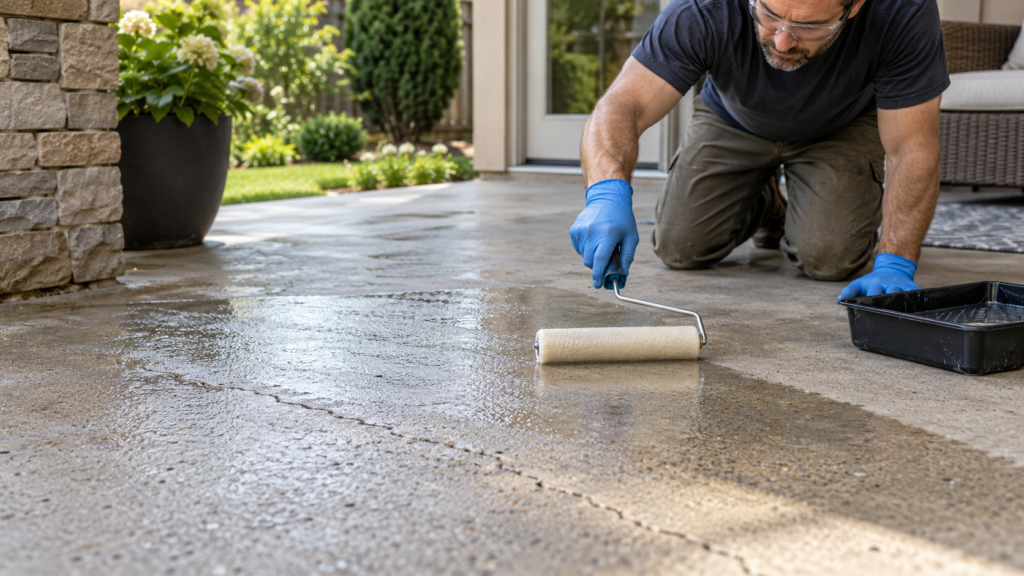
For Flex Seal Liquid, the manufacturer’s current directions say to start with a clean, dry surface free of grease, oil, and dirt. They describe brush, roller, dip, and pour application; they also advise allowing coats to dry before adding more. Confirm the current instructions on the container or official product page before starting, particularly for surface preparation, protective clothing, application method, coat sequence, and curing.
For a patio, the manufacturer’s wet-slip warning remains the deciding issue. Careful preparation does not remove that limitation. If the area will receive substantial foot traffic, choose a product whose documentation supports that use.
Common Claims That Need Qualification
“It works on concrete, so it is right for a concrete patio.”
Concrete compatibility does not establish suitability for every use. The manufacturer’s concrete guidance specifically cautions against large areas with substantial foot traffic because the surface can become slippery when wet.
“It will stop the patio from cracking.”
A coating does not stop the mechanisms that cause concrete to crack. It cannot stabilize settlement or restore structural capacity. Diagnose moving or displaced cracks before applying a surface layer.
“It waterproofs the whole patio.”
A coating’s claim to form a water barrier does not mean the entire patio assembly is waterproof. Water can enter through cracks, joints, edges, and transitions, or collect because of poor drainage. Treat persistent water intrusion as a water-management problem, not just a coating problem.
“It will last for years without maintenance.”
Service life depends on the product, concrete condition, preparation, exposure, and use. Unless the manufacturer gives a relevant claim for this exact use, do not assume a fixed lifespan. Inspect the surface and use the product’s maintenance guidance.
“A test patch proves it is safe for the full patio.”
A patch can show appearance and help assess local compatibility. It cannot by itself establish the long-term performance or wet slip resistance of a large, heavily used patio.
Frequently Asked Questions
1. Can Flex Seal Liquid be used on concrete?
The manufacturer lists concrete among the surfaces Flex Seal Liquid can adhere to. That does not mean it is suitable for every concrete application. For a patio, read the manufacturer’s specific warning about large areas with substantial foot traffic.
2. Should I use Flex Seal Liquid to coat my whole patio?
I would not recommend it for a whole patio with regular foot traffic. The manufacturer says it does not recommend sealing large areas that receive a lot of foot traffic because the liquid can become slippery when wet. Select a coating with documentation that supports exterior pedestrian use and appropriate wet-surface guidance.
3. Is Flex Seal Liquid slippery when wet?
The manufacturer warns that Flex Seal Liquid can become slippery when wet when used on large areas with substantial foot traffic. That warning is especially relevant to exposed walking surfaces such as patios. Do not assume a cured coating is safe to walk on when wet without product guidance for that use.
4. Can Flex Seal stop a patio crack from coming back?
A surface coating cannot stop the causes of cracking, such as shrinkage, settlement, restraint, or movement. A recurring or widening crack needs assessment to determine whether it is a stable crack, a movement joint, or a sign of a larger problem.
5. Can I use it on a small crack?
The right repair depends on the crack’s condition and the exact product instructions. A small, stable surface defect differs from a moving crack or a designed joint. Confirm the product is suitable for that repair and do not use a coating to conceal displacement or ongoing movement.
6. Does Flex Seal make a patio completely waterproof?
Do not assume that coating the slab makes the whole patio waterproof. Water can still pass through cracks, joints, edges, and transitions, and the coating does not correct poor drainage. Use a system designed for the water exposure and details involved.
7. Will Flex Seal change how my patio looks?
A rubberized surface coating can change colour, sheen, and texture. Test a small inconspicuous area and assess it after the product reaches its stated cure condition. A test patch helps assess appearance; it does not remove the manufacturer’s warning about large pedestrian areas.
8. Can I apply Flex Seal over an old concrete sealer or paint?
Do not assume that the products are compatible. An existing coating may block adhesion or fail underneath the new layer. Identify the existing treatment and follow the current instructions for testing, preparation, and removal.
9. How long should I wait before walking on a coated patio?
Use the cure and re-entry instructions for the exact product and current conditions. “Dry to the touch” may not mean fully cured. Also, a cure time does not establish that the coating is appropriate for a wet pedestrian surface.
10. What is a better choice for reducing water absorption?
A penetrating sealer made for exterior concrete may suit a goal of reducing water absorption while keeping the surface relatively unchanged. Check compatibility with previous treatments and the manufacturer’s use instructions. It will not repair cracks or fix drainage.
11. What should I do if water keeps entering through the patio?
Look for the source: drainage and slope, cracks, joints, edges, and connections to the building. A surface coating may not address the route water is taking. Choose a repair or waterproofing system based on the diagnosed condition.
12. What if the coating starts peeling?
Do not apply another layer over loose or failing material. The cause may be moisture, contamination, weak concrete, an incompatible prior coating, or application outside the product’s instructions. Identify and correct the cause, then follow the manufacturer’s guidance for removing failed material and preparing the surface.
Conclusion
Flex Seal Liquid can adhere to concrete, but the manufacturer’s warning about large areas with substantial foot traffic is decisive for a typical patio: the surface can become slippery when wet. I would choose a coating or sealer documented for exterior pedestrian use instead of treating Flex Seal as the default whole-patio solution. Before any coating is applied, check the concrete, previous treatments, cracks, joints, drainage, and wet-surface requirements; match the repair to the actual problem.