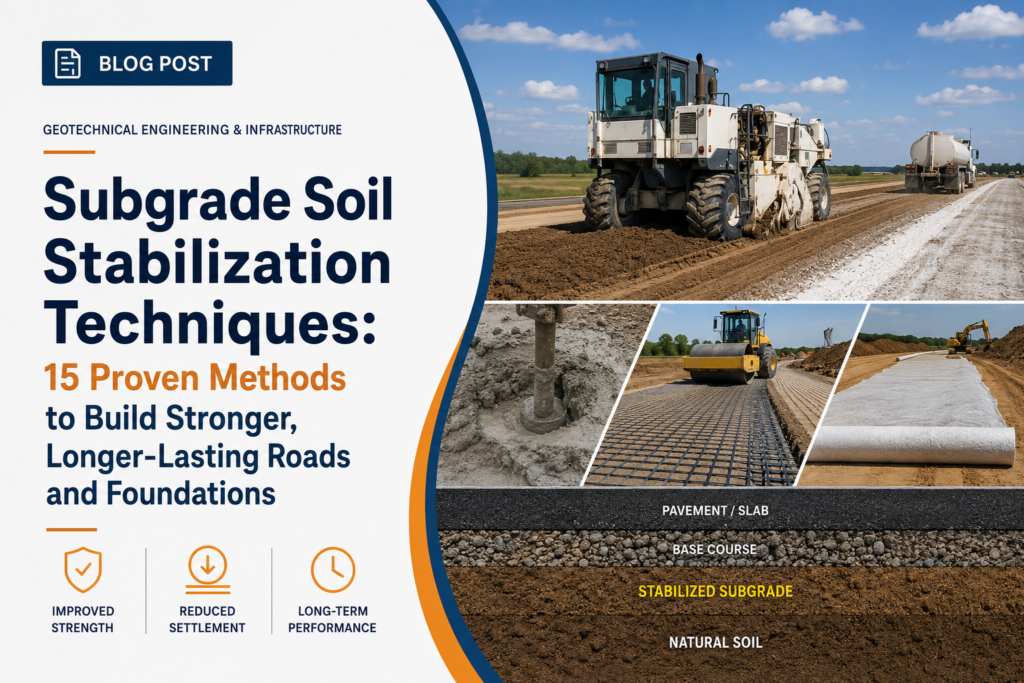
Subgrade soil stabilization is the process of improving weak soil beneath roads, highways, railways, airports, foundations, and pavements so it can safely support structural loads. Engineers enhance soil strength by modifying its physical or chemical properties using methods such as mechanical compaction, lime stabilization, cement stabilization, fly ash treatment, geosynthetics, and newer technologies like geopolymers and microbial stabilization.
The appropriate stabilization method depends on several factors, including soil type, moisture content, California Bearing Ratio (CBR), project budget, environmental conditions, and expected traffic loading.
For example:
- Clay soils typically respond well to lime stabilization.
- Sandy soils often benefit from mechanical compaction or cement treatment.
- Soft subgrades frequently require geogrids or geocells.
- Highly saturated soils may need drainage combined with chemical stabilization.
- Sustainable projects increasingly use recycled materials and bio-based stabilizers to reduce carbon emissions.
Proper stabilization minimizes settlement, prevents pavement failures, reduces maintenance costs, and significantly extends the service life of transportation and building infrastructure.
Modern infrastructure begins long before asphalt or concrete is placed. Every successful road, runway, industrial floor, railway track, or building foundation depends on one often-overlooked component—the subgrade. A pavement system is only as reliable as the soil beneath it. Even premium construction materials cannot compensate for a weak, poorly prepared foundation.
Globally, billions of dollars are spent each year repairing pavement failures caused by inadequate subgrade preparation rather than deficiencies in the pavement itself. Poor drainage, expansive clay, loose granular soils, frost action, and repeated traffic loads gradually weaken untreated subgrades, leading to rutting, cracking, differential settlement, and premature structural failure.
Fortunately, modern geotechnical engineering offers numerous stabilization techniques that improve soil performance, increase bearing capacity, reduce moisture sensitivity, and enhance long-term durability. Advances in materials science have expanded the field beyond traditional lime and cement stabilization to include geosynthetics, recycled industrial by-products, nanomaterials, and biologically inspired solutions.
Let’s explore it further below.
What Is Subgrade Soil Stabilization?
Subgrade soil stabilization refers to any engineering process that improves the strength, stiffness, durability, or moisture resistance of natural soil before construction. Rather than replacing poor-quality soil entirely, engineers modify its properties so it performs as a reliable load-bearing layer.
The subgrade forms the lowest structural layer supporting pavements and foundations. It transfers loads from upper layers into the ground while maintaining uniform support throughout the structure’s service life.
Without proper stabilization, several problems may develop:
- Excessive settlement
- Pavement rutting
- Reflective cracking
- Water infiltration
- Frost heaving
- Pumping of fines
- Edge failures
- Differential movement
The goal is not simply to make soil “harder.” Instead, stabilization seeks to achieve predictable engineering properties such as:
| Engineering Property | Why It Matters |
|---|---|
| Bearing Capacity | Supports structural loads safely |
| CBR Value | Determines pavement thickness requirements |
| Compressibility | Controls settlement |
| Shear Strength | Prevents sliding failures |
| Permeability | Improves drainage behavior |
| Plasticity | Reduces swelling and shrinkage |
| Durability | Extends infrastructure life |
Engineers select stabilization methods after evaluating laboratory and field test results rather than relying on visual inspection alone.
Did You Know? Many pavement failures originate below the visible surface. A perfectly constructed asphalt road can still fail within a few years if the underlying subgrade lacks adequate strength or drainage.
Why Weak Subgrades Fail
Subgrade failure rarely results from a single issue. Instead, it is usually the cumulative effect of soil behavior, water movement, traffic loading, and environmental conditions.
One of the most common causes is inadequate bearing capacity. Weak soils compress excessively under repeated wheel loads, causing deformation that eventually appears as surface rutting or cracking.
Moisture is another major contributor. Clay soils absorb water, increasing in volume during wet periods and shrinking during dry seasons. This cyclic movement introduces stresses into pavement systems that eventually exceed their design capacity.
Common causes include:
| Cause | Effect |
|---|---|
| High moisture | Reduced strength |
| Expansive clay | Swelling and shrinkage |
| Organic soil | Excessive settlement |
| Poor compaction | Differential deformation |
| Frost action | Surface heaving |
| Heavy traffic | Permanent rutting |
| Poor drainage | Softening of subgrade |
| High groundwater | Reduced bearing capacity |
For highways carrying heavy trucks, these failures accelerate because each axle load repeatedly stresses the same weak zones. Airports experience similar issues, although aircraft loading patterns differ significantly.
Another often-overlooked factor is construction quality. Even well-designed stabilization methods may fail if mixing, moisture control, curing, or compaction are poorly executed.
Understanding why soils fail enables engineers to select the most effective stabilization strategy rather than relying on generic solutions.
Soil Investigation Before Choosing a Stabilization Method
Selecting the wrong stabilization method can waste time, increase costs, and even reduce soil performance. That is why every successful stabilization project begins with a detailed geotechnical investigation rather than immediately adding cement, lime, or other additives.
The purpose of soil investigation is to understand how the ground behaves under anticipated loads and environmental conditions. Engineers evaluate physical, mechanical, and chemical properties before recommending a stabilization strategy.
Typical investigations include field exploration followed by laboratory testing.
Field Investigation
During the field stage, engineers identify:
- Soil profile and stratification
- Groundwater level
- Moisture conditions
- Existing pavement failures
- Surface drainage patterns
- Presence of organic material or fill
Common field methods include trial pits, boreholes, cone penetration tests (CPT), and dynamic cone penetration (DCP) testing.
Laboratory Testing
Laboratory tests quantify soil behavior.
| Test | Purpose |
|---|---|
| Grain Size Analysis | Determines soil classification |
| Atterberg Limits | Measures plasticity |
| Standard/Modified Proctor Test | Finds optimum moisture content and maximum dry density |
| California Bearing Ratio (CBR) | Evaluates pavement support capacity |
| Unconfined Compressive Strength (UCS) | Measures stabilized soil strength |
| Direct Shear Test | Determines shear resistance |
| Triaxial Test | Evaluates stress-strain behavior |
| Moisture Content Test | Assesses field condition |
Among these, the California Bearing Ratio (CBR) is one of the most influential parameters in pavement design. A low CBR typically indicates weak soil requiring stabilization or thicker pavement layers.
Soil Classification Matters
Different soils respond differently to stabilizers.
| Soil Type | Recommended Stabilization |
|---|---|
| Clay | Lime, cement, fly ash |
| Silt | Cement, lime, geotextiles |
| Sand | Mechanical compaction, cement |
| Gravel | Mechanical stabilization |
| Organic Soil | Replacement usually preferred |
| Peat | Removal or deep improvement methods |
Choosing a stabilization method without understanding soil mineralogy is like prescribing medicine without a diagnosis. Two soils with similar appearances may behave entirely differently under load due to differences in clay minerals, moisture sensitivity, or organic content.
A thorough investigation also reduces project risk by minimizing costly design changes during construction.
Mechanical Subgrade Soil Stabilization Techniques
Mechanical stabilization improves soil performance without fundamentally altering its chemical composition. Instead, engineers increase density, optimize particle arrangement, reduce air voids, and improve load distribution through physical methods.
For many projects, mechanical stabilization is the most economical solution because it uses locally available materials and standard construction equipment. It is particularly effective for granular soils with low plasticity, although it can also be combined with chemical stabilization for more challenging conditions.
1. Compaction
Compaction is the most widely used stabilization technique worldwide. By applying mechanical energy through rollers, vibratory compactors, or rammers, soil particles are forced closer together, reducing voids and increasing dry density.
The effectiveness of compaction depends on:
- Soil type
- Moisture content
- Lift thickness
- Roller type
- Number of passes
- Compaction energy
Different equipment suits different soils:
| Equipment | Best Soil Type | Typical Application |
|---|---|---|
| Smooth Drum Roller | Sand and Gravel | Highways, Runways |
| Vibratory Roller | Granular Soil | Roads, Embankments |
| Padfoot Roller | Clay | Earth Dams, Subgrades |
| Pneumatic Roller | Mixed Soils | Final Compaction |
| Plate Compactor | Small Areas | Utility Trenches |
The relationship between moisture and density is determined through the Proctor Compaction Test, which identifies the Optimum Moisture Content (OMC) and Maximum Dry Density (MDD). Compaction performed too dry or too wet rarely achieves the desired strength.
2. Soil Replacement
Sometimes the existing subgrade is simply too weak to stabilize economically. Organic soils, peat, and highly compressible deposits often fall into this category.
In such cases, engineers excavate unsuitable material and replace it with engineered fill.
Typical replacement materials include:
- Crushed stone
- Well-graded gravel
- Selected borrow soil
- Granular sub-base
- Recycled aggregate (where permitted)
Although replacement increases initial construction costs, it can significantly reduce long-term maintenance for heavily loaded facilities such as airports, container terminals, and industrial yards.
3. Blending Different Soil Types
Another mechanical technique involves mixing soils with complementary characteristics.
For example:
- High-plasticity clay may be blended with sand.
- Silty soils may be improved with gravel.
- Fine-grained soils can be mixed with crushed rock.
The objective is to achieve a well-graded material with reduced plasticity, improved drainage, and higher bearing capacity.
4. Dynamic Compaction
Dynamic compaction is used for deeper soil improvement. Heavy weights, often ranging from 10 to 40 tonnes, are repeatedly dropped from significant heights to densify loose granular soils.
Typical applications include:
- Industrial developments
- Airport expansions
- Reclaimed land
- Port facilities
- Large warehouse foundations
Unlike surface rolling, dynamic compaction can improve soil several meters below ground level.
Advantages of Mechanical Stabilization
| Advantage | Benefit |
|---|---|
| Low material cost | Uses existing soil where possible |
| Fast construction | Minimal curing time |
| Environmentally friendly | Limited chemical additives |
| Widely available equipment | Easy implementation |
| Immediate strength gain | Suitable for fast-track projects |
Limitations
Mechanical stabilization alone may not be sufficient for:
- Highly plastic clays
- Organic soils
- Peat deposits
- Saturated subgrades
- Expansive soils
- Sulfate-rich soils
In such situations, chemical or geosynthetic stabilization usually provides better long-term performance.
Did You Know? A properly compacted subgrade can reduce long-term pavement maintenance costs by extending service life and minimizing differential settlement. In many road projects, achieving the specified field density is one of the most critical quality-control milestones.
Chemical Subgrade Soil Stabilization Techniques
Chemical stabilization modifies the mineral structure of soil through reactions between additives and soil particles. Unlike mechanical stabilization, which rearranges particles, chemical stabilization creates new cementitious bonds that improve strength, reduce plasticity, and enhance durability.
It is especially effective for clay-rich soils, which often present challenges due to swelling, shrinkage, and moisture sensitivity.
1. Lime Stabilization
Lime stabilization has been used for decades and remains one of the most effective treatments for expansive clay soils.
When quicklime or hydrated lime is mixed with clay, several reactions occur:
- Immediate reduction in plasticity.
- Moisture reduction through drying.
- Flocculation and agglomeration of clay particles.
- Long-term pozzolanic reactions forming cementitious compounds.
Typical benefits include:
- Higher CBR
- Increased shear strength
- Reduced swelling
- Improved workability
- Lower plasticity index
Lime is generally unsuitable for sandy soils because they lack sufficient clay minerals to react effectively.
2. Cement Stabilization
Portland cement stabilization is one of the most versatile techniques because it works with a wide range of soil types.
Hydration reactions create calcium silicate hydrate (C-S-H) gels, binding soil particles into a stronger matrix.
Applications include:
- Highways
- Airport pavements
- Industrial floors
- Logistics parks
- Heavy-duty access roads
Typical improvements include:
- Increased compressive strength
- Higher modulus of elasticity
- Improved durability
- Better resistance to erosion
However, cement production has a relatively high carbon footprint, prompting interest in lower-carbon alternatives.
3. Fly Ash Stabilization
Fly ash, a by-product of coal-fired power generation, can improve soil when used alone or in combination with lime.
Advantages include:
- Lower material cost
- Utilization of industrial waste
- Improved long-term strength
- Reduced plasticity
- Enhanced workability
The performance depends on the type of fly ash and the availability of calcium for pozzolanic reactions.
4. Bituminous Stabilization
Bituminous materials coat soil particles, making them more resistant to water infiltration.
Typical applications include:
- Low-volume roads
- Temporary haul roads
- Surface treatments
- Dust control
This method is less common for structural stabilization but remains useful in specific conditions where moisture resistance is the primary objective.
5. Chemical Polymers
Modern polymer stabilizers are increasingly used for rural roads, mine haul roads, and environmentally sensitive projects.
Benefits include:
- Faster application
- Reduced dust
- Improved erosion resistance
- Lower water permeability
- Enhanced durability
Performance varies depending on polymer chemistry and soil type, so laboratory trials are essential before large-scale implementation.
Comparison of Common Chemical Stabilizers
| Stabilizer | Best Soil | Strength Gain | Swell Reduction | Relative Cost |
|---|---|---|---|---|
| Lime | Clay | High | Excellent | Low |
| Cement | Most soils | Very High | Good | Medium |
| Fly Ash | Clay, Silt | Moderate | Good | Low |
| Bitumen | Sandy soils | Moderate | Excellent moisture resistance | Medium |
| Polymer | Various soils | Moderate to High | Good | Medium to High |
Construction Best Practices
Successful chemical stabilization depends on more than simply adding a binder. Engineers must control:
- Binder dosage
- Moisture content
- Uniform mixing
- Layer thickness
- Compaction timing
- Curing conditions
- Field density
- Quality assurance testing
Poor mixing or insufficient curing can leave untreated pockets that become weak points under traffic, much like knots in a piece of timber reducing its overall strength.
Did You Know? The chemistry of lime stabilization continues long after construction. Pozzolanic reactions can develop for months, gradually increasing soil strength as new cementitious compounds form.
Geosynthetic Subgrade Soil Stabilization Techniques
Traditional stabilization methods improve the soil itself. Geosynthetics take a different approach—they reinforce, separate, filter, drain, or confine the soil to improve the overall performance of the pavement system. Over the past three decades, geosynthetics have become standard practice in highways, airports, railways, ports, and industrial developments because they can significantly reduce pavement thickness while increasing service life.
Unlike chemical stabilization, geosynthetics do not rely on curing or chemical reactions. Their performance depends on tensile strength, stiffness, aperture size, and interaction with surrounding soil.
1. Geotextiles
Geotextiles are permeable synthetic fabrics placed between different soil layers.
Their primary functions include:
- Separation of fine and coarse materials
- Filtration while allowing water flow
- Drainage
- Reinforcement
- Erosion control
Without a separation layer, aggregate gradually sinks into soft subgrade while fine particles migrate upward. This contamination reduces pavement strength over time.
Typical applications include:
- Rural roads
- Highway embankments
- Railways
- Landfills
- Temporary access roads
2. Geogrids
Geogrids are polymer grids with high tensile strength designed to interlock with aggregates.
Unlike geotextiles, geogrids primarily reinforce the base course by restricting lateral movement of aggregates.
Benefits include:
- Increased load distribution
- Reduced rutting
- Lower aggregate thickness
- Longer pavement life
- Improved bearing capacity
Geogrids are widely used for:
- Heavy haul roads
- Container terminals
- Airport taxiways
- Industrial yards
- Logistics parks
3. Geocells
Geocells consist of interconnected three-dimensional honeycomb structures.
Once filled with soil or aggregate, the cells provide confinement that dramatically improves load distribution.
Advantages include:
- Improved weak subgrades
- Reduced differential settlement
- Better slope stability
- Less imported fill
- Excellent erosion resistance
They are particularly effective on:
- Steep embankments
- Riverbanks
- Soft clay deposits
- Desert roads
- Military roads
4. Geomembranes
Although primarily used as impermeable barriers, geomembranes sometimes complement stabilization projects where groundwater isolation is critical.
Applications include:
- Waste containment
- Chemical storage facilities
- Mining projects
- Water reservoirs
5. Geonets and Drainage Composites
Drainage is often as important as stabilization.
Geonets provide continuous drainage pathways beneath pavements, preventing water pressure buildup that weakens subgrades.
Common uses include:
- Retaining walls
- Tunnel drainage
- Landfills
- Pavement edge drains
Comparison of Geosynthetics
| Product | Primary Function | Best Application |
|---|---|---|
| Geotextile | Separation & Filtration | Roads, Railways |
| Geogrid | Reinforcement | Highways, Airports |
| Geocell | Confinement | Soft Ground |
| Geomembrane | Impermeable Barrier | Landfills |
| Geonet | Drainage | Pavements |
Advantages of Geosynthetic Stabilization
- Faster installation
- Reduced excavation
- Lower aggregate requirements
- Better long-term performance
- Improved drainage
- Lower maintenance costs
- Reduced carbon footprint through material savings
However, correct product selection is essential. Using a separator geotextile where reinforcement is needed—or vice versa—can compromise performance despite using high-quality materials.
Did You Know? A geogrid weighs only a fraction of the aggregate it helps replace, yet it can significantly improve load distribution. It’s a reminder that engineering isn’t always about adding more material—sometimes it’s about placing the right material in the right location.
Emerging and Sustainable Soil Stabilization Technologies
Infrastructure projects are increasingly expected to balance performance with environmental responsibility. Traditional stabilizers like cement and lime remain highly effective, but they also contribute to greenhouse gas emissions. This has accelerated research into sustainable stabilization methods that reduce carbon footprints while maintaining engineering performance.
1. Geopolymer Stabilization
Geopolymers are inorganic binders produced by activating aluminosilicate-rich materials such as fly ash or ground granulated blast-furnace slag (GGBS) with alkaline solutions.
Compared with Portland cement, geopolymers can offer:
- High compressive strength
- Excellent chemical resistance
- Reduced shrinkage
- Lower embodied carbon
- Improved durability
They are increasingly studied for road bases, industrial pavements, and infrastructure in aggressive environments.
2. Microbial Induced Calcite Precipitation (MICP)
One of the most fascinating developments in geotechnical engineering is Microbial Induced Calcite Precipitation (MICP).
In this process, naturally occurring bacteria produce calcium carbonate (calcite), which binds soil particles together much like natural cement.
Potential advantages include:
- Minimal environmental impact
- Increased soil strength
- Reduced permeability
- Improved erosion resistance
While promising, MICP is still emerging and is generally limited to research projects and specialized applications.
3. Bio-Enzyme Stabilization
Bio-enzymes are organic compounds derived from natural fermentation processes.
They react with fine-grained soils to improve:
- Compaction efficiency
- Moisture resistance
- Long-term stability
These products are often promoted for rural roads where transporting conventional stabilizers is expensive. Their effectiveness depends heavily on soil mineralogy, making laboratory evaluation essential.
4. Fiber Reinforcement
Short fibers distributed throughout soil create a composite material capable of resisting tensile stresses.
Common fibers include:
- Polypropylene
- Polyester
- Basalt
- Glass
- Natural fibers (coir, jute)
Fiber-reinforced soils show improvements in:
- Crack resistance
- Ductility
- Shear strength
- Post-failure behavior
This approach is increasingly used in embankments, slopes, and pavement subgrades.
5. Nanomaterials
Nanotechnology has introduced materials such as:
- Nano-silica
- Nano-clay
- Carbon nanotubes
- Graphene derivatives
Even small dosages can significantly influence soil microstructure by enhancing particle bonding and reducing permeability.
Although still relatively expensive, nanomaterials may become more practical as production costs decline.
6. Industrial By-Products
Many stabilization projects now incorporate recycled materials that would otherwise become waste.
Examples include:
- Fly ash
- Steel slag
- Copper slag
- Cement kiln dust
- Rice husk ash
- Ground granulated blast-furnace slag (GGBS)
These materials support circular economy principles while reducing dependence on virgin construction resources.
Sustainability Comparison
| Method | Carbon Footprint | Performance | Commercial Maturity |
|---|---|---|---|
| Cement | High | Excellent | Very High |
| Lime | Medium | Excellent | Very High |
| Fly Ash | Low | Good | High |
| Geopolymer | Low | Excellent | Medium |
| Bio-Enzyme | Very Low | Moderate | Medium |
| MICP | Very Low | Promising | Low |
| Fiber Reinforcement | Low | Good | High |
The future of soil stabilization is likely to combine traditional engineering with digital technologies. Machine learning models are already being explored to predict optimal binder content, while BIM and digital twins help engineers monitor long-term pavement performance and maintenance needs.
The humble subgrade—once treated as little more than “the dirt underneath”—is becoming a data-rich engineering system where materials science, microbiology, and digital engineering intersect.
Did You Know? Some researchers are exploring “self-healing” soils using biological processes that can naturally repair small cracks by precipitating minerals over time. It sounds like science fiction, but the underlying chemistry is very real and actively studied.
Construction Procedure for Subgrade Soil Stabilization
Selecting the right stabilization method is only half the challenge. The construction process determines whether the design intent translates into real-world performance. A poorly executed stabilization project can fail even if the laboratory mix design is technically correct. Quality control at every stage is therefore just as important as selecting the appropriate stabilizer.
The following workflow represents a typical sequence for road, airport, railway, and industrial pavement projects.
Step 1: Site Investigation and Design
Construction begins with a detailed geotechnical investigation. Engineers identify:
- Soil classification
- Groundwater level
- Moisture content
- Existing drainage conditions
- CBR value
- Plasticity Index (PI)
- Bearing capacity
- Sulfate or organic content
Laboratory testing determines whether the soil is suitable for mechanical improvement or requires chemical stabilization, reinforcement, or replacement.
Step 2: Surface Preparation
Before stabilization begins:
- Remove vegetation
- Strip topsoil
- Excavate unsuitable material
- Establish temporary drainage
- Grade the working platform
Proper drainage at this stage prevents rainfall from compromising the prepared surface.
Step 3: Moisture Conditioning
Moisture content has a direct influence on compaction efficiency.
Engineers either:
- Add water if the soil is too dry.
- Aerate or scarify if the soil is too wet.
Compaction is typically performed close to the Optimum Moisture Content (OMC) identified during the Proctor test.
Step 4: Spreading the Stabilizer
Depending on the selected method, materials may include:
- Lime
- Cement
- Fly ash
- Slag
- Polymer
- Bio-enzyme
- Aggregate
- Fibers
Uniform spreading is critical. Uneven distribution creates localized weak zones that may later develop into pavement failures.
Step 5: Mixing
Mixing may be performed using:
- Rotary mixers
- Reclaimers
- Pulverizers
- Motor graders (for smaller projects)
The objective is to achieve complete blending of the stabilizer throughout the specified treatment depth.
Step 6: Compaction
Compaction begins immediately after mixing.
Typical equipment includes:
| Equipment | Suitable Soil |
|---|---|
| Padfoot Roller | Clay |
| Vibratory Roller | Sand & Gravel |
| Pneumatic Roller | Mixed Soil |
| Smooth Drum Roller | Final Surface |
Field density is verified using methods such as:
- Sand cone test
- Nuclear density gauge
- Intelligent compaction systems
- Dynamic cone penetration testing
Step 7: Curing
Chemical stabilization requires curing to allow cementitious reactions to develop.
Typical curing periods are:
| Stabilizer | Typical Cure Time |
|---|---|
| Cement | 7–28 days |
| Lime | 3–28 days |
| Fly Ash | 7–28 days |
| Geopolymer | Project dependent |
Premature trafficking before curing can significantly reduce long-term performance.
Step 8: Quality Assurance
Quality assurance commonly includes:
- Field density tests
- Moisture verification
- Layer thickness checks
- CBR testing
- UCS testing
- Plate load testing
- Visual inspection
- Material certification
Modern projects increasingly integrate GPS-enabled construction equipment and intelligent compaction systems, allowing engineers to monitor compaction coverage and density in real time.
Typical Construction Workflow
Site Investigation
        ↓
Laboratory Testing
        ↓
Method Selection
        ↓
Surface Preparation
        ↓
Moisture Conditioning
        ↓
Apply Stabilizer
        ↓
Mix Thoroughly
        ↓
Compaction
        ↓
Curing
        ↓
Quality Control Testing
        ↓
Construction of Pavement Layers
Following a systematic workflow reduces variability and improves the consistency of stabilized layers across the project.
Did You Know? Intelligent compaction rollers equipped with GPS and onboard sensors can produce real-time compaction maps, helping engineers identify under-compacted areas before paving begins.
Choosing the Right Stabilization Method
There is no universal stabilization technique suitable for every project. Soil properties, climate, traffic loading, environmental regulations, construction schedule, and budget all influence the decision.
A structured decision-making process minimizes risk and optimizes long-term performance.
Selection Factors
Engineers typically evaluate:
- Soil classification
- Plasticity Index (PI)
- California Bearing Ratio (CBR)
- Moisture content
- Groundwater conditions
- Frost susceptibility
- Sulfate content
- Organic matter
- Traffic loading
- Pavement design life
- Material availability
- Construction equipment
- Environmental impact
- Project cost
Stabilization Decision Matrix
| Site Condition | Recommended Technique |
|---|---|
| Expansive Clay | Lime Stabilization |
| Sandy Soil | Mechanical Compaction |
| Silty Soil | Cement Stabilization |
| Weak Soft Clay | Geogrid + Lime |
| High Groundwater | Drainage + Geotextile |
| Heavy Truck Traffic | Cement + Geogrid |
| Airport Runway | Cement Stabilization |
| Rural Road | Lime or Fly Ash |
| Temporary Haul Road | Polymer Stabilization |
| Environmentally Sensitive Area | Bio-Enzyme or Geopolymer |
Selection Based on CBR
The California Bearing Ratio is widely used for pavement design and stabilization decisions.
| Existing CBR | Typical Recommendation |
|---|---|
| Below 2% | Replacement or Deep Improvement |
| 2–5% | Chemical Stabilization |
| 5–8% | Mechanical + Chemical |
| 8–15% | Mechanical Improvement |
| Above 15% | Minor Stabilization or Compaction Only |
These values are indicative and should always be confirmed through project-specific design and local standards.
Cost Comparison
Project cost depends on haul distance, local material availability, labor rates, and construction scale.
| Method | Relative Initial Cost | Long-Term Maintenance |
|---|---|---|
| Mechanical Compaction | Low | Medium |
| Lime | Low | Low |
| Cement | Medium | Very Low |
| Fly Ash | Low | Low |
| Geogrid | Medium | Very Low |
| Geocell | Medium–High | Very Low |
| Polymer | Medium | Low |
| Geopolymer | Medium–High | Low |
The lowest initial cost is not always the most economical solution over the infrastructure’s life cycle. A slightly higher upfront investment in stabilization can substantially reduce maintenance, rehabilitation, and user-delay costs over decades.
Common Failures and How to Prevent Them
Subgrade stabilization failures often stem from execution errors rather than flaws in the stabilization concept itself. Understanding common problems helps engineers implement preventive measures before construction begins.
1. Inadequate Soil Investigation
Using generic stabilization recommendations without proper testing can result in poor performance. Different soils respond differently to the same stabilizer.
Prevention: Conduct comprehensive geotechnical investigations and laboratory mix design testing before selecting a treatment method.
2. Incorrect Moisture Content
Compaction outside the Optimum Moisture Content significantly reduces achievable density and strength.
Prevention: Continuously monitor field moisture and adjust through watering or aeration before compaction.
3. Uneven Mixing
Insufficient blending leaves untreated zones that become weak points under repeated traffic.
Prevention: Use calibrated reclaimers or rotary mixers and verify mixing depth and uniformity during construction.
4. Poor Compaction
Even the best stabilizer cannot compensate for inadequate compaction.
Prevention: Follow specified lift thicknesses, roller passes, and field density requirements, verified through quality-control testing.
5. Premature Loading
Opening stabilized layers to construction traffic before curing is complete can damage the developing soil structure.
Prevention: Respect curing periods and protect treated areas until the specified strength is achieved.
6. Poor Drainage
Water remains one of the greatest threats to pavement performance. Even stabilized soils can deteriorate if drainage is neglected.
Prevention: Incorporate side drains, edge drains, and proper surface grading to control water infiltration.
Did You Know? Many pavement investigations reveal that drainage deficiencies—not inadequate pavement thickness—are the primary cause of long-term deterioration. Water is often the quiet saboteur of otherwise sound engineering.
Case Studies: Subgrade Soil Stabilization in Real-World Projects
The principles of soil stabilization become far more meaningful when viewed through actual engineering applications. While laboratory tests establish design parameters, field performance ultimately determines whether a stabilization strategy has been successful.
The following examples illustrate how different stabilization techniques are selected based on soil conditions, loading requirements, climate, and project objectives.
Case Study 1: National Highway Through Expansive Clay (India)
Project Challenge
A highway section traversed expansive black cotton soil, known for its high shrink-swell potential. Seasonal moisture variations caused pavement cracking, rutting, and shoulder deformation.
Engineering Solution
The project team implemented:
- Lime stabilization
- Moisture conditioning
- Padfoot roller compaction
- Cement-treated sub-base
- Improved roadside drainage
Outcome
- Significant reduction in plasticity index
- Increased California Bearing Ratio (CBR)
- Reduced seasonal pavement movement
- Lower maintenance requirements over the pavement’s design life
This approach remains one of the most effective solutions for expansive clay regions across central and western India.
Case Study 2: Airport Taxiway Expansion (Middle East)
Project Challenge
The project site consisted predominantly of loose sandy soils with localized weak pockets. Heavy aircraft loads demanded a uniformly stiff pavement foundation.
Engineering Solution
Engineers adopted:
- Mechanical compaction
- Cement stabilization
- Geogrid reinforcement beneath the aggregate base
- Intelligent compaction monitoring
Outcome
- Improved load distribution
- Reduced differential settlement
- Increased pavement stiffness
- Enhanced long-term durability under repeated aircraft loading
Case Study 3: Logistics Park Development (Europe)
Project Challenge
A large logistics hub required pavements capable of supporting high-frequency heavy goods vehicles without excessive settlement.
Engineering Solution
The stabilization strategy included:
- Cement-treated subgrade
- Geotextile separation layer
- Crushed aggregate base
- Comprehensive quality-control testing
Outcome
- Reduced imported fill requirements
- Lower construction time
- Improved pavement life-cycle performance
- Simplified long-term maintenance
Case Study 4: Rural Road Improvement (Africa)
Project Challenge
Limited construction budgets and remote project locations made transporting cement economically challenging.
Engineering Solution
The project incorporated:
- Locally available lateritic soil
- Lime stabilization
- Mechanical compaction
- Improved drainage ditches
Outcome
- Reduced material transportation costs
- Improved all-weather accessibility
- Longer pavement service life
- Greater use of locally available resources
Case Study 5: Industrial Yard on Soft Ground (North America)
Project Challenge
A distribution facility required pavements capable of supporting heavily loaded forklifts, trailers, and container handling equipment.
Engineering Solution
The final design incorporated:
- Geocells
- Geogrids
- Cement stabilization
- High-quality drainage system
Outcome
- Reduced pavement thickness
- Improved bearing capacity
- Lower long-term maintenance costs
- Better resistance to rutting
Future Trends in Subgrade Soil Stabilization
Soil stabilization is evolving rapidly as sustainability, digital engineering, and materials science reshape the construction industry. The next generation of stabilization techniques will focus not only on improving soil performance but also on reducing environmental impact, enhancing construction efficiency, and enabling predictive maintenance.
Artificial Intelligence and Machine Learning
Artificial intelligence (AI) is increasingly being used to optimize stabilization designs. By analyzing historical project data, laboratory test results, and field performance, machine learning models can predict the most effective stabilizer type and dosage for specific soil conditions.
Potential applications include:
- Predicting CBR improvement
- Optimizing binder content
- Estimating settlement
- Forecasting pavement performance
- Reducing laboratory testing iterations
Building Information Modeling (BIM)
Building Information Modeling (BIM) is expanding beyond structural design into geotechnical engineering. Digital models can now incorporate:
- Borehole data
- Soil stratification
- Groundwater levels
- Stabilization zones
- Material quantities
- Quality-control records
This integration improves coordination between geotechnical, civil, and construction teams while supporting better documentation throughout the project lifecycle.
Digital Twins
Digital twins create virtual representations of physical infrastructure that continuously update using sensor data.
Future stabilized subgrades may be monitored using:
- Settlement sensors
- Moisture sensors
- Temperature probes
- Pressure cells
- Traffic monitoring systems
These systems enable predictive maintenance rather than reactive repairs.
Low-Carbon Construction Materials
Reducing embodied carbon has become a key objective for infrastructure owners. Future stabilization projects are expected to make greater use of:
- Geopolymers
- Industrial by-products
- Recycled aggregates
- Bio-based binders
- Carbon capture technologies
These materials aim to maintain engineering performance while reducing greenhouse gas emissions.
Smart Construction Equipment
Modern construction machinery increasingly incorporates:
- GPS positioning
- Automated grade control
- Intelligent compaction
- Real-time density monitoring
- Cloud-based reporting
These technologies improve consistency, reduce human error, and provide digital records for quality assurance.
Did You Know? Future pavements may not only support traffic but also continuously report their condition through embedded sensors, creating infrastructure that effectively “communicates” with engineers before failures become visible.
Common Mistakes to Avoid
Avoiding common mistakes during design and construction can dramatically improve the performance and longevity of stabilized subgrades.
- Skipping detailed geotechnical investigations. Assumptions based solely on visual inspection often lead to selecting ineffective stabilization methods.
- Using a single stabilization technique for every soil type. Clay, sand, silt, and organic soils behave differently and require tailored engineering solutions.
- Ignoring drainage design. Stabilized soil can still weaken if water accumulates within the pavement structure.
- Failing to control moisture during compaction. Soil compacted outside its optimum moisture range rarely achieves the required density.
- Neglecting quality-control testing. Laboratory mix designs must be validated through field density, moisture, and strength testing throughout construction.
Expert Tips to Remember
- Always begin with comprehensive laboratory and field investigations before selecting a stabilization strategy.
- Consider life-cycle costs rather than focusing solely on initial construction expenses.
- Combine stabilization techniques where appropriate—for example, geogrids with cement-treated soil or lime stabilization with improved drainage.
- Verify field performance through rigorous quality assurance, including density, moisture, and strength testing.
- Evaluate environmentally sustainable alternatives, such as geopolymers or recycled industrial by-products, where project requirements and local availability permit.
Frequently Asked Questions (FAQs)
1. What is subgrade soil stabilization?
Subgrade soil stabilization is the process of improving the engineering properties of weak soils so they can safely support roads, pavements, foundations, railways, and other infrastructure. This is achieved through mechanical, chemical, biological, or geosynthetic methods.
2. Why is soil stabilization necessary?
Weak soils can lead to settlement, rutting, cracking, and premature pavement failure. Stabilization improves bearing capacity, durability, and resistance to moisture, extending the service life of infrastructure.
3. Which stabilization method is best for clay soils?
Lime stabilization is generally one of the most effective solutions for high-plasticity clay because it reduces plasticity, limits swelling, and increases long-term strength through pozzolanic reactions.
4. Can sandy soils be stabilized?
Yes. Sandy soils typically respond well to mechanical compaction and cement stabilization. In some cases, geogrids or geocells are also used to improve load distribution.
5. What is the California Bearing Ratio (CBR)?
The California Bearing Ratio (CBR) is a standardized measure of a soil’s bearing capacity. It is widely used in pavement design to determine the required thickness of pavement layers and assess the need for stabilization.
6. What are geosynthetics?
Geosynthetics are polymer-based materials such as geotextiles, geogrids, geocells, geomembranes, and geonets used to reinforce, separate, filter, drain, or contain soil in civil engineering projects.
7. How long does chemical stabilization take to cure?
The curing period depends on the stabilizer used. Cement-treated soils commonly require 7–28 days, while lime stabilization may continue developing strength for several weeks or even months.
8. Is soil stabilization environmentally friendly?
Many modern stabilization methods are designed to reduce environmental impacts. Techniques using recycled industrial by-products, geopolymers, bio-enzymes, or optimized material quantities can lower embodied carbon compared to conventional approaches.
9. Can weak soils always be stabilized?
Not always. Extremely organic soils, peat, or highly compressible deposits may require excavation, replacement, or deep ground improvement methods rather than conventional stabilization.
10. What industries benefit from subgrade stabilization?
Subgrade stabilization is widely used in highway construction, airports, railways, ports, industrial developments, residential projects, commercial buildings, mining operations, and renewable energy infrastructure.
Conclusion
Subgrade soil stabilization is one of the most critical processes in civil and geotechnical engineering. Whether constructing a rural road, an international airport, a railway corridor, or a high-rise building, the long-term success of the project depends on the strength and stability of the soil beneath it.
No single stabilization technique is universally applicable. Mechanical compaction, chemical additives, geosynthetics, and emerging sustainable technologies each address different soil conditions and project objectives. The most successful designs begin with detailed geotechnical investigations, followed by careful material selection, quality-controlled construction, and long-term performance monitoring.
As digital engineering, artificial intelligence, and low-carbon materials continue to evolve, soil stabilization is becoming more precise, sustainable, and data-driven. Engineers are no longer simply improving soil—they are designing resilient ground systems that support safer, longer-lasting, and more sustainable infrastructure.
Key Takeaways
- Subgrade soil stabilization improves the strength, durability, and load-bearing capacity of weak soils beneath infrastructure.
- The most appropriate stabilization method depends on soil properties, moisture conditions, loading requirements, environmental factors, and project economics.
- Mechanical, chemical, geosynthetic, and emerging sustainable techniques each offer distinct advantages for different applications.
- Comprehensive geotechnical investigations, proper construction practices, and rigorous quality control are essential for successful stabilization.
- Advances in AI, BIM, digital twins, and sustainable materials are transforming soil stabilization into a smarter and more environmentally responsible discipline.