

Have you ever wondered how engineers calculate the pressure that the Earth exerts on structures like walls, foundations, and tunnels? Earth pressure is a crucial aspect of civil and geotechnical engineering, as it plays a key role in designing stable structures. Whether it’s a retaining wall holding back soil, a foundation supporting a building, or a tunnel beneath a mountain, calculating the earth pressure is necessary for ensuring that these structures can handle the forces of the soil pushing against them.
But how exactly do engineers go about calculating it? In this article, we’ll break down the various methods, formulas, and key factors involved in calculating earth pressure. By the end, you’ll have a solid understanding of why this calculation is so important for safe and effective engineering designs.
What is Earth Pressure?
Before diving into how engineers calculate earth pressure, it’s important to understand what this pressure actually is.
Earth pressure refers to the horizontal and vertical forces exerted by the surrounding soil or rock on a structure. For example, imagine a wall built to retain soil. The soil exerts pressure on the wall due to its weight and the forces acting on it. The greater the height or depth of the soil, the more pressure it exerts.
Types of Earth Pressure
There are two main types of earth pressure engineers work with:
- Active Earth Pressure: This occurs when the structure or wall is allowed to move slightly, leading the soil to shear and exert a reduced pressure.
- Passive Earth Pressure: This is the resistance from soil when a structure or wall pushes into it, causing the soil to compress and exert an increased pressure.
Understanding both types of pressure is critical because it helps engineers design structures that can withstand soil movements and the forces acting on them.
How Do Engineers Calculate Earth Pressure?
There’s no single formula that works for all scenarios when it comes to calculating earth pressure. Engineers must take into account various factors like the type of soil, the height of the soil, the presence of water, and external forces acting on the structure. Let’s take a closer look at the most common methods and formulas used in practice.
1. The Active Earth Pressure Formula
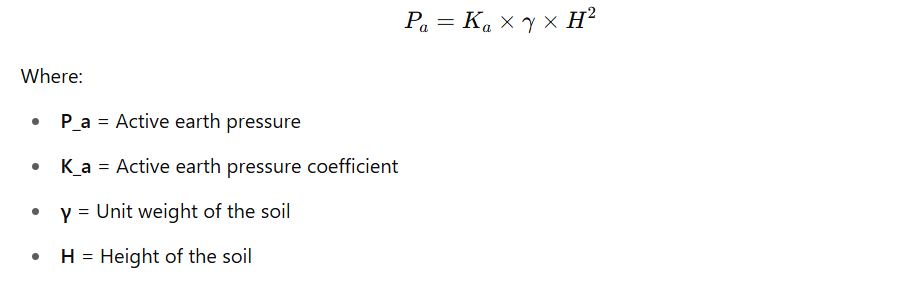
Active earth pressure is the force exerted by the soil when the retaining wall or structure is allowed to move slightly. This movement causes the soil to shear, and as a result, the pressure on the wall decreases.
The formula used for calculating active earth pressure is:
What is the Active Earth Pressure Coefficient ?
The active earth pressure coefficient, is a constant that depends on the angle of internal friction (φ) of the soil. It’s calculated using the following formula:

This equation helps engineers determine the level of pressure exerted on the structure when the soil is allowed to move.
What is Active Earth Pressure?
Simply put, active earth pressure is the reduced force exerted by the soil when the structure can move slightly. Engineers design walls to allow for this movement, ensuring that the soil pressure doesn’t cause structural failure. This formula is used primarily when there is some wall movement or flexibility in the system.
2. The Passive Earth Pressure Formula
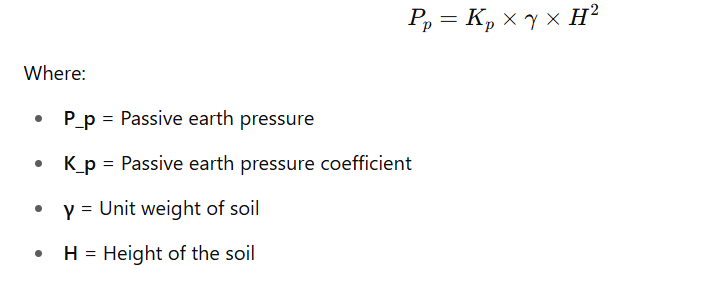
Passive earth pressure occurs when the wall or structure is pushed back into the soil, causing the soil to resist the wall’s movement. In this scenario, the soil compacts and pushes back harder, exerting greater pressure on the structure.
The formula used for calculating passive earth pressure is:
What is the Passive Earth Pressure Coefficient (K_p)?
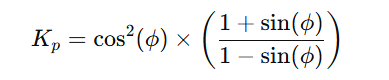
The passive earth pressure coefficient, K_p, is calculated based on the angle of internal friction (φ) of the soil and the wall’s inclination. It’s typically calculated using the following equation:
What is Passive Earth Pressure?
Passive earth pressure refers to the force exerted by the soil when the wall is pushed into the soil, causing it to resist the movement. This pressure is typically higher than active earth pressure and is used to calculate the force a structure must withstand if subjected to pressure from surrounding soil.
What Factors Affect Earth Pressure?
Calculating earth pressure isn’t just about applying formulas. Engineers also have to consider several real-world factors that influence how soil behaves and, in turn, how much pressure it exerts on a structure. These include:
1. Type of Soil
Different soils exert different amounts of pressure. For instance:
- Cohesive soils, like clay, have high cohesion and internal friction, meaning they can exert higher pressures.
- Granular soils, like sand, have less cohesion but more frictional resistance, which impacts how they push against structures.
2. Depth of the Soil
The depth of the soil is another crucial factor. The deeper the soil, the greater the weight of the soil above it, which increases the pressure at the bottom. This means that the deeper the foundation or retaining wall goes, the greater the force it needs to withstand.
3. Water Content
Water can dramatically change the amount of pressure exerted by soil. When soil is wet or saturated with water, it can exert higher pressure because the water adds weight and increases the friction between soil particles. Engineers must consider the water table and groundwater levels when calculating earth pressure in these conditions.
4. External Loads
External loads are any additional forces that may act on the structure. These include:
- Vehicle traffic passing over a retaining wall.
- Heavy equipment placed near the structure.
- Buildings or structures located nearby that add extra weight.
These external forces increase the pressure the soil exerts on a wall or foundation, and engineers must account for them in their calculations to prevent failure.
Why is Earth Pressure Calculation Important in Engineering?
You might be thinking, “Why do engineers need to calculate earth pressure so carefully?” The answer is simple: safety and stability.
1. Structural Stability
If earth pressure is not calculated accurately, the results can be catastrophic. Overestimating or underestimating the pressure can lead to unstable designs, causing walls to collapse or foundations to sink. Properly calculating the pressure ensures that the structure can withstand the forces acting on it.
2. Preventing Settlement
Incorrect calculations can also lead to differential settlement, where some parts of a structure sink more than others. This can result in cracks, tilting, or even complete failure of the structure. Engineers use earth pressure calculations to ensure that the foundation distributes the weight evenly and prevents such issues.
3. Optimizing Material Use
Earth pressure calculations help engineers optimize the materials used in construction. Using too much material results in unnecessary costs, while using too little could compromise the integrity of the structure. Accurate calculations help strike the perfect balance.
How Do Engineers Calculate Earth Pressure in Retaining Walls?
Retaining walls are common structures used to hold back soil and prevent erosion. Engineers carefully calculate earth pressure when designing retaining walls to ensure that they don’t fail under the pressure of the soil.
1. Considering the Angle of Repose
The angle of repose is the steepest angle at which a pile of soil remains stable. If the soil behind a retaining wall is built at a steeper angle than the angle of repose, it can become unstable and exert more pressure on the wall. Engineers factor in this angle when designing retaining walls to prevent soil slippage or instability.
2. Impact of Friction Between Soil and Wall
The friction between the soil and the wall is an important factor in earth pressure calculations. The greater the friction, the less pressure the soil will exert on the wall. Engineers use friction factors to adjust their calculations accordingly, ensuring the wall can handle the pressure.
What Are the Different Types of Earth Pressure?
In engineering, understanding the different types of earth pressure is critical for accurate calculations and designing safe structures. Here, we break down the two main categories that engineers focus on:
1. Lateral Earth Pressure
Lateral earth pressure is the horizontal force exerted by soil on a structure. It is most commonly associated with retaining walls or foundations where the soil is acting against the structure in a sideways direction. The soil exerts lateral pressure as a result of its weight, along with the effects of moisture content, compaction, and soil composition. Lateral earth pressure is the most challenging to manage because it can shift over time, especially in the presence of water or shifting soil.
When is Lateral Earth Pressure Calculated?
- When designing retaining walls to hold back soil.
- For foundations that must resist pressure from the surrounding earth.
- When building tunnels and other underground structures that experience shifting soil forces.
2. Vertical Earth Pressure
Vertical earth pressure, on the other hand, is the force exerted downward due to the weight of the overlying soil and any additional loads, such as buildings or equipment. This pressure increases with depth, as the weight of the soil above continues to accumulate. Vertical pressure is particularly important for foundations and the support of structures built on soil.
When is Vertical Earth Pressure Calculated?
- Foundations: To determine how much weight the foundation needs to bear from the soil and the structure above.
- Piles: For deep foundations where piles or caissons extend through the soil to support the building structure above.
- Subsurface Structures: When designing underground tunnels, basements, or parking garages where vertical pressure from the soil must be taken into account.
How Do Engineers Deal with Dynamic Loads in Earth Pressure Calculations?
In many cases, the forces on a structure are not static—they change over time. Dynamic loads, such as traffic, earthquakes, or vibration from nearby activities, can drastically alter the pressure acting on the structure. Engineers need to consider these dynamic loads in their earth pressure calculations.
1. Impact of Traffic Loads
For retaining walls or foundations near roads or railways, the weight of vehicles or trains can increase the earth pressure on structures. Engineers calculate how traffic loads combine with earth pressure to determine if the structure can safely support these forces over time.
2. Earthquake Loads
Earthquakes introduce dynamic, lateral forces on structures that can change the soil’s behavior. During an earthquake, the ground shakes, causing an increase in the lateral pressure exerted by the soil on nearby structures. Engineers use seismic coefficients to adjust earth pressure calculations when designing structures in earthquake-prone areas.
3. Vibration and Other Dynamic Loads
Vibration from nearby machinery or construction activities also needs to be considered in earth pressure calculations. This can cause soil particles to move and shift, which alters the pressure exerted on the structure. Engineers may use dynamic analysis to evaluate the potential impact of vibrations on a retaining wall or foundation.
What Is the Role of Soil Compaction in Earth Pressure?
Soil compaction is another critical factor that affects earth pressure calculations. Compacted soil is denser, which increases the pressure it exerts on surrounding structures. Engineers need to assess the level of compaction to determine how much pressure the soil will exert. This is particularly important for the design of retaining walls, foundations, and roads.
How Compaction Affects Earth Pressure:
- Loose Soil: Less compacted soil has more voids and less friction, which typically results in lower earth pressure.
- Compacted Soil: Denser, more compacted soil exerts more pressure due to its higher density and lower void ratio. This increases the force acting on structures.
Engineers typically use Standard Penetration Tests (SPT) or other field tests to measure soil compaction and adjust their calculations accordingly.
Do Engineers Use Soil Mechanics to Calculate Earth Pressure?
Yes! Soil mechanics plays a key role in calculating earth pressure. This is the study of how soil behaves under various conditions, including pressure, moisture, and load. Engineers rely heavily on soil mechanics principles to assess how soil will react to the forces exerted on it.
Key Soil Mechanics Principles Used:
- Mohr-Coulomb Failure Criterion: This criterion helps engineers understand how soil will fail under stress. It combines the effects of normal stress (vertical pressure) and shear stress (horizontal pressure) to predict when soil will start to slide or shift.
- Shear Strength of Soil: The shear strength of soil is a measure of how resistant it is to sliding or shifting under applied forces. Engineers calculate this strength to estimate how much pressure the soil can handle before failure occurs.
- Soil Compressibility: Soils compress under pressure. Engineers need to account for the degree of soil compressibility when designing foundations to prevent excessive settlement.
By applying soil mechanics principles, engineers can create accurate models of earth pressure that ensure structures are safe and stable.
How Do Engineers Account for Water in Earth Pressure Calculations?
Water is one of the most critical factors that affect earth pressure, and it’s essential to consider its presence in the soil. Water can change the weight of the soil and the amount of friction between soil particles, which in turn alters the pressure exerted on a structure.
1. Saturated Soil
When the soil is saturated with water, its weight increases, which means the earth pressure it exerts on a structure will also be greater. Engineers need to account for the increased pressure by adding the weight of the water when calculating earth pressure.
2. Water Table Considerations
The location of the water table plays an important role in how much pressure the soil exerts. If the water table is high, the soil will be more saturated, and the pressure exerted by the soil will be higher. Engineers design drainage systems and waterproofing to handle this extra pressure and ensure stability.
3. Capillary Action
Capillary action refers to the way water is drawn upward through soil particles. This process can add extra pressure on structures, especially when water rises above the water table. Engineers account for capillary pressure when designing foundations and walls in areas with high groundwater levels.
Conclusion
To sum up, calculating earth pressure is one of the most critical tasks for engineers involved in the design and construction of structures that interact with the ground, like retaining walls, tunnels, and foundations. Accurate earth pressure calculations ensure structural stability, prevent settlement, and optimize material use. Engineers must take various factors into account—soil type, depth, water content, external loads, and friction—all of which impact the pressure exerted by the soil.
If you’re an aspiring engineer or just curious about how it all works, understanding earth pressure is essential. Whether you’re working on new construction or assessing existing structures, the ability to calculate earth pressure ensures that the structures you design will be safe and durable for years to come.
Do You Know?
- Engineers use geotechnical investigation to determine soil properties and understand how the soil will behave under pressure. Without this step, calculating accurate earth pressure would be nearly impossible.
FAQs
- What is earth pressure?
- Earth pressure is the force exerted by soil or rock on a structure like a retaining wall or foundation. It is essential in designing safe structures.
- How do engineers calculate earth pressure?
- Engineers use formulas like the active and passive earth pressure formulas, taking into account the type of soil, depth, and other external factors.
- What is the difference between active and passive earth pressure?
- Active earth pressure occurs when soil is allowed to shift, while passive earth pressure is the resistance from soil when a structure pushes into it.
- Why is earth pressure calculation important?
- It ensures the stability and safety of structures, preventing collapse or settlement due to incorrectly calculated forces.
- What factors affect earth pressure?
- Soil type, depth of the soil, water content, and external loads all influence earth pressure.
- How does water affect earth pressure?
- Soils saturated with water can exert higher pressure, so engineers must account for groundwater levels in their calculations.
- What is the angle of repose in earth pressure calculations?
- The angle of repose is the steepest angle at which soil remains stable, and engineers consider it when designing retaining walls.
- What is lateral earth pressure?
- Lateral earth pressure is the horizontal force exerted by soil or rock on a structure, often due to soil movement or external forces.
- What is vertical earth pressure?
- Vertical earth pressure acts downward due to the weight of overlying soil or any additional loads.
- How do engineers handle soil friction in calculations?
- Engineers account for the friction between the soil and the structure to adjust the calculated pressure.
