
A BIM Manager is the central authority responsible for planning, implementing, and managing Building Information Modeling (BIM) processes across a project. They ensure that digital models are accurate, collaborative workflows are followed, and project data is structured for efficient decision-making throughout the lifecycle—from design to construction and beyond.
Think of a BIM Manager as the “air traffic controller” of a project’s digital environment—coordinating multiple disciplines, preventing clashes, and ensuring everything flows smoothly in real time.
Key responsibilities include:
- Defining BIM standards, protocols, and execution plans
- Managing model coordination across architects, engineers, and contractors
- Ensuring data quality, compliance, and interoperability
- Leading collaboration using Common Data Environments (CDEs)
- Supporting project teams with BIM tools, training, and workflows
The role is critical in reducing rework, improving cost control, and enabling smarter construction through data-driven decisions. Without a BIM Manager, projects often face coordination errors, delays, and inconsistent data handling.
Let’s explore it further below.
What Does a BIM Manager Actually Do on a Project?
A BIM Manager operates at the intersection of technology, engineering, and project management. Their job goes far beyond simply handling 3D models—they manage the entire digital ecosystem of a project.
At the start of a project, the BIM Manager develops a BIM Execution Plan (BEP). This document defines how information will be created, shared, and maintained. It includes modeling standards, file naming conventions, level of detail (LOD), and collaboration protocols. This ensures that every stakeholder—from architects to contractors—works in a structured and unified way.
During the design phase, the BIM Manager oversees model creation and ensures consistency across disciplines. For example, if the structural model does not align with the architectural layout, the BIM Manager identifies and resolves this early using clash detection tools.
In the construction phase, the role evolves into ensuring that models reflect real-world conditions. They coordinate updates, manage revisions, and ensure site teams can rely on BIM data for accurate execution.
In large infrastructure or commercial projects, the BIM Manager also supports:
- 4D scheduling (time-based simulation)
- 5D cost estimation (integrated cost data)
- Digital twins for facility management
They act as the “single source of truth” guardian, ensuring that the project model is always reliable.
BIM managers often prevent up to 40% of construction rework by identifying clashes before they reach the site.
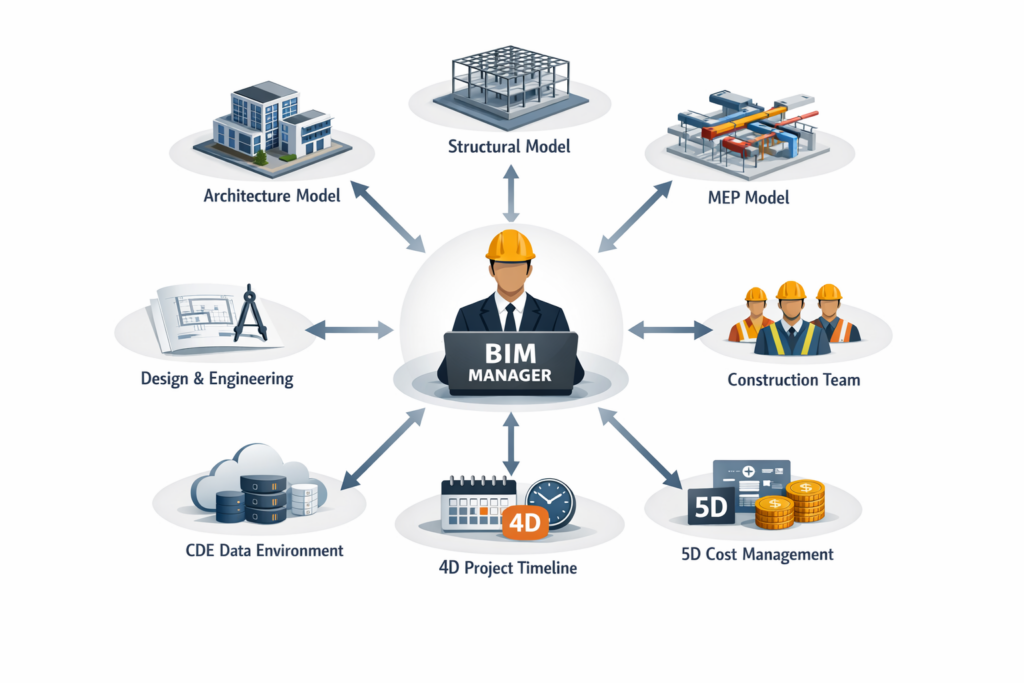
Core Responsibilities of a BIM Manager Explained
The responsibilities of a BIM Manager can be grouped into five major categories: strategy, coordination, data management, compliance, and leadership.
1. Strategy & Planning
The BIM Manager defines how BIM will be used in the project. This includes:
- Developing BIM Execution Plans
- Setting project goals for digital delivery
- Defining Level of Information Need (LOIN)
For example, in a hospital project, BIM may be used not just for design coordination but also for asset management post-construction.
2. Model Coordination
They ensure all discipline models integrate seamlessly. This includes:
- Running clash detection (e.g., HVAC vs structural beams)
- Resolving coordination issues before construction
- Maintaining federated models
3. Data & Information Management
BIM is not just geometry—it’s data. The BIM Manager ensures:
- Correct parameter usage
- Structured data for facility management
- Version control across teams
4. Standards & Compliance
Projects often follow national or international BIM standards. The BIM Manager enforces:
- ISO 19650 compliance
- Company-specific BIM guidelines
- Naming conventions and file structures
5. Team Leadership & Support
They act as a bridge between technical teams and management by:
- Training team members on BIM tools
- Supporting troubleshooting
- Facilitating collaboration meetings
This mix of responsibilities makes the BIM Manager both a technical expert and a strategic leader.
Why BIM Managers Are Critical for Modern Construction Projects
Modern construction projects are more complex than ever. Multiple stakeholders, tight deadlines, and increasing demand for sustainability make coordination difficult without a centralized digital strategy.
This is where the BIM Manager becomes indispensable.
Without BIM management:
- Teams work in silos
- Data becomes inconsistent
- Errors are discovered late (costly fixes)
With a BIM Manager:
- All stakeholders work from a unified model
- Conflicts are resolved before construction
- Decisions are based on real-time data
For example, in a high-rise building project, a BIM Manager can identify that a duct clashes with a beam before construction begins. Fixing this digitally takes minutes—fixing it on-site can cost thousands and delay schedules.
They also play a key role in sustainability. BIM Managers help teams simulate energy performance, optimize material usage, and reduce waste.
Projects using structured BIM management report up to 20% cost savings due to reduced errors and improved planning.
Additionally, BIM Managers enable digital transformation in construction by integrating technologies like:
- Cloud collaboration platforms
- AI-driven clash detection
- IoT-enabled digital twins
Their presence ensures that projects are not just built—but built intelligently.
BIM Manager vs BIM Coordinator vs BIM Modeler
One of the most common sources of confusion in the industry is the difference between BIM roles. While all three work within the BIM ecosystem, their responsibilities vary significantly.
| Role | Focus Area | Key Responsibility |
|---|---|---|
| BIM Manager | Strategy & Leadership | Defines BIM processes and oversees implementation |
| BIM Coordinator | Coordination | Manages model integration and clash detection |
| BIM Modeler | Execution | Creates and updates BIM models |
BIM Manager
The BIM Manager operates at a high level. They define standards, manage workflows, and ensure compliance. They rarely model but oversee everything.
BIM Coordinator
The coordinator works under the BIM Manager. They handle day-to-day coordination tasks like clash detection and model reviews.
BIM Modeler
Modelers create the actual 3D models using software like Revit. They follow the guidelines set by the BIM Manager.
Think of it like a construction hierarchy:
- BIM Manager = Project strategist
- BIM Coordinator = Site supervisor
- BIM Modeler = Skilled worker
Each role is essential, but the BIM Manager ensures that all parts work together efficiently.
In large-scale projects, a single BIM Manager may oversee 10–50+ modelers and multiple coordinators.
Key Skills Required to Become a Successful BIM Manager
A BIM Manager is not just a software expert—they are a hybrid professional combining technical mastery, strategic thinking, and leadership. The role demands a wide skill set that goes beyond modeling.
1. Technical Expertise
A BIM Manager must deeply understand BIM tools and platforms such as Revit, Navisworks, and cloud-based Common Data Environments (CDEs). However, knowing software is just the baseline. They must also understand:
- Model structuring and data schemas
- Interoperability between different software
- Clash detection workflows and automation
For instance, knowing how to export and validate IFC files properly can prevent major coordination breakdowns across teams using different tools.
2. Understanding of Construction & Engineering
Without domain knowledge, BIM becomes just a digital drawing. A BIM Manager must understand:
- Structural systems
- MEP coordination
- Construction sequencing
This allows them to identify real-world issues—not just digital conflicts.
3. Data Management & Information Control
Modern BIM is data-driven. A BIM Manager must handle:
- Metadata standards
- Asset tagging systems
- Information lifecycle management
This becomes especially important in facility management, where inaccurate data can affect operations long after construction ends.
4. Leadership & Communication
A BIM Manager coordinates multiple teams with different priorities. Strong communication skills are essential to:
- Resolve conflicts
- Conduct coordination meetings
- Align stakeholders
5. Problem-Solving Mindset
Every project presents unique challenges. BIM Managers must think proactively and solve issues before they escalate.
The most successful BIM Managers spend less than 20% of their time modeling—and over 80% on coordination, strategy, and communication.
BIM Manager Responsibilities Across Project Lifecycle
The role of a BIM Manager evolves across different stages of a project. Their involvement is continuous—from concept to facility management.
1. Pre-Design Phase
At this stage, the BIM Manager sets the foundation:
- Define BIM goals and uses
- Establish project standards
- Create BIM Execution Plan (BEP)
This stage is critical because poor planning leads to confusion later.
2. Design Phase
During design, the BIM Manager ensures:
- Models are developed correctly
- Coordination between disciplines is smooth
- Clash detection is performed regularly
For example, in a commercial complex, they ensure electrical conduits don’t conflict with HVAC systems.
3. Construction Phase
Here, BIM becomes a decision-making tool:
- 4D simulations for scheduling
- Model updates reflecting site conditions
- Coordination with contractors
The BIM Manager ensures that site teams trust the model as a reliable reference.
4. Post-Construction / Facility Management
After handover, BIM data is used for:
- Maintenance planning
- Asset tracking
- Digital twin creation
A well-managed BIM process ensures that the building continues to deliver value long after completion.
Facilities using BIM-based asset management can reduce maintenance costs by up to 15%.
How BIM Managers Improve Project Efficiency and Reduce Costs
The financial impact of a BIM Manager is one of the strongest arguments for their importance.
1. Clash Detection Saves Money
Identifying conflicts before construction avoids expensive rework. For example:
- Fixing a clash digitally = minutes
- Fixing on-site = days + labor + material costs
2. Improved Scheduling with 4D BIM
BIM Managers integrate time into models, allowing teams to visualize construction sequences. This:
- Reduces delays
- Improves planning
- Identifies risks early
3. Accurate Cost Estimation with 5D BIM
By linking cost data with models:
- Quantity takeoffs become automated
- Budget tracking improves
- Cost overruns are minimized
4. Better Collaboration
A centralized CDE ensures:
- Everyone works on updated data
- Miscommunication is reduced
- Decisions are faster
5. Reduced Waste & Increased Sustainability
BIM Managers optimize material usage and reduce waste through precise planning.
Construction waste can be reduced by up to 30% when BIM is properly implemented and managed.
BIM Standards and Protocols a BIM Manager Must Follow
Standardization is the backbone of successful BIM implementation. Without it, projects become chaotic.
1. ISO 19650 Framework
This is the global standard for information management in BIM. It defines:
- Data organization
- Information delivery cycles
- Roles and responsibilities
A BIM Manager ensures that all teams follow this structure.
2. BIM Execution Plan (BEP)
The BEP is the project’s BIM roadmap. It includes:
- Modeling guidelines
- Naming conventions
- Data exchange protocols
3. Level of Development (LOD)
LOD defines how detailed a model should be at each stage:
- LOD 100: Concept
- LOD 300: Detailed design
- LOD 500: As-built
The BIM Manager ensures that models meet the required LOD at the right time.
4. Common Data Environment (CDE)
A CDE is a centralized platform where all project data is stored. The BIM Manager:
- Controls access
- Manages versioning
- Ensures data integrity
5. Interoperability Standards
Different teams use different tools. The BIM Manager ensures seamless data exchange using formats like IFC.
Poor data management—not design errors—is responsible for a significant portion of project delays.
Common Mistakes to Avoid
Even experienced teams struggle with BIM when the role of a BIM Manager is misunderstood or poorly executed. Avoiding these mistakes can significantly improve project outcomes.
1. Treating BIM as Just 3D Modeling
One of the biggest mistakes is assuming BIM is only about creating 3D models. This limits its potential. BIM is about information management, not just visualization. When teams ignore data structuring, they lose the real value—cost control, scheduling, and lifecycle management.
2. Lack of Clear BIM Execution Plan (BEP)
Starting a project without a well-defined BEP leads to confusion. Teams may use different standards, naming conventions, or modeling approaches. This results in inconsistencies and coordination issues later.
3. Poor Communication Between Teams
Even with advanced tools, lack of communication can break workflows. BIM Managers must ensure regular coordination meetings and clear issue tracking. Without this, clashes remain unresolved until construction.
4. Ignoring Data Quality
Incorrect parameters, missing information, or outdated models can make BIM unreliable. A BIM Manager must enforce strict quality checks. Otherwise, decisions based on faulty data can lead to costly errors.
5. Late BIM Implementation
Introducing BIM mid-project reduces its effectiveness. BIM should start at the planning stage. Late adoption often results in incomplete integration and missed benefits.
Expert Tips to Remember
To truly maximize the value of a BIM Manager, these expert-level strategies make a measurable difference.
1. Focus on Information, Not Just Models
Always prioritize data accuracy over visual perfection. A clean dataset is more valuable than a visually detailed but inaccurate model.
2. Automate Repetitive Tasks
Use scripts and automation tools to:
- Validate models
- Check naming conventions
- Detect clashes faster
This saves time and reduces human error.
3. Align BIM Goals with Project Goals
BIM should not exist in isolation. Whether the goal is cost reduction, faster delivery, or sustainability—BIM processes must support it directly.
4. Invest in Team Training
Even the best BIM strategy fails if teams don’t understand it. Regular training ensures consistency and improves adoption across disciplines.
5. Use BIM for Lifecycle Value
Think beyond construction. Plan BIM for:
- Facility management
- Maintenance
- Future renovations
Buildings spend nearly 80% of their lifecycle cost in operation—not construction—making BIM data crucial long-term.
FAQs
1. What is the main responsibility of a BIM Manager?
The primary responsibility of a BIM Manager is to oversee and manage BIM processes across a project. This includes setting standards, coordinating models, ensuring data quality, and enabling collaboration between teams.
2. Is a BIM Manager a technical or managerial role?
It is a hybrid role. A BIM Manager must have strong technical knowledge of BIM tools while also managing teams, workflows, and project strategies.
3. Do BIM Managers need to know coding?
Coding is not mandatory, but it is highly beneficial. Knowledge of scripting (like Dynamo or Python) helps automate tasks and improve efficiency.
4. What software do BIM Managers use?
Common tools include Revit, Navisworks, and cloud-based collaboration platforms. They may also use data management and visualization tools depending on project needs.
5. How is a BIM Manager different from a project manager?
A BIM Manager focuses on digital processes and information management, while a project manager oversees overall project delivery, including budget, schedule, and resources.
6. Can small projects benefit from a BIM Manager?
Yes. Even small projects benefit from better coordination, reduced errors, and improved efficiency when BIM is properly managed.
7. What qualifications are required to become a BIM Manager?
Typically, a background in architecture, engineering, or construction is required, along with experience in BIM tools and workflows.
8. Is BIM Manager a high-demand job?
Yes. As digital construction grows, demand for skilled BIM Managers continues to increase across industries.
9. What is a BIM Execution Plan (BEP)?
A BEP is a document that defines how BIM will be implemented on a project, including standards, workflows, and responsibilities.
10. How does a BIM Manager improve project outcomes?
They reduce errors, improve coordination, optimize costs, and ensure reliable data—leading to faster and more efficient project delivery.
Conclusion
The role of a BIM Manager has evolved into one of the most critical positions in modern construction and infrastructure projects. They are no longer just technical specialists—they are strategic leaders who ensure that digital processes translate into real-world efficiency.
By managing workflows, enforcing standards, and enabling collaboration, BIM Managers eliminate costly errors before they happen. Their ability to turn complex data into actionable insights makes projects faster, smarter, and more predictable.
From planning to facility management, their impact spans the entire lifecycle. Projects without strong BIM leadership often struggle with coordination, delays, and inconsistent data. In contrast, projects led by skilled BIM Managers consistently achieve better outcomes in cost, time, and quality.
Key Takeaways
- A BIM Manager controls the entire digital workflow of a project, not just 3D models
- They ensure coordination, data accuracy, and compliance with standards
- Their role reduces rework, delays, and overall project costs
- BIM Managers bridge the gap between technology and construction teams
- Their impact continues beyond construction into facility management
- Strong BIM leadership is essential for successful modern projects