

Are you gearing up for a structural design engineer interview? Feeling a bit nervous about the technical questions they might throw at you? Don’t worry, you’re not alone. Interviews can feel like a roller coaster ride, but with the right prep, you can totally ace it. I’ve done my homework and gathered the top 50 questions that often come up in these interviews — along with detailed, clear answers. Let’s dive right in!
1. What is the difference between stress and strain in structural engineering?
Stress and strain are fundamental concepts in structural design. Stress is the force applied on a material per unit area (like pushing or pulling on a beam). Think of it as how hard you’re squeezing or stretching something. It’s measured in Pascals (Pa).
On the other hand, strain is the deformation or change in shape that occurs because of that stress. Imagine stretching a rubber band — the more you stretch it, the higher the strain. Strain is dimensionless because it’s the ratio of change in length to the original length.
In simpler terms:
- Stress = How much force you apply.
- Strain = How much the material bends or stretches because of that force.
Knowing these helps you understand if a structure can hold up under load without breaking or bending too much.
2. How do you calculate the bending moment in a simply supported beam?
The bending moment is crucial because it tells you how much a beam will bend under a load. For a simply supported beam (one resting on two supports), the bending moment depends on where the load is applied.
Say you have a beam of length L with a point load P in the middle. The maximum bending moment at the center is:
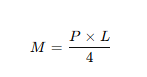
This formula means the load times the span length, divided by 4. If the load is not at the center, you calculate the moments at points to find the max.
Think of the beam like a diving board — the further out you stand, the more it bends. Bending moments tell us where the board might snap or flex too much.
3. What are the different types of loads considered in structural design?
Loads are the forces that act on structures. They fall mainly into these categories:
- Dead loads: These are permanent, like the weight of the building materials themselves — walls, beams, floors. They don’t change.
- Live loads: Temporary loads like people, furniture, or cars. These can vary over time.
- Environmental loads: Wind, earthquake forces, snow — nature’s wild cards.
- Dynamic loads: Loads that change rapidly like machinery vibrations or impacts.
Why does this matter? Because structures must be designed to safely handle all these loads without failure. It’s like packing a suitcase: you need to know what you’re putting in to avoid breaking the zipper.
4. How do you ensure the safety factor in structural design?
A safety factor is like a cushion — it’s the extra strength designed into a structure beyond the expected loads. Engineers don’t just design for the max load; they add safety to prevent failures due to uncertainties.
For example, if the max load is 1000 kg, and the safety factor is 2, the structure should safely hold 2000 kg.
How do you decide the safety factor? It depends on the material, usage, risk level, and codes. Steel might have a lower safety factor than concrete due to its predictable behavior.
In essence, safety factors make sure your bridge or building doesn’t just barely stand but stays strong even if unexpected things happen.
5. What is the difference between moment of inertia and section modulus?
Both terms are vital in structural calculations but serve different roles.
- Moment of inertia (I): Measures a shape’s resistance to bending or deflection. Bigger I means less bending. It depends on the shape and size of the cross-section.
- Section modulus (S): Is derived from moment of inertia and tells you how strong a beam section is in bending. It relates bending moment to stress.
A simple metaphor:
If the beam was a tree branch, the moment of inertia tells you how stiff the branch is. The section modulus tells you how much load it can take before snapping.
Knowing both helps you pick the right beam size and shape for a given load.
6. How do you analyze a statically indeterminate structure?
Statically indeterminate structures have more unknown forces than equations of equilibrium can solve. That means you can’t figure out internal forces with just static equations.
So, what’s the trick? Use compatibility conditions along with material behavior — in other words, apply structural analysis methods like:
- Force method: Guess redundant forces, then use deformation compatibility to solve.
- Displacement method: Calculate displacements to find forces (common in software).
- Finite element analysis (FEA): A numerical approach breaking down the structure into smaller elements.
In short, you need extra math tools beyond basic statics. It’s like solving a mystery with extra clues — more complex, but doable.
7. What are the main differences between steel and concrete structures?
Steel and concrete are two giants in structural design. Here’s the lowdown:
- Steel: Strong, ductile, and flexible. It can bend a lot before breaking, making it great for tall buildings or bridges. It’s lighter than concrete but prone to corrosion.
- Concrete: Strong in compression but weak in tension. It’s heavy and brittle but can be reinforced with steel bars (rebar) to handle tension. It’s fire-resistant and cost-effective.
Choosing between them depends on project needs — steel for flexibility and speed, concrete for durability and mass.
8. What is the significance of load path in structural design?
Load path is the route the loads take from where they are applied down to the ground. Think of it like water flowing downhill.
If the load path is clear and direct, the structure efficiently transfers forces safely. If it’s not, stress can build up in unexpected places causing damage or failure.
Imagine a domino chain: if one piece is out of place, the whole line falls. Same with load paths — missing or weak links can cause trouble.
Designing good load paths ensures the building stands strong and stable.
9. How do you determine the natural frequency of a structure?
Natural frequency is the rate at which a structure vibrates when disturbed. Every structure has its own natural frequency, like a tuning fork’s pitch.
Why care? If external forces like wind or earthquakes match this frequency, the structure can experience resonance — vibrations grow bigger and can cause failure.
Calculating natural frequency involves mass and stiffness of the structure, generally using formulas like:
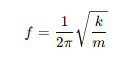
Where k is stiffness and m is mass.
In practice, engineers use software and models to find this and design to avoid resonance problems.
10. What software tools do you prefer for structural design and why?
Software is a structural engineer’s best friend. Some popular ones are:
- AutoCAD: Great for drawing plans.
- STAAD.Pro: Used for analysis and design of steel and concrete structures.
- ETABS: Focuses on building analysis, especially high-rises.
- SAP2000: General structural analysis tool.
- Revit: For BIM (Building Information Modeling), combining design and documentation.
Why these? They save tons of time, reduce errors, and help visualize complex designs. I personally love STAAD.Pro for its ease in analyzing different materials and load cases.
Do You Know?
- The safety factor in structural engineering often ranges from 1.5 to 3, depending on material and code requirements.
- The first documented use of steel in structures was in the 19th century, revolutionizing construction.
- Load paths can sometimes be indirect, causing hidden stress points — that’s why engineers do detailed analyses.
11. What is the difference between ductile and brittle materials?
Ductile materials can stretch or deform significantly before breaking. Imagine bending a metal wire until it twists without snapping — that’s ductility. Steel is a classic ductile material.
Brittle materials, like glass or unreinforced concrete, break suddenly without much deformation. Think of cracking a dry twig: it snaps instead of bending.
Why does this matter? Ductile materials warn you before failure (they bend), while brittle materials fail abruptly, which can be dangerous. Engineers often design structures to be ductile for safety.
12. What is the purpose of reinforcement in concrete?
Concrete is great at handling compression but weak under tension. To fix this, engineers add steel reinforcement bars (rebar).
Reinforcement helps the concrete resist tensile forces, improve ductility, and control cracking. Think of it as the skeleton inside the concrete body, giving it strength and flexibility.
Without reinforcement, concrete beams or slabs would crack and fail easily when bent or stretched.
13. How do you perform a load combination analysis?
Load combinations consider different loads acting together, like dead load + live load + wind load. Since loads rarely act alone, engineers combine them based on codes to check worst-case scenarios.
For example, one common load combination (as per many codes) is:

Or for wind:

This ensures the structure can safely handle any realistic combination of forces.
14. What is lateral stability, and why is it important?
Lateral stability means a structure’s ability to resist sideways forces, like wind or earthquakes, that push it off balance.
Without lateral stability, a tall building or bridge might sway dangerously or even collapse sideways. Engineers use bracing, shear walls, or moment frames to keep structures stable laterally.
Think of it like standing with your feet apart for balance — the wider your stance, the less likely you fall over.
15. How do you determine the slenderness ratio, and why does it matter?
Slenderness ratio compares the length of a column to its radius of gyration (a property linked to cross-section shape). It’s calculated as:

This ratio helps predict whether a column will fail by buckling (bending sideways) rather than crushing.
High slenderness means the column is long and thin, so it’s more likely to buckle. Lower slenderness means it’s stiffer and stronger.
16. What is shear force, and how is it different from bending moment?
Shear force is the force that tries to slice through a beam, like scissors cutting paper. It acts vertically along the beam.
Bending moment, however, tries to bend the beam around a point, causing it to curve or flex.
In a beam under load, shear force is highest near supports, while bending moment is highest near the middle.
Both are key to designing safe beams, but they affect different failure modes.
17. How do you design a retaining wall to resist earth pressure?
Retaining walls hold back soil, so they must resist lateral earth pressure pushing against them.
Design involves calculating earth pressure (using Rankine or Coulomb theories), considering soil weight, water pressure, and surcharge loads.
Engineers design the wall’s thickness, base width, and reinforcement to resist sliding, overturning, and soil bearing failure.
Imagine holding back a pile of sand — your wall must be strong enough not to tip or slide under the force.
18. What are the common types of foundations, and when do you use them?
Foundations transfer loads from the structure to the ground. Common types include:
- Shallow foundations: Like spread footings or raft foundations, used when soil near surface is strong.
- Deep foundations: Like piles or drilled shafts, used when surface soil is weak or loads are heavy.
Choosing the right foundation depends on soil condition, load magnitude, and type of structure.
19. What is creep in concrete, and why is it important in design?
Creep is the slow, long-term deformation of concrete under sustained load.
Even if the load stays constant, concrete keeps deforming slowly over months or years, which can cause deflection or cracking.
Designers must consider creep to ensure long-term safety and serviceability, especially in bridges and tall buildings.
20. How do you check for deflection in beams?
Deflection is how much a beam bends under load. Too much deflection can cause structural or cosmetic issues.
Engineers calculate deflection using formulas or software based on load, beam material, and shape.
For example, for a simply supported beam with a point load in the center:
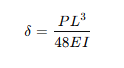
Where:
- P = Load
- L = Length of beam
- E = Modulus of elasticity
- I = Moment of inertia
Limits on deflection depend on codes and use — like floors shouldn’t sag noticeably under people’s weight.
Do You Know?
- Concrete can creep up to 0.1% strain over years — tiny but important for big structures.
- Lateral stability problems caused the Tacoma Narrows Bridge collapse in 1940 — a classic engineering lesson.
- The slenderness ratio is why really tall buildings have thick lower columns to avoid buckling.
21. What is the difference between elastic and plastic deformation?
Elastic deformation is temporary — like a rubber band stretching and snapping back. When you remove the load, the material returns to its original shape.
Plastic deformation is permanent — like bending a paperclip. Once the load passes a certain limit (called the yield point), the material stays deformed even after the load is gone.
In structural design, staying within elastic limits ensures safety, while plastic deformation might lead to failure.
22. How do you determine the critical buckling load of a column?
The critical buckling load is the load at which a column suddenly bends and fails. Euler’s formula is used:
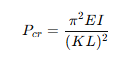
Where:
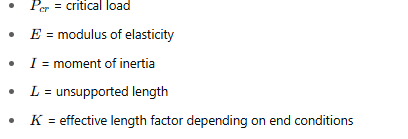
This formula assumes a perfect, slender column. It helps predict when buckling will happen.
23. What are the types of stresses that develop in a curved beam?
Curved beams don’t behave like straight ones. They experience:
- Bending stress: Varies across the section, not linear like straight beams.
- Radial stress: Acts perpendicular to the curved surface.
- Tangential stress: Along the beam’s length, due to bending.
Because of this complexity, curved beams require special formulas or software for analysis.
24. What is the difference between plastic hinge and moment connection?
A plastic hinge is a point in a structure where the material yields and rotates like a hinge under load, allowing redistribution of moments.
Moment connections are rigid connections that resist rotation, transmitting moments between beams and columns.
Understanding these helps design structures to either allow controlled rotation (ductile behavior) or remain rigid.
25. How does thermal expansion affect structural design?
Materials expand or contract with temperature changes. Thermal expansion can cause stresses or deformation if not accounted for.
Engineers include expansion joints or allow movement in connections to avoid cracks or buckling due to temperature shifts.
Think of railroad tracks — without expansion joints, heat would warp them.
26. What are the main types of beams, and how do you choose between them?
Common beam types:
- Simply supported beams: Supported at both ends, free to rotate.
- Cantilever beams: Fixed at one end, free at the other.
- Continuous beams: Extend over more than two supports.
- Fixed beams: Both ends fixed, resist rotation.
Choice depends on structure layout, load, span, and support conditions.
27. How do you account for earthquake loads in structural design?
Earthquake loads are dynamic and unpredictable. Engineers use seismic design codes that require:
- Designing structures to withstand lateral forces.
- Using ductile materials and connections.
- Incorporating base isolators or dampers to absorb energy.
The goal is to prevent collapse and minimize damage during shaking.
28. What is strain energy, and why is it important?
Strain energy is the energy stored in a structure as it deforms elastically. It’s like a stretched spring storing energy.
This concept is important for methods like Castigliano’s theorem to calculate deflections and internal forces.
Understanding strain energy helps in more advanced structural analysis.
29. What is the difference between first-order and second-order analysis?
First-order analysis assumes small deformations — the structure’s geometry doesn’t change under load.
Second-order analysis accounts for large deformations and stability effects — changes in geometry affect forces.
For tall or slender structures, second-order effects are important to avoid unsafe designs.
30. What factors influence the choice of structural material?
Several factors, including:
- Strength and stiffness needed.
- Environmental conditions (corrosion, temperature).
- Cost and availability.
- Construction speed.
- Maintenance needs.
For example, steel is preferred for fast construction and high strength, while concrete is durable and fire-resistant.
Do You Know?
- Plastic hinges are key to designing earthquake-resistant frames by allowing energy dissipation.
- Thermal expansion coefficients vary: steel expands roughly 12×10^-6 /°C, concrete less so.
- Second-order effects can increase moments by 10-30% in tall buildings!
31. What is the significance of the factor of safety (FoS) in structural design?
The factor of safety (FoS) is a multiplier applied to account for uncertainties in loads, materials, and construction quality. It ensures the structure won’t fail under unexpected conditions.
For example, if a beam can safely carry 1000 kg and the FoS is 1.5, the design load would be limited to around 666 kg to add a safety buffer.
FoS protects against errors, material defects, and unforeseen stresses, making designs more reliable.
32. How do you calculate bending stress in a beam?
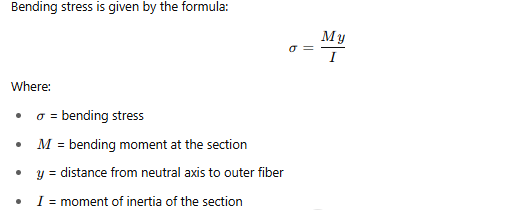
This formula helps predict whether the beam will fail due to bending.
33. What is the difference between serviceability and ultimate limit states?
- Serviceability Limit State (SLS): Ensures the structure remains usable and comfortable — limiting deflection, vibration, and cracking.
- Ultimate Limit State (ULS): Focuses on safety — preventing collapse or failure under maximum loads.
Engineers design structures to satisfy both limits.
34. How do you design a beam for shear reinforcement?
Shear reinforcement (like stirrups) is added to resist shear forces and prevent diagonal cracking.
Design steps:
- Calculate shear force at critical sections.
- Determine nominal shear strength of concrete.
- Provide additional stirrups if shear force exceeds concrete capacity.
This keeps the beam safe against sliding failures.
35. What is the purpose of camber in beams?
Camber is a slight upward curve introduced during beam fabrication to counteract deflection under load.
It ensures that when loaded, the beam levels out rather than sags.
Think of it as pre-arching a beam to improve appearance and performance.
36. How do you analyze load distribution in a slab?
Slabs distribute loads to supporting beams or columns.
Analysis methods include:
- One-way slab: Load flows in one direction; supported on two opposite sides.
- Two-way slab: Load flows in two directions; supported on all sides.
Engineers calculate reactions and moments accordingly.
37. What is the importance of moment of inertia in beam design?
Moment of inertia (I) quantifies a section’s resistance to bending.
Higher III means the beam bends less under the same load.
It depends on shape and size of the cross-section, crucial for designing beams that are stiff and strong.
38. How do you design against buckling in slender columns?
To prevent buckling:
- Use shorter column lengths or bracing.
- Increase cross-sectional area or change shape for higher moment of inertia.
- Use appropriate end conditions to reduce effective length.
Checking slenderness ratio helps decide when buckling controls design.
39. What are the different types of loads considered in structural design?
- Dead loads: Permanent, like structure’s own weight.
- Live loads: Temporary, like people or furniture.
- Wind loads: Horizontal forces from wind pressure.
- Seismic loads: Forces from earthquakes.
- Thermal loads: Expansion or contraction due to temperature changes.
- Snow loads: Accumulated snow weight in cold regions.
Design codes guide how to combine these for safety.
40. How does reinforced concrete behave under load?
Reinforced concrete combines concrete’s strength in compression with steel’s strength in tension.
Under load:
- Concrete carries compressive forces.
- Steel reinforcement resists tension forces.
Together, they allow concrete structures to be strong, durable, and ductile.
41. What is moment redistribution in reinforced concrete design?
Moment redistribution allows engineers to adjust calculated bending moments in continuous beams or frames, transferring moments from highly stressed regions to less stressed areas.
This technique leverages the ductility of concrete and steel, allowing the structure to better handle loads without over-reinforcing every section.
Codes often permit limited redistribution to optimize material use and reduce costs, but care must be taken to maintain safety.
42. How do you calculate deflection in beams?
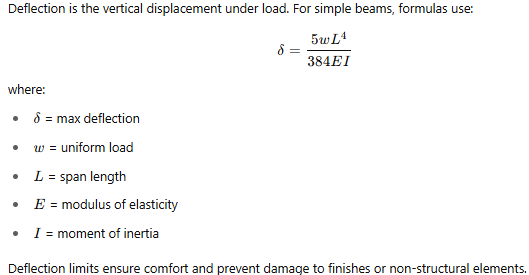
43. What is shear force and bending moment diagram?
Shear force and bending moment diagrams graphically show how internal forces vary along a beam’s length.
- Shear force diagram indicates where shear forces peak, critical for designing stirrups.
- Bending moment diagram shows maximum moments where reinforcement is needed.
Drawing these helps visualize load effects and design appropriate reinforcements.
44. What is the difference between a portal frame and a braced frame?
- Portal frames are rigid frames with fixed joints designed to resist moments and shear.
- Braced frames use diagonal braces to resist lateral loads mainly through axial forces in the braces.
Portal frames provide flexibility in openings; braced frames are generally stiffer and lighter but restrict openings.
45. What are the main failure modes of a concrete beam?
Common failure modes include:
- Flexural failure: Concrete crushes or steel yields in bending.
- Shear failure: Sudden diagonal cracking due to shear forces.
- Bond failure: Steel slipping from concrete.
Proper design ensures the beam fails in a ductile flexural mode, not brittle shear.
46. How do you select appropriate cross-sectional shapes for beams?
Considerations include:
- Moment of inertia for stiffness.
- Ease of construction and fabrication.
- Load type and direction.
- Aesthetic and space constraints.
Common shapes: rectangular, I-beam, T-beam, box section.
I-beams are popular for their high stiffness-to-weight ratio.
47. What is the difference between statically determinate and indeterminate structures?
- Statically determinate: Internal forces can be found using equilibrium equations alone.
- Statically indeterminate: Extra supports or connections require compatibility equations or advanced analysis.
Indeterminate structures are more common today due to their better strength and stability but need computer analysis.
48. How does creep affect concrete structures?
Creep is the slow deformation of concrete under sustained load over time.
It can cause long-term deflections and redistribution of stresses.
Engineers account for creep in design by using reduced modulus values or limiting stresses.
49. What is the difference between uniform and concentrated loads?
- Uniform load: Spread evenly over length or area, like a floor’s weight.
- Concentrated load: Applied at a single point, like a heavy machine.
The load type influences stress distribution and design calculations.
50. How do you ensure durability in concrete structures?
Durability depends on:
- Proper mix design with low water-cement ratio.
- Adequate cover to reinforcement.
- Use of corrosion inhibitors.
- Protection from freeze-thaw cycles and chemical attack.
Durability ensures long service life and reduces maintenance.
Conclusion
To wrap it up, mastering the top 10 technical questions for structural design engineer interviews is your ticket to confidence and success. From stress and strain to software tools, knowing these inside out will make you shine. Remember, interviews aren’t just about what you know but how you explain it. Use simple terms, stay calm, and think like an engineer solving a puzzle. Good luck—you got this!
