
Real estate engineering and management professionals serve as the bridge between project vision, technical design, construction execution, budget control, and long-term asset performance. They collaborate closely with architects to ensure designs are technically feasible, financially viable, and aligned with project goals. At the same time, they work with contractors to coordinate construction activities, manage risks, monitor schedules, control costs, and maintain quality standards.
In modern projects, collaboration is no longer limited to meetings and drawings. Digital tools such as Building Information Modeling (BIM), Common Data Environments (CDEs), project dashboards, and construction management platforms allow all stakeholders to work from a single source of truth.
Key collaboration responsibilities include:
- Translating business objectives into technical requirements.
- Coordinating design reviews between architects and engineering teams.
- Managing project budgets, schedules, and procurement activities.
- Resolving design and construction conflicts before they impact the site.
- Ensuring quality, safety, and regulatory compliance throughout the project lifecycle.
A successful project depends on continuous communication, shared accountability, and data-driven decision-making. When architects focus on design excellence, contractors focus on construction execution, and real estate engineering managers coordinate both sides, projects are more likely to be delivered on time, within budget, and according to quality expectations.
The most effective collaboration occurs when all stakeholders are involved early, communicate regularly, and use integrated workflows rather than working in isolated departments.
Let’s explore it further below.
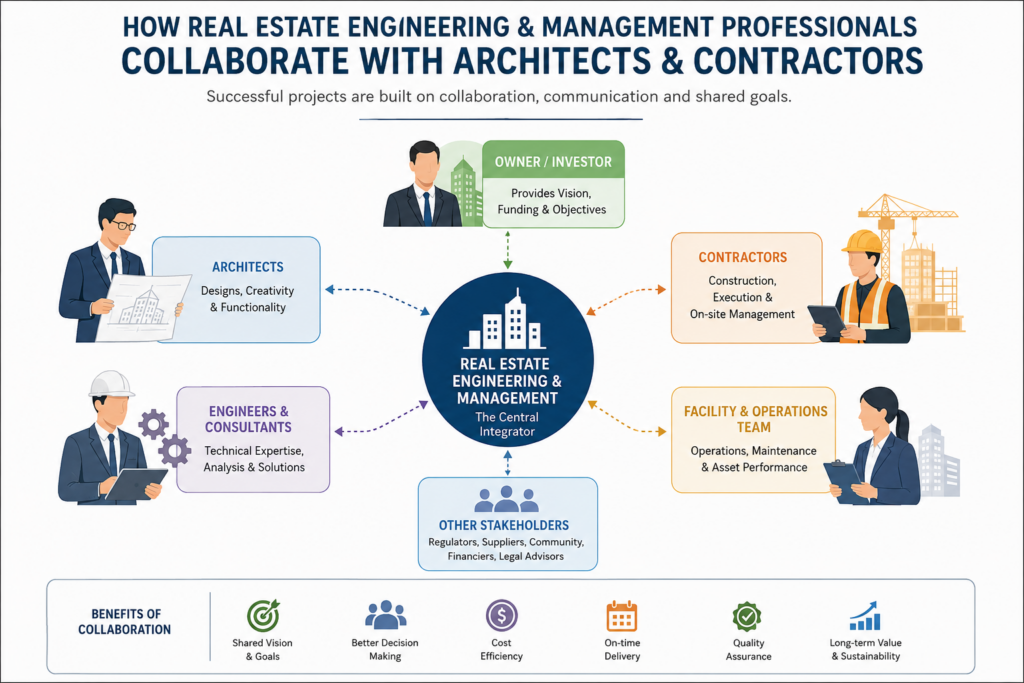
What Is Real Estate Engineering and Management?
Real estate engineering and management is the discipline that combines technical engineering expertise, project management principles, financial planning, construction coordination, and asset lifecycle management. Its primary objective is to transform a development concept into a functional, profitable, and sustainable built asset.
Unlike traditional engineering disciplines that focus solely on design and technical calculations, real estate engineering and management takes a broader view. Professionals in this field oversee the entire development process, including planning, design coordination, budgeting, construction oversight, stakeholder management, operations planning, and long-term asset performance.
A modern development project involves dozens of stakeholders. Architects create designs, structural engineers develop building systems, contractors construct the project, consultants provide specialized expertise, investors fund development, and facility managers operate the completed asset. Real estate engineering managers ensure these stakeholders work toward common objectives.
Their responsibilities often include:
| Area | Responsibility |
|---|---|
| Planning | Feasibility studies and project strategy |
| Design | Design coordination and reviews |
| Construction | Monitoring execution and quality |
| Finance | Budget control and cost management |
| Risk | Identifying and mitigating project risks |
| Operations | Asset lifecycle planning |
Consider a commercial office tower project. Architects may envision an iconic façade, while contractors focus on constructability and installation methods. Investors prioritize profitability, while facility operators seek lower maintenance costs. Real estate engineering managers balance all these requirements to achieve the best overall outcome.
This multidisciplinary role has become increasingly important because projects today are more complex than ever. Sustainability targets, digital workflows, regulatory requirements, and stakeholder expectations require constant coordination across multiple disciplines.
Without real estate engineering and management professionals, projects often suffer from communication gaps, budget overruns, schedule delays, and design conflicts.
Why Collaboration Is Critical in Modern Construction Projects
Construction projects involve thousands of interconnected decisions. A small change in one area can trigger significant consequences elsewhere. This is why collaboration between architects, contractors, and real estate engineering professionals has become a fundamental requirement rather than a desirable practice.
Historically, many projects followed a linear workflow. Architects completed designs, contractors received drawings, and construction began. Problems were often discovered only after work had started on-site.
This approach created several challenges:
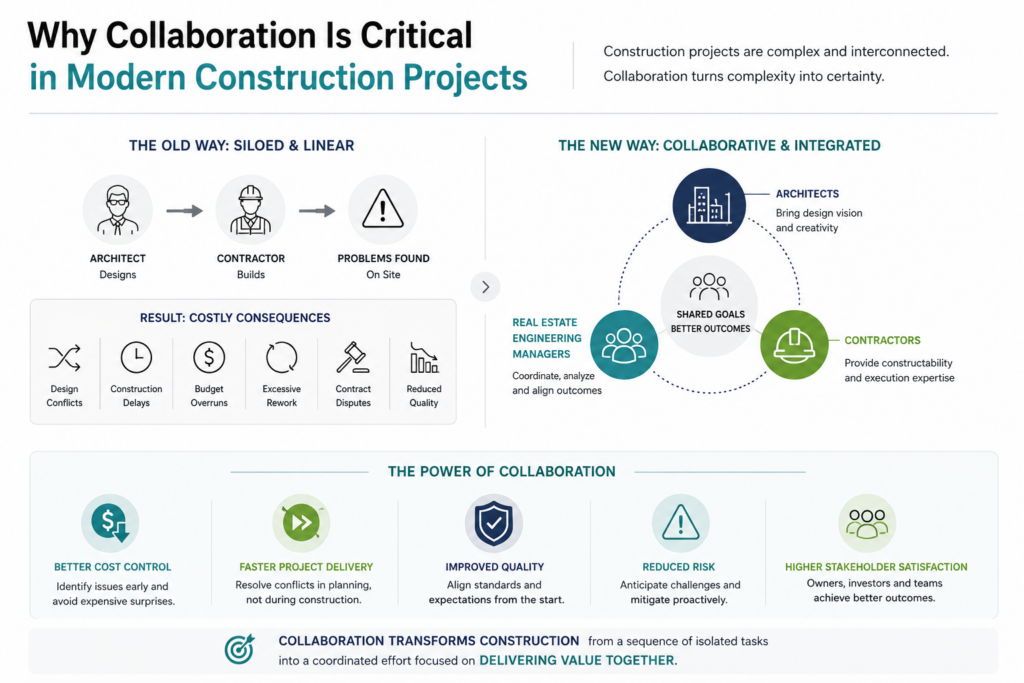
- Design conflicts.
- Construction delays.
- Budget overruns.
- Excessive rework.
- Contract disputes.
- Reduced project quality.
Today’s projects require a much more integrated approach.
For example, an architect may specify a complex curtain wall system that achieves aesthetic goals. However, contractors may identify installation challenges, procurement risks, or schedule impacts. Real estate engineering managers facilitate discussions between both parties to find solutions before construction begins.
Effective collaboration creates benefits across multiple dimensions:
Better Cost Control
Early coordination helps identify expensive design decisions before procurement and construction activities begin.
Faster Project Delivery
Teams can resolve conflicts during planning instead of dealing with costly changes later.
Improved Quality
Architects, engineers, and contractors align expectations and standards from the beginning.
Reduced Risk
Potential issues are identified and addressed before they become major project obstacles.
Higher Stakeholder Satisfaction
Owners, investors, occupants, and project teams achieve better outcomes through shared objectives.
The shift toward integrated project delivery methods has further reinforced the importance of collaboration. Rather than operating independently, project teams now work together from the earliest planning stages.
This collaborative mindset transforms construction from a sequence of isolated activities into a coordinated effort focused on common goals.
Did You Know? Research across major construction markets consistently shows that design-related changes discovered during construction can cost several times more than issues identified during the planning stage.
The Role of Architects in Collaborative Project Delivery
Architects play a central role in shaping the vision, functionality, and user experience of a development project. Their work extends beyond creating attractive buildings. They must balance aesthetics, functionality, regulations, sustainability, user requirements, and technical feasibility.
In collaborative project environments, architects act as both designers and coordinators.
The design process typically begins with understanding project objectives. Real estate engineering managers provide information regarding budget constraints, development goals, target users, and operational requirements. Architects then translate these objectives into conceptual designs.
Collaboration occurs throughout several design phases:
Concept Development
Architects explore potential design solutions and present options for stakeholder review.
Design Development
Project teams refine layouts, building systems, materials, and performance requirements.
Technical Documentation
Detailed drawings and specifications are prepared for construction.
Construction Support
Architects provide clarifications, review submittals, and respond to site-related questions.
Architects rely heavily on collaboration with real estate engineering managers because design decisions have financial and operational consequences.
For example:
- A premium façade system may increase construction costs.
- Larger spans may affect structural requirements.
- Sustainable features may impact lifecycle costs.
- Complex geometries may create construction challenges.
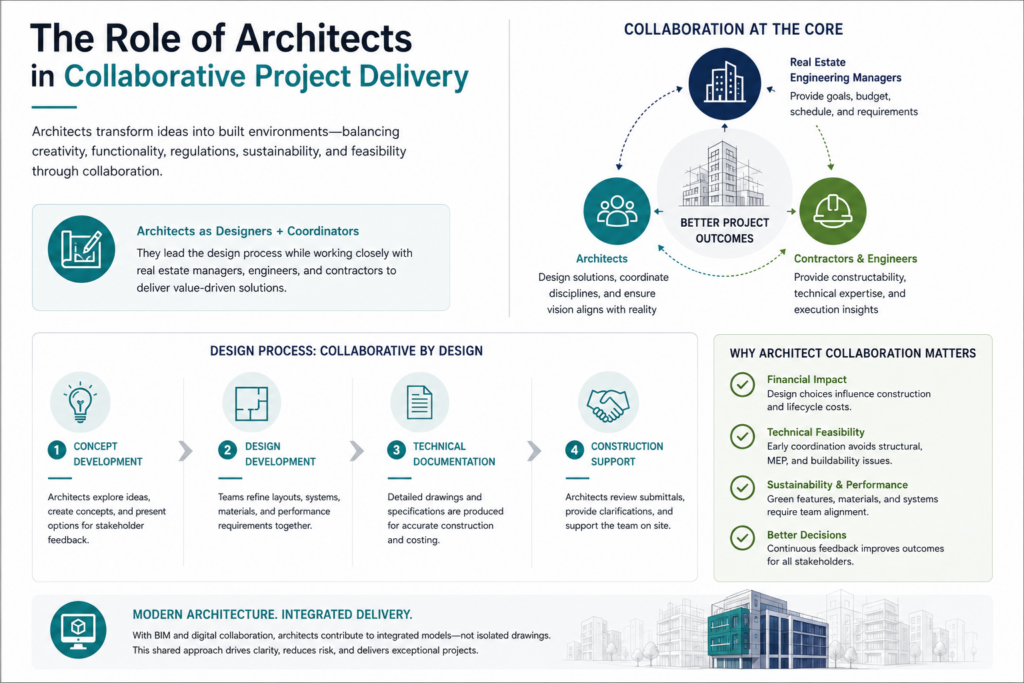
Through continuous coordination, architects gain valuable feedback from contractors and engineering managers regarding constructability, scheduling, and cost implications.
Modern architectural practice increasingly involves multidisciplinary collaboration supported by BIM workflows. Rather than producing isolated drawings, architects now contribute to integrated digital models that allow all stakeholders to visualize and coordinate project information.
This collaborative approach reduces misunderstandings and improves decision-making throughout the project lifecycle.
How Contractors Contribute to Successful Collaboration
Contractors transform design concepts into physical reality. Their expertise extends beyond construction activities to include planning, logistics, procurement, scheduling, resource allocation, quality management, and safety compliance.
In collaborative projects, contractors become active participants during the early stages rather than joining only after design completion.
This early involvement provides significant advantages.
Contractors possess practical knowledge about:
- Construction methods.
- Material availability.
- Labor requirements.
- Site logistics.
- Equipment needs.
- Schedule optimization.
When contractors participate in design discussions, they can identify potential issues before construction begins.
Consider a large residential development. Architects may propose a specific construction sequence based on design considerations. Contractors may recommend alternative approaches that reduce construction duration without compromising quality.
Real estate engineering managers facilitate these discussions by balancing design intent with construction practicality.
Contractors contribute throughout multiple project phases:
| Project Phase | Contractor Contribution |
|---|---|
| Planning | Constructability reviews |
| Design | Cost and schedule feedback |
| Procurement | Material sourcing strategies |
| Construction | Site execution and coordination |
| Handover | Commissioning support |
Effective contractors also play a key role in risk management.
They identify:
- Site constraints.
- Supply chain challenges.
- Safety concerns.
- Weather-related risks.
- Resource limitations.
Through proactive communication, contractors help project teams develop mitigation strategies before problems escalate.
Modern construction environments increasingly rely on digital collaboration tools. Contractors now participate in model reviews, clash detection sessions, issue tracking workflows, and cloud-based project management platforms.
This digital transformation has significantly improved transparency and accountability across project teams.
Did You Know? Some large-scale developments conduct weekly multidisciplinary coordination meetings involving architects, engineers, contractors, procurement teams, and project managers to resolve issues before they affect construction progress.
How Real Estate Engineering Managers Act as the Central Coordinator
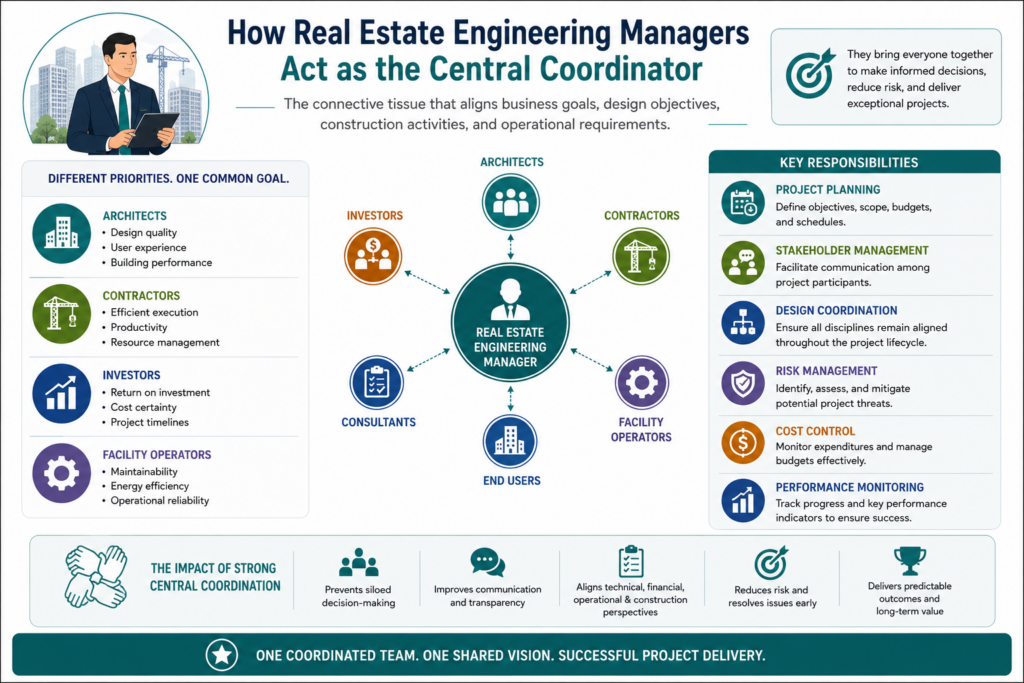
Among all project stakeholders, real estate engineering managers often serve as the primary coordinators responsible for aligning business goals, design objectives, construction activities, and operational requirements.
They function as the connective tissue that links architects, contractors, consultants, investors, and end users.
A major challenge in construction projects is that each stakeholder naturally focuses on different priorities.
Architects prioritize:
- Design quality.
- User experience.
- Building performance.
Contractors prioritize:
- Efficient execution.
- Productivity.
- Resource management.
Investors prioritize:
- Return on investment.
- Cost certainty.
- Project timelines.
Facility operators prioritize:
- Maintainability.
- Energy efficiency.
- Operational reliability.
Real estate engineering managers bring these perspectives together through structured coordination processes.
Their responsibilities typically include:
Project Planning
Defining objectives, scope, budgets, and schedules.
Stakeholder Management
Facilitating communication among project participants.
Design Coordination
Ensuring all disciplines remain aligned.
Risk Management
Identifying and mitigating project threats.
Cost Control
Monitoring expenditures against approved budgets.
Performance Monitoring
Tracking project progress and key performance indicators.
One of their most valuable contributions is preventing siloed decision-making. Instead of allowing teams to work independently, they encourage transparency, collaboration, and shared accountability.
The result is a more predictable project environment where decisions are evaluated from technical, financial, operational, and construction perspectives simultaneously.
This integrated approach significantly improves project outcomes and helps ensure successful delivery.
Did You Know? On highly coordinated projects, a single design modification can automatically update schedules, quantity takeoffs, cost estimates, and construction sequencing information through connected digital workflows.
How Collaboration Begins During the Planning and Feasibility Stage
The foundation of successful collaboration is established long before design drawings are produced or construction activities begin. The planning and feasibility stage is where project stakeholders align expectations, define objectives, assess risks, and determine whether a project is financially and technically viable.
At this stage, real estate engineering and management professionals take the lead in bringing together developers, investors, architects, consultants, and construction specialists.
The primary objective is to answer a critical question:
Can this project be delivered successfully while meeting business, technical, and operational goals?
Several activities occur during this phase.
Market and Demand Analysis
Project teams evaluate:
- Target users
- Occupancy projections
- Revenue potential
- Competitive developments
- Long-term asset value
These findings influence building size, functionality, and project scope.
Site Assessment
Architects and engineers review:
- Topography
- Accessibility
- Utilities
- Environmental conditions
- Regulatory constraints
Early site analysis prevents costly redesigns later.
Preliminary Budgeting
Real estate engineering managers develop initial cost estimates and financial models.
These estimates help architects understand budget boundaries before creating conceptual designs.
Risk Identification
Potential risks are documented, including:
| Risk Category | Examples |
|---|---|
| Financial | Inflation, funding issues |
| Technical | Complex structures |
| Regulatory | Permit delays |
| Environmental | Soil conditions |
| Operational | Maintenance challenges |
When stakeholders collaborate early, projects benefit from realistic expectations and better decision-making.
For example, a proposed mixed-use development may initially include extensive underground parking. During feasibility discussions, contractors may identify excavation challenges while financial analysts highlight cost implications. This feedback can influence design decisions before significant resources are invested.
The planning stage often determines the success or failure of a project. Teams that establish clear communication channels early are better equipped to handle challenges throughout design and construction.
Did You Know? Many project failures can be traced back to decisions made during the planning stage rather than problems encountered during construction itself.
Design Coordination: Where Architects, Engineers, and Managers Work Together
Design coordination is one of the most important collaboration activities in any development project. It is the process of ensuring that architectural, structural, mechanical, electrical, plumbing, fire protection, landscape, and specialty systems work together without conflicts.
Without effective coordination, projects frequently encounter:
- Design clashes
- Rework
- Delays
- Cost overruns
- Site disputes
Real estate engineering managers facilitate coordination meetings where multiple disciplines review designs collectively rather than independently.
Consider a simple example.
An architect may place a feature ceiling in a lobby to create a premium user experience. However, mechanical engineers may require ductwork above that ceiling. Electrical teams may need cable trays in the same space. Without coordination, these systems compete for the same physical area.
This is where collaborative design reviews become essential.
Key design coordination activities include:
Multidisciplinary Reviews
Teams evaluate designs from different perspectives:
- Architecture
- Structure
- MEP systems
- Construction
- Operations
Clash Detection
Digital models identify physical conflicts before construction begins.
Examples include:
- Ducts intersecting beams
- Pipes crossing electrical trays
- Equipment conflicting with access routes
Constructability Reviews
Contractors assess whether proposed designs can be built efficiently and safely.
Cost Optimization Reviews
Engineering managers evaluate whether design decisions align with approved budgets.
A coordinated design environment creates several advantages:
| Benefit | Impact |
|---|---|
| Fewer clashes | Less rework |
| Better communication | Faster decisions |
| Improved constructability | Higher productivity |
| Cost certainty | Reduced overruns |
| Better quality | Improved project outcomes |
Successful design coordination is not a one-time event. It is an ongoing process that continues until construction documentation is finalized.
Projects that invest heavily in coordination often experience significantly fewer issues during execution.
The Role of BIM in Improving Collaboration
Building Information Modeling (BIM) has fundamentally changed how project teams collaborate.
Traditional workflows relied on disconnected drawings, spreadsheets, emails, and manual coordination. BIM introduces a shared digital environment where stakeholders work using coordinated information models.
Rather than viewing buildings as collections of separate drawings, BIM treats the project as an integrated digital asset.
Architects, engineers, contractors, and real estate managers contribute information to a centralized model.
This collaborative approach offers several benefits.
Enhanced Visualization
Stakeholders can understand project requirements more clearly through 3D models.
Complex designs become easier to review and communicate.
Clash Detection
Potential conflicts can be identified before construction begins.
This reduces site disruptions and expensive rework.
Improved Quantity Takeoffs
Accurate quantities can be extracted directly from models.
This improves budgeting and procurement planning.
Better Schedule Planning
Construction activities can be linked to model elements.
This creates visual construction sequencing simulations.
Improved Decision-Making
Project teams gain access to real-time information.
Decisions become data-driven rather than assumption-based.
A typical BIM collaboration workflow includes:
- Model creation.
- Model sharing.
- Coordination reviews.
- Clash detection.
- Issue resolution.
- Model updates.
- Construction planning.
Real estate engineering managers frequently oversee BIM implementation because it affects multiple project stakeholders.
They establish:
- Modeling standards
- Information requirements
- Coordination procedures
- Review processes
- Data management protocols
BIM also supports facility management after project completion.
Information created during design and construction can be used throughout the building’s operational life, creating long-term value for asset owners.
Did You Know? Modern BIM environments can contain millions of data points covering geometry, materials, schedules, maintenance information, and operational requirements within a single project model.
Communication Systems That Keep Projects Moving
Communication is often cited as the most important factor in project success.
Even highly skilled architects, contractors, and engineers struggle when communication breaks down.
Modern projects generate enormous volumes of information, including:
- Drawings
- Specifications
- Requests for information (RFIs)
- Change orders
- Meeting minutes
- Progress reports
- Procurement records
- Quality inspections
Without structured communication systems, critical information can easily be lost or misunderstood.
Real estate engineering managers typically establish formal communication frameworks to ensure consistency across project teams.
Coordination Meetings
Regular meetings provide opportunities to:
- Review progress
- Resolve issues
- Align priorities
- Assign responsibilities
Common Data Environments (CDEs)
A CDE provides a centralized location for project information.
Benefits include:
- Version control
- Document traceability
- Access management
- Improved transparency
Issue Management Workflows
Issues are tracked systematically until resolution.
This prevents problems from being forgotten or overlooked.
Reporting Dashboards
Project dashboards provide real-time visibility into:
- Budget status
- Schedule performance
- Risks
- Quality metrics
- Safety performance
Decision Logs
Major project decisions are documented and communicated to relevant stakeholders.
This reduces confusion and improves accountability.
An effective communication framework typically includes:
| Communication Tool | Purpose |
|---|---|
| Coordination meetings | Team alignment |
| Dashboards | Performance visibility |
| RFIs | Clarifications |
| Issue logs | Problem tracking |
| Reports | Progress monitoring |
| Digital platforms | Information sharing |
The most successful project teams recognize that communication is not merely the exchange of information. It is the process of creating shared understanding among stakeholders with different priorities and expertise.
Managing Cost, Schedule, and Quality Through Collaboration
Every project is evaluated using three primary performance indicators:
- Cost
- Schedule
- Quality
These factors are interconnected.
Changes in one area often affect the others.
For example:
- Accelerating construction may increase costs.
- Reducing costs may affect quality.
- Design modifications may impact schedules.
Real estate engineering managers collaborate with architects and contractors to balance these competing priorities.
Cost Management
Architects influence costs through design decisions.
Contractors influence costs through procurement and construction methods.
Engineering managers monitor expenditures and identify opportunities for optimization.
Typical cost-control activities include:
- Value engineering
- Budget tracking
- Procurement planning
- Change management
Schedule Management
Construction schedules involve thousands of interconnected activities.
Collaborative planning helps teams identify:
- Critical activities
- Resource requirements
- Potential delays
- Recovery strategies
Quality Management
Quality is achieved through proactive coordination rather than reactive inspections.
Project teams establish:
- Quality standards
- Inspection procedures
- Testing requirements
- Acceptance criteria
Collaboration improves project performance because stakeholders understand how their decisions affect others.
For example, if architects propose a material substitution, contractors can evaluate installation implications while engineering managers assess cost and schedule impacts.
This integrated decision-making process creates more balanced outcomes.
Projects that successfully manage cost, schedule, and quality rarely achieve this through strict control alone. They achieve it through continuous collaboration and informed decision-making.
Did You Know? The most expensive project problem is often not a design error or construction defect but a communication failure that allows small issues to grow into major disruptions.
Managing Risks and Resolving Conflicts Before They Become Problems
Every construction and real estate development project faces uncertainty. Market fluctuations, design changes, labor shortages, material delays, regulatory requirements, and unforeseen site conditions can all impact project performance.
The difference between successful and unsuccessful projects often lies in how risks are managed.
Real estate engineering and management professionals act as risk coordinators who bring architects, contractors, consultants, and stakeholders together to identify and mitigate threats before they escalate.
A collaborative risk management process typically follows five steps:
| Step | Purpose |
|---|---|
| Identify | Recognize potential risks |
| Assess | Evaluate likelihood and impact |
| Plan | Develop mitigation strategies |
| Monitor | Track risk status |
| Respond | Implement corrective actions |
Consider a project involving a complex façade system.
Architects may focus on design aesthetics, while contractors evaluate installation methods. Engineering managers assess procurement lead times and budget implications.
By discussing these factors early, the team can identify risks such as:
- Long manufacturing lead times
- Specialized installation requirements
- Increased maintenance needs
- Supply chain disruptions
Without collaboration, these issues may only emerge during construction, causing delays and cost overruns.
Conflict resolution is another critical aspect of project management.
Common sources of conflict include:
- Design changes
- Scope ambiguities
- Budget constraints
- Schedule pressures
- Resource shortages
- Contract interpretations
The most effective project teams address disagreements through structured communication rather than assigning blame.
Successful conflict resolution often involves:
- Defining the issue clearly.
- Reviewing available data.
- Understanding stakeholder perspectives.
- Evaluating alternatives.
- Reaching a mutually beneficial solution.
When architects, contractors, and engineering managers collaborate proactively, risks become manageable challenges rather than project-threatening crises.
How Digital Technologies Are Transforming Collaboration
The construction and real estate industries are experiencing a digital transformation that is changing how project teams collaborate.
Historically, information was exchanged through paper drawings, emails, spreadsheets, and manual reports. These methods often resulted in inconsistent data, delayed communication, and fragmented decision-making.
Today’s projects increasingly rely on integrated digital ecosystems.
Several technologies are driving this change.
Building Information Modeling (BIM)
BIM creates a shared digital representation of the project.
Stakeholders can coordinate designs, detect clashes, and visualize construction activities before work begins.
Common Data Environments (CDEs)
A CDE serves as a centralized platform where project information is stored, managed, and shared.
Benefits include:
- Version control
- Document traceability
- Controlled access
- Improved transparency
Digital Dashboards
Project dashboards provide real-time insights into:
- Progress
- Costs
- Risks
- Quality metrics
- Productivity indicators
Mobile Field Applications
Construction teams can access project information directly from the site.
This reduces delays associated with manual reporting and documentation.
Digital Twins
A digital twin extends project information beyond construction.
It creates a dynamic representation of the built asset that supports operations and maintenance.
The impact of these technologies extends beyond efficiency.
They fundamentally change collaboration by creating a shared source of truth.
For example, when a design revision is approved, all stakeholders can access the updated information immediately.
This reduces:
- Miscommunication
- Rework
- Duplicate effort
- Decision delays
The future of project collaboration will likely involve even greater integration of data, automation, and predictive analytics.
Organizations that embrace digital collaboration are increasingly positioned to deliver projects more efficiently and with greater certainty.
Did You Know? Some large developments now generate millions of project records, making digital information management just as important as managing physical construction activities.
Collaboration During Construction Execution
Construction is the stage where planning becomes reality.
Even the most detailed designs and schedules must be executed effectively on-site to achieve project objectives.
During construction, collaboration intensifies because project activities occur simultaneously across multiple disciplines.
Architects continue to support design intent.
Contractors focus on execution.
Real estate engineering managers oversee performance and coordination.
Several collaboration activities become particularly important during this phase.
Site Coordination Meetings
Regular meetings help align teams regarding:
- Progress updates
- Safety concerns
- Material deliveries
- Upcoming activities
- Potential risks
Request for Information (RFI) Management
When contractors encounter unclear design details, RFIs provide a structured process for obtaining clarifications.
Prompt responses prevent delays.
Change Management
Design modifications often occur during construction.
Collaborative review ensures changes are evaluated for:
- Cost impacts
- Schedule impacts
- Quality implications
- Operational consequences
Quality Assurance
Architects, contractors, and engineering managers work together to verify compliance with project requirements.
Safety Coordination
Safe construction requires cooperation among all site participants.
Clear communication reduces incidents and improves productivity.
A typical construction collaboration workflow may look like this:
| Activity | Participants |
|---|---|
| Progress review | Managers and contractors |
| Design clarification | Architects and contractors |
| Quality inspection | Engineers and contractors |
| Schedule updates | All stakeholders |
| Issue resolution | Multidisciplinary teams |
Projects that maintain strong collaboration during construction often experience:
- Fewer delays
- Better quality outcomes
- Reduced rework
- Improved stakeholder satisfaction
Construction success is rarely the result of individual effort. It is typically the outcome of coordinated teamwork supported by effective communication and leadership.
The Importance of Value Engineering in Project Collaboration
Value engineering is a structured process used to maximize project value while maintaining required performance, quality, and functionality.
Contrary to common misconceptions, value engineering is not simply about reducing costs.
Its primary objective is to achieve the best balance between:
- Performance
- Cost
- Quality
- Maintainability
- Sustainability
Collaboration plays a crucial role in successful value engineering.
Architects contribute design expertise.
Contractors provide constructability insights.
Engineering managers evaluate financial and operational impacts.
Consider a building façade system.
An architect may specify a premium material based on aesthetics and performance. Contractors may propose an alternative system that offers similar performance with lower installation complexity.
Engineering managers assess lifecycle costs and operational implications.
Together, the team determines which option provides the greatest overall value.
Typical value engineering opportunities include:
Material Optimization
Selecting materials that achieve required performance more efficiently.
Construction Methods
Improving installation processes to increase productivity.
System Integration
Reducing duplication across building systems.
Lifecycle Performance
Considering long-term maintenance and operating costs.
Sustainability Improvements
Enhancing resource efficiency and environmental performance.
A collaborative value engineering process typically includes:
- Reviewing project requirements.
- Identifying improvement opportunities.
- Evaluating alternatives.
- Analyzing costs and benefits.
- Implementing approved solutions.
Projects that incorporate value engineering early often achieve substantial benefits without compromising quality.
The key is ensuring that all stakeholders participate in decision-making rather than evaluating options from a single perspective.
Did You Know? The most successful value engineering initiatives often improve performance and reduce costs simultaneously because they focus on eliminating inefficiencies rather than removing valuable project features.
Collaboration Beyond Construction: Operations and Asset Management
Project success does not end when construction is completed.
A building may operate for decades, making long-term performance just as important as initial delivery.
This is why modern real estate engineering and management professionals emphasize lifecycle collaboration.
The transition from construction to operations involves multiple stakeholders, including:
- Facility managers
- Asset managers
- Building operators
- Owners
- Maintenance teams
Architects and contractors contribute valuable information that supports future operations.
Examples include:
- Equipment specifications
- Maintenance requirements
- Warranty information
- As-built documentation
- Operational procedures
Real estate engineering managers coordinate the handover process to ensure information is transferred effectively.
Key handover activities include:
Commissioning
Verifying that systems perform according to design intent.
Documentation Transfer
Providing accurate project records.
Training
Educating facility personnel regarding building systems.
Asset Data Management
Organizing information for future use.
Performance Monitoring
Tracking operational efficiency after occupancy.
Lifecycle collaboration creates several benefits:
| Benefit | Outcome |
|---|---|
| Better maintenance planning | Reduced downtime |
| Improved energy performance | Lower operating costs |
| Enhanced asset value | Greater return on investment |
| Faster issue resolution | Improved occupant satisfaction |
| Accurate records | Better decision-making |
The most advanced projects now use digital twins and connected asset management systems to maintain collaboration long after construction ends.
This approach ensures that information generated during design and construction continues to create value throughout the building lifecycle.
Common Mistakes to Avoid
1. Involving Contractors Too Late
Waiting until construction begins to engage contractors often results in constructability issues, cost increases, and schedule delays. Early involvement allows practical insights to influence design decisions.
2. Treating Disciplines as Separate Teams
Projects perform poorly when architects, engineers, and contractors operate independently. Collaboration should occur continuously throughout the project lifecycle.
3. Ignoring Data and Digital Workflows
Manual processes increase the likelihood of errors and miscommunication. Centralized digital collaboration platforms improve transparency and efficiency.
4. Poor Change Management
Uncontrolled design changes can significantly affect budgets and schedules. Every modification should be reviewed collaboratively before approval.
5. Focusing Only on Construction
Successful projects consider operations and asset performance from the earliest planning stages rather than after handover.
Expert Tips to Remember
1. Establish Collaboration Protocols Early
Define communication channels, responsibilities, review cycles, and decision-making procedures before design begins.
2. Use a Single Source of Truth
Maintain all project information within a centralized environment to avoid conflicting versions of documents and data.
3. Conduct Regular Coordination Reviews
Frequent reviews help identify issues while they remain inexpensive and easy to resolve.
4. Prioritize Lifecycle Value
Evaluate decisions based on long-term performance rather than initial cost alone.
5. Encourage Transparency
Open communication creates trust, improves accountability, and accelerates problem-solving.
FAQs
1. What is the main role of real estate engineering and management professionals?
Their primary role is to coordinate planning, design, construction, cost control, risk management, and asset performance. They ensure that all stakeholders work toward shared project objectives.
2. How do architects and contractors collaborate during a project?
Architects provide design intent and technical documentation, while contractors contribute construction expertise and execution planning. Continuous communication ensures designs can be built efficiently and correctly.
3. Why is collaboration important in construction projects?
Collaboration reduces errors, improves decision-making, minimizes rework, controls costs, and helps projects meet schedule and quality objectives.
4. How does BIM improve collaboration?
BIM provides a shared digital environment where stakeholders can coordinate designs, detect clashes, visualize construction activities, and access consistent project information.
5. What causes collaboration failures in construction?
Common causes include poor communication, unclear responsibilities, fragmented information systems, inadequate planning, and delayed stakeholder involvement.
6. What is a Common Data Environment?
A Common Data Environment is a centralized platform used to manage and share project information. It improves document control, transparency, and collaboration.
7. How do real estate engineering managers support architects?
They provide budget guidance, project requirements, operational considerations, and coordination support to ensure designs align with business objectives.
8. How do contractors contribute during design?
Contractors provide constructability reviews, scheduling insights, procurement recommendations, and risk assessments that improve project outcomes.
9. What is value engineering?
Value engineering is a structured process that improves project value by optimizing performance, quality, cost, and lifecycle efficiency without compromising functionality.
10. Why is lifecycle collaboration important?
Buildings operate for many years after construction. Lifecycle collaboration ensures that design and construction decisions support efficient operations, maintenance, and long-term asset performance.
Conclusion
Professionals in real estate engineering and management play a central role in connecting architects, contractors, investors, operators, and project stakeholders throughout the entire project lifecycle. Their ability to coordinate technical, financial, operational, and construction requirements transforms individual efforts into a unified project strategy.
Successful collaboration begins during feasibility studies, continues through design coordination, expands during construction execution, and remains important throughout facility operations. Modern digital technologies such as BIM, Common Data Environments, digital dashboards, and digital twins have further strengthened collaboration by creating shared information environments and improving decision-making.
Projects that encourage transparency, early stakeholder involvement, structured communication, and lifecycle thinking consistently achieve better outcomes. As construction projects continue to grow in complexity, collaboration will remain one of the most important factors influencing project success, profitability, and long-term asset value.
Key Takeaways
- Real estate engineering and management professionals act as the central coordinators between architects, contractors, and stakeholders.
- Early collaboration significantly reduces risks, delays, and costly rework.
- BIM and digital collaboration platforms improve communication and decision-making.
- Effective coordination balances cost, schedule, quality, constructability, and operational performance.
- Value engineering focuses on maximizing project value rather than simply reducing costs.
- Collaboration should continue beyond construction to support long-term asset management and building performance.