

Quick Answer
Designing a retaining wall to resist earth pressure involves careful engineering to ensure stability and safety. Here’s how it’s done:
- Analyze soil conditions: Determine soil type, angle of repose, and water table level.
- Calculate lateral earth pressure using theories like Rankine or Coulomb.
- Choose the right wall type: gravity, cantilever, anchored, or sheet pile, based on site conditions.
- Design for sliding, overturning, and bearing capacity to ensure the wall stays stable.
- Include proper drainage systems like weep holes or drainage pipes to reduce hydrostatic pressure.
- Use reinforcements such as steel bars in concrete walls if needed.
- Consider surcharge loads from nearby structures or traffic.
- Ensure compliance with local codes and engineering standards.
Proper design and drainage are key to preventing wall failure and ensuring long-term performance.
Designing a retaining wall that can hold back earth pressure is no easy task. You might ask, why is it so tricky? Well, the soil pushes against the wall with a lot of force. If the wall isn’t designed well, it might crack, lean, or even fall over. That’s a disaster you don’t want!
But don’t worry. I’ve done the research and worked with engineers, and I’ll break down everything for you. By the end of this article, you’ll understand how to design a retaining wall that stands strong against earth pressure. Ready? Let’s get to it!
What Is Earth Pressure, and Why Does It Matter in Retaining Wall Design?
Earth pressure is the force exerted by soil on a structure like a retaining wall. Imagine the soil as a heavy crowd pushing against a door—you need a strong door to hold them back!
There are three types of earth pressure to consider:
- Active Earth Pressure: The soil pushes against the wall but can move slightly to release some pressure.
- Passive Earth Pressure: The soil resists movement when the wall pushes into it.
- At-Rest Earth Pressure: The soil presses on the wall when neither soil nor wall moves.
Why is this important? Because knowing these pressures helps you decide how thick and strong your wall should be. If you ignore this, the wall might fail, causing landslides or property damage. So, earth pressure is the invisible but powerful enemy your wall must resist.
How Do You Calculate Earth Pressure for a Retaining Wall?
Calculating earth pressure is like measuring how hard your wall gets pushed. The most common way to calculate this is by using Rankine or Coulomb theories. Don’t let the fancy names scare you!
The basic formula for active earth pressure (simplified) is:
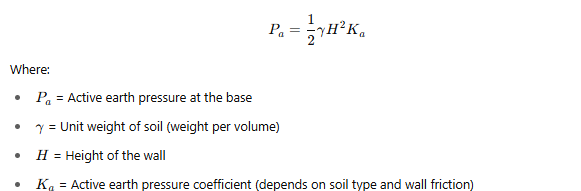
The higher the wall or heavier the soil, the more pressure you get.
Why does this matter? Because knowing the pressure helps design the wall thickness, reinforcement, and footing size. It’s like knowing how much weight your bookshelf will hold before building it.
What Are the Best Materials to Use When Designing a Retaining Wall?
Choosing the right materials is a game-changer. Here are common options and why they matter:
- Concrete: Strong and durable. Great for tall walls and heavy earth pressure.
- Masonry blocks: Easier to build but usually need reinforcement.
- Timber: Good for small walls, but less durable long-term.
- Gabion walls: Wire baskets filled with rocks. Flexible and good for drainage.
- Stone: Natural look but expensive and labor-intensive.
For resisting earth pressure, concrete is king because it’s strong and can handle huge forces. But don’t forget drainage and reinforcement!
How Does Drainage Affect the Design of a Retaining Wall?
Drainage is often overlooked but super important. Water in soil adds weight and pressure, making the wall work harder. Imagine trying to hold back a crowd, then suddenly they start carrying heavy backpacks!
Good drainage reduces water buildup behind the wall, lowering pressure and preventing damage like cracking or tilting.
Ways to improve drainage:
- Use gravel or crushed stone behind the wall
- Add perforated pipes to carry water away
- Install weep holes in the wall
Without proper drainage, even the strongest wall might fail. So, always design your wall with water flow in mind!
Which Design Techniques Help Retaining Walls Resist Earth Pressure Effectively?
There are a few popular design styles, and each handles earth pressure differently:
- Gravity Walls: Heavy walls that rely on their own weight to resist pressure.
- Cantilever Walls: Use a thin stem and a base slab to transfer pressure into the ground.
- Counterfort Walls: Have additional supports (counterforts) on the back to strengthen the wall.
- Anchored Walls: Use cables or rods anchored into the soil behind to add extra support.
Each type is chosen based on soil conditions, wall height, and budget. Cantilever walls are common for medium heights, while gravity walls are for shorter walls with heavy soil.
What Role Does Soil Type Play in Designing Retaining Walls?
Soil isn’t just dirt—it’s a character in your story! Different soils behave differently:
- Clay: Sticky and holds water. Generates high pressure when wet.
- Sand: Drains well but can shift easily.
- Gravel: Drains very well and creates less pressure.
- Silt: Fine particles that hold water like clay but weaker.
Knowing the soil type helps determine earth pressure and what kind of wall suits best. For example, clay needs good drainage and stronger walls because it swells and gets heavy.
How Do You Ensure Stability in Retaining Wall Design?
Stability means the wall won’t tip, slide, or sink. Here’s how you ensure it:
- Overturning Resistance: The wall should be heavy and wide enough so it doesn’t tip over.
- Sliding Resistance: The base must have enough friction with the soil or use anchors.
- Bearing Capacity: The soil below should be strong enough to hold the wall’s weight.
- Proper Reinforcement: Use steel bars inside concrete walls to prevent cracks.
Testing these through calculations and safety factors makes sure your wall stays put no matter what.
What Are Common Mistakes to Avoid When Designing a Retaining Wall?
Even experts make mistakes! Watch out for these:
- Ignoring soil pressure calculations.
- Forgetting drainage design.
- Using weak or wrong materials.
- Not reinforcing tall walls.
- Underestimating water pressure after rain.
- Poor footing design causing sinking.
Avoid these, and your retaining wall will be a champion, not a disaster.
How Long Does a Well-Designed Retaining Wall Last?
If designed and built correctly, retaining walls can last 50 years or more. Concrete walls with good drainage and reinforcement might last 70+ years. Timber walls, however, may only last 10-20 years.
Regular inspections help spot issues early. Fix small cracks or drainage problems before they grow into major failures.
Do You Know?
- Retaining walls resist earth pressure by balancing forces like a see-saw with heavy weights on one side.
- The pressure on a retaining wall can be stronger than a parked car pressing against it!
- Using recycled materials like gabions can be eco-friendly and effective.
- Adding plants on top of walls helps reduce water absorption and soil erosion.
How Do You Start Designing a Retaining Wall?
Designing a retaining wall begins with understanding the site conditions. Think of it like baking a cake: you need the right ingredients first.
Here’s your checklist:
- Site Survey: Measure wall height, length, and soil type.
- Soil Testing: Get soil samples tested for properties like unit weight, friction angle, and cohesion.
- Determine Loads: Besides soil pressure, account for surcharge loads like vehicles or buildings near the wall.
- Select Wall Type: Choose gravity, cantilever, counterfort, or anchored based on height and load.
- Drainage Plan: Design drainage to reduce hydrostatic pressure.
- Calculate Earth Pressure: Use Rankine or Coulomb methods to find active earth pressure.
This methodical approach sets you up for a smooth design process.
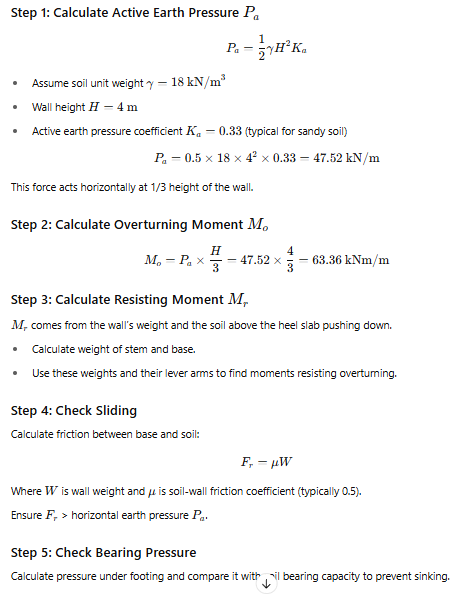
What Are the Step-by-Step Calculations in Designing a Cantilever Retaining Wall?
Cantilever walls are popular due to their efficiency. Here’s how you calculate forces for one:
How Do You Reinforce a Retaining Wall Against Earth Pressure?
Concrete walls often crack under tension. Steel reinforcement bars (rebars) inside the wall prevent this by carrying tension forces.
- Vertical rebars resist bending moments.
- Horizontal rebars handle shear stresses.
- Reinforcement should be placed according to design codes (e.g., spacing, size).
For cantilever walls, the stem needs more reinforcement near the base because that’s where tension is highest.
What Is the Role of the Base or Footing in Resisting Earth Pressure?
The base of the wall is like its foundation. It spreads the wall’s weight over a large area to prevent sinking.
Key points:
- The base must be wide enough to resist sliding and overturning.
- It helps transfer the earth pressure forces into the ground.
- Usually designed thicker than the stem and may include a heel (under the retained soil) and a toe (in front of the wall).
A poorly designed footing is the weak link that can cause wall failure.
Which Safety Factors Are Used in Retaining Wall Design?
Safety factors ensure your wall can handle unexpected loads or weak soil.
- Factor of Safety against Overturning: Usually 1.5 or higher.
- Factor of Safety against Sliding: Minimum of 1.5.
- Factor of Safety for Bearing Pressure: Minimum 2.5.
This means the wall’s resisting forces must be 1.5 to 2.5 times greater than the forces trying to move or tip it.
What Are Counterfort and Anchored Retaining Walls, and When to Use Them?
- Counterfort Walls: These have vertical supports on the back side connected to the wall stem, reducing bending and making the wall stronger. Used for tall walls over 6 meters.
- Anchored Walls: Steel cables or rods are fixed deep into the soil behind the wall, anchored into solid ground. These are used when the wall is very tall or soil is weak.
Both methods increase the wall’s ability to resist earth pressure but are more expensive and complex.
How Do Temperature and Weather Affect Retaining Wall Design?
Weather impacts materials and soil behavior:
- Freeze-thaw cycles can crack concrete.
- Rainwater increases soil weight and pressure.
- Dry seasons can cause soil shrinkage and wall movement.
Design walls with weather-resistant materials and proper drainage to avoid these problems.
Do You Know?
- Sometimes, simple vegetation behind a wall reduces earth pressure by drying soil and holding it together.
- Modern software can simulate earth pressure and wall behavior to optimize design.
- Retaining walls in earthquake zones need special design for seismic forces.
FAQs about Designing Retaining Walls to Resist Earth Pressure
1. How thick should a retaining wall be to resist earth pressure?
The thickness depends on height, soil type, and wall type. For example, a 3 ft high concrete wall might be 8-12 inches thick. Taller walls need thicker bases.
2. Can a retaining wall be built without drainage?
It’s not recommended. Water pressure behind the wall can cause failure. Drainage is key to safety.
3. What is the safest type of retaining wall?
Cantilever walls are popular because they use less material but are strong. Gravity walls are very safe for small heights.
4. How deep should the footing of a retaining wall be?
Usually, footing depth is at least 12 inches below the frost line and wide enough to distribute pressure. This varies with soil.
5. Is reinforcement necessary for all retaining walls?
No, small gravity walls may not need it, but most concrete walls over 3 feet tall should have steel reinforcement.
6. What is active vs. passive earth pressure?
Active pressure is soil pushing the wall. Passive pressure is soil resisting the wall’s movement.
7. How do I calculate the earth pressure coefficient KaK_aKa?
It depends on soil friction angle and wall friction. Tables and formulas in engineering handbooks provide these.
8. Can plants help stabilize a retaining wall?
Yes! Roots help hold soil, and plants reduce water absorption.
9. What if my soil is very clayey?
Design with extra drainage and stronger walls. Clay holds water and creates high pressure.
10. How often should I inspect my retaining wall?
Twice a year, and after heavy rain or earthquakes. Look for cracks, tilting, or water pooling.
Conclusion
Designing a retaining wall to resist earth pressure is like building a fortress against an invisible, heavy enemy. You need to understand how soil pushes, calculate forces, pick the right materials, and add drainage. Remember, the best walls balance strength and smart design.
Start by knowing your soil and earth pressure, then choose the right wall type and reinforcement. Don’t forget drainage—water is the sneaky troublemaker. Avoid common mistakes, and your wall will last decades.
If you’re unsure, consulting a structural engineer is always smart. With these tips, you’re well on your way to designing strong, safe retaining walls that keep earth at bay.
Top Facts Summary:
- Earth pressure depends on soil weight, wall height, and soil type.
- Proper drainage cuts down pressure significantly.
- Cantilever and gravity walls are common, each with pros and cons.
- Reinforcement and footing size are critical for stability.
- Soil type changes how you design your wall dramatically.
