Quick Answer
High-strength concrete demands precise curing methods to achieve its full durability, load capacity, and crack resistance. Curing is the controlled process of maintaining adequate moisture, temperature, and time after placement to ensure proper hydration of cement particles. Poor curing can reduce strength by up to 40%, while correct curing enhances performance across climates—from U.S. skyscrapers to Asian infrastructure megaprojects.
Key curing methods include:
- Water curing (ponding, sprinkling, wet coverings) for maximum hydration.
- Membrane curing with curing compounds for arid regions.
- Steam curing for precast elements and rapid strength gain.
- Plastic sheeting for preventing evaporation on exposed slabs.
- Curing blankets for cold-weather concreting.
- Internal curing using lightweight aggregates or superabsorbent polymers.
- Infrared curing for accelerated construction timelines.
- Combination curing for projects with extreme environmental variations.
The takeaway: The “best” curing method depends on project type, climate, and required performance—but every method aims at one universal goal: maximizing cement hydration to produce stronger, more durable concrete.
Why Curing Matters in High-Strength Concrete
Imagine pouring a billion-dollar bridge deck and watching it crack within months. That’s not an engineering horror story—it’s a direct result of poor curing. Concrete isn’t just a hardening liquid; it’s a living chemical system in its early days. Cement hydration, the reaction between water and cement, builds the calcium silicate hydrate (C-S-H) gel that gives concrete its backbone strength.
In high-strength concrete, the stakes are higher. Water-to-cement ratios are low, admixtures are often complex, and the margin for error shrinks dramatically. Without controlled curing, early-age shrinkage, microcracking, and strength loss are inevitable. Studies show improper curing can reduce compressive strength by 25–40%, even in mixes designed for 80 MPa (11,600 psi) or more.
Globally, curing challenges vary:
- U.S. and EU focus on sustainability and long-term durability.
- India and Asia battle high evaporation rates in hot climates.
- Cold-weather regions struggle with ice formation that disrupts hydration.
Curing isn’t a one-size-fits-all activity—it’s a tailored approach that aligns with climate, mix design, and construction timelines. Let’s dive into the eight most effective methods.
1. Water Curing: The Gold Standard
Water curing remains the most effective and widely used method. It directly supplies the concrete surface with continuous moisture, keeping hydration active. There are three common approaches:
- Ponding: Creating shallow “ponds” of water over flat slabs.
- Sprinkling/Fogging: Regular spraying or misting on large surfaces.
- Wet Coverings: Using hessian, jute mats, or sand layers kept moist.
Advantages
- Ensures maximum hydration, achieving the highest possible strength.
- Reduces plastic shrinkage and cracking.
- Simple and cost-effective in regions with abundant water.
Limitations
- Requires constant water availability—challenging in arid areas (e.g., parts of India, Middle East).
- Labor-intensive and less practical for vertical or complex forms.
Did You Know? In ancient India’s stepwells, masons used wet burlap and continuous flooding techniques—rudimentary versions of water curing—to strengthen stone and lime mortars centuries before modern concrete.
2. Membrane Curing: Locking Moisture Inside
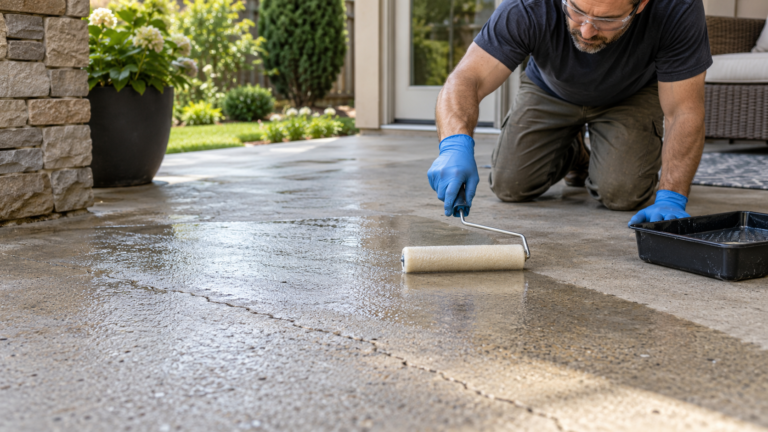
Where water is scarce, membrane curing steps in. A curing compound—often wax, resin, or synthetic emulsion—is sprayed or rolled on the fresh surface. Once dry, it forms a thin film that seals in moisture.
Advantages
- Ideal for hot and arid climates such as Rajasthan or Middle Eastern deserts.
- Reduces dependence on water supply and manual labor.
- Compatible with large-scale road and runway projects.
Limitations
- Less effective if applied late or unevenly.
- Some compounds may interfere with later surface finishes or coatings.
- Environmental regulations in the EU require low-VOC (volatile organic compound) alternatives.
Did You Know? The first commercial curing compounds appeared in the early 20th century U.S. highway projects, dramatically reducing shrinkage cracking compared to untreated concrete pavements.
3. Steam Curing: Speed Meets Strength
When time is money—as in precast factories, metro rail projects, or high-rise cores—steam curing takes center stage. In this method, moist heat is applied to accelerate the hydration process, producing rapid strength gain. It’s especially common in precast yards for beams, sleepers, and hollow-core slabs.
Advantages
- Strength develops quickly, allowing early demolding and faster construction cycles.
- Enhances durability by reducing permeability when properly controlled.
- Well-suited for industrial-scale precast operations worldwide.
Limitations
- Requires precise temperature control; excessive heat can cause thermal cracking.
- Energy-intensive, raising sustainability concerns in the EU and U.S. green building codes.
- Not practical for large in-situ pours on site.
Global Context:
- In India, metro rail precast segments rely heavily on steam curing for project speed.
- In Europe, energy-efficient low-pressure steam systems are gaining popularity to align with climate goals.
Did You Know? Steam curing was first patented in the late 1800s to boost brick production in the U.S.—well before reinforced concrete became mainstream.
4. Plastic Sheeting: The Simplest Barrier
Sometimes, the solution is as straightforward as covering concrete with plastic film. Plastic sheeting (polyethylene) acts as a barrier, preventing surface water evaporation while maintaining a moist micro-environment. It’s widely used on slabs, pavements, and bridge decks.
Advantages
- Low-cost, lightweight, and easy to apply.
- Protects against wind and solar radiation in exposed environments.
- Ideal for regions with unreliable water supply.
Limitations
- Can trap uneven moisture, leading to patchy curing or discoloration.
- Risk of wind uplift or tearing if not anchored properly.
- Plastic waste disposal raises environmental challenges.
Global Context:
- In Asia, thin polyethylene sheets are often reused multiple times to cut costs.
- In cold climates like Northern Europe, plastic is often combined with insulating blankets to counter heat loss.
Did You Know? Researchers in Japan have experimented with transparent plastic sheets that allow UV penetration—accelerating surface hardening while still maintaining hydration.
5. Curing Blankets: Battling the Cold
In cold-weather concreting, hydration slows dramatically, and freezing can ruin early-age strength. Curing blankets—insulated mats made of synthetic fibers or composites—trap heat and protect fresh concrete from low temperatures. They’re rolled over slabs, columns, or bridge decks right after finishing.
Advantages
- Maintain internal temperatures for consistent hydration.
- Prevent freezing damage in regions like Canada, Northern U.S., Scandinavia, and North India’s Himalayas.
- Reusable and durable, offering cost-effectiveness over multiple projects.
Limitations
- Not effective in hot climates where cooling, not heating, is the challenge.
- Higher upfront cost compared to plastic sheeting.
- Require proper anchoring to avoid air gaps that reduce insulation efficiency.
Global Context:
- U.S. DOT guidelines mandate thermal protection for bridge decks below certain temperatures.
- In China’s northeast, curing blankets are often combined with heating coils for megaprojects during harsh winters.
Did You Know? The earliest “curing blankets” were improvised—builders in medieval Europe covered lime-based mortars with straw and wool to trap warmth during winter construction.
6. Internal Curing: Moisture From Within
Unlike surface methods, internal curing supplies water from inside the concrete itself. Lightweight aggregates pre-soaked with water or superabsorbent polymers (SAPs) release moisture gradually as hydration progresses. This method is especially effective in high-performance mixes with low water-to-cement ratios.
Advantages
- Reduces autogenous shrinkage (self-desiccation) in high-strength concrete above 60 MPa (8,700 psi).
- Improves long-term durability and reduces cracking.
- Particularly useful in India and Asia, where high ambient temperatures accelerate moisture loss.
Limitations
- Requires careful design and proportioning of aggregates or polymers.
- May increase material costs compared to traditional curing.
- Not always necessary for lower-strength or mass concrete.
Global Context:
- Widely researched in the U.S. by ACI (American Concrete Institute) for bridges and pavements.
- European Union-funded projects promote internal curing for sustainable construction by reducing water usage.
Did You Know? Internal curing concepts trace back to ancient Roman builders, who mixed porous volcanic pumice in their concrete. Modern science proves that this technique—accidentally—helped prevent cracks in aqueducts and harbor walls that still stand today.
7. Infrared Curing: Technology Meets Concrete
Infrared curing is a modern approach where infrared lamps or heaters apply controlled thermal energy to accelerate hydration. It’s typically used in specialized applications like rapid repair works, precast components, or research labs where time is critical.
Advantages
- Rapid strength gain without needing a full steam-curing setup.
- Localized curing—perfect for patch repairs on highways or airport runways.
- Energy efficiency compared to large-scale steam curing when applied in smaller zones.
Limitations
- Equipment costs can be high.
- Limited depth of heat penetration—better suited for thin sections.
- Requires skilled operation to avoid overheating.
Global Context:
- In the U.S., infrared curing is increasingly tested for emergency infrastructure repairs after hurricanes and earthquakes.
- In Asia, portable infrared units are used for fast-setting concrete overlays in busy urban transport networks.
Did You Know? NASA researchers in the 1960s explored infrared curing for high-performance aerospace composites—tech that later found its way into civil engineering.
8. Combination Curing: Adapting to Reality
No project site is perfect, and often a hybrid approach works best. Combination curing uses two or more methods to handle challenging climates or specialized structural requirements. For example:
- Plastic sheeting + curing blankets in cold, windy regions.
- Internal curing + membrane curing in hot, arid climates.
- Steam curing + water curing for precast elements needing durability after demolding.
Advantages
- Provides flexibility across diverse conditions.
- Maximizes hydration efficiency while adapting to resource constraints.
- Especially valuable for global megaprojects spanning different environments.
Limitations
- Requires careful coordination and supervision.
- Higher material and labor costs if not optimized.
- May complicate quality control if inconsistently applied.
Global Context:
- Mega-dams in India and China often rely on combination curing to balance vast surface areas, varying temperatures, and local material constraints.
- In the EU, hybrid systems are being tested with eco-friendly compounds plus insulating blankets for sustainability.
Did You Know? The Three Gorges Dam in China used a mix of fogging, cooling pipes, and membrane curing to manage hydration heat across millions of cubic meters of concrete.
Common Mistakes to Avoid
Even with the right method, execution errors can sabotage concrete strength:
- Curing too late: Delaying curing by even a few hours after finishing can cause surface drying, microcracks, and reduced bond strength.
- Stopping too early: Many projects halt curing after 3–5 days, but high-strength mixes often need 7–14 days for full hydration.
- Uneven application: Applying membrane compounds unevenly or leaving gaps in plastic sheets causes patchy curing.
- Ignoring climate factors: Using water curing in arid zones without frequent checks leads to rapid evaporation and poor results.
- Neglecting quality checks: Failing to test curing compounds or blankets for compliance with standards (e.g., ASTM C309 in the U.S., EN 934 in Europe) results in unpredictable outcomes.
Expert Tips to Remember
- Match method to climate: Choose water curing for humid regions, membrane curing for deserts, and blankets for cold zones.
- Start early: Begin curing as soon as finishing is complete and the surface won’t be marred by water or coverings.
- Monitor temperature and humidity: Use sensors for critical projects like bridges and high-rises to ensure hydration conditions stay within optimal ranges.
- Combine smartly: Don’t hesitate to use hybrid approaches when facing complex environments—many iconic global structures rely on them.
- Think sustainability: Consider low-VOC curing compounds, reusable blankets, or internal curing to minimize environmental impact.
FAQs
1. Why is curing more critical for high-strength concrete than normal concrete?
Because high-strength concrete has a lower water-to-cement ratio, it risks faster self-desiccation. Without proper curing, hydration stalls, leading to shrinkage and cracks.
2. How long should curing continue for high-strength concrete?
Typically at least 7–14 days, but for mixes above 80 MPa, continuous curing for up to 28 days may be recommended, especially in hot or dry climates.
3. Which curing method is best for hot climates like India or the Middle East?
Membrane curing and internal curing are most effective, as they minimize evaporation and reduce water dependency.
4. Can over-curing damage concrete?
No, but improper methods—like excessive heat in steam curing—can cause thermal cracking or delayed ettringite formation.
5. Is curing necessary if admixtures are used?
Yes. Even with admixtures like superplasticizers, curing is essential for complete hydration and durability.
6. What’s the most eco-friendly curing method?
Internal curing with lightweight aggregates or polymers, since it reduces external water usage and waste.
7. Do curing compounds affect surface finishes?
Yes, some leave a residue that may interfere with painting, tiling, or sealants. Always confirm compatibility before use.
8. What happens if curing is skipped entirely?
Strength can drop by 25–40%, shrinkage cracks appear, and long-term durability is severely compromised.
9. How does curing differ for precast vs. cast-in-place concrete?
Precast elements often use steam curing for speed, while cast-in-place relies on water, membranes, or blankets depending on climate.
10. Are there standards for curing methods?
Yes. ASTM C31, ASTM C309 (U.S.), EN 12390 (Europe), and IS 456 (India) provide detailed curing guidelines.
Conclusion
Curing isn’t an afterthought—it’s the invisible backbone of high-strength concrete performance. From ponding slabs in India’s heat to insulating bridge decks in Scandinavia, the right curing method turns cement paste into a resilient, load-bearing material that lasts decades. The eight methods—ranging from traditional water curing to modern internal and infrared systems—prove there’s no single solution, only context-driven choices.
Key Takeaways
- High-strength concrete requires longer and more controlled curing than normal concrete.
- Water curing is the gold standard but impractical in water-scarce regions.
- Membrane and internal curing shine in hot, arid climates.
- Steam and infrared curing accelerate timelines for precast and repair projects.
- Hybrid or combination curing often delivers the best results on large-scale global projects.
- Proper curing can improve strength by up to 40% compared to poorly cured concrete.