A Safety Manager interview tests far more than whether you can define a hazard, explain PPE, or quote safety regulations. The interviewer is trying to understand whether you can recognize serious risks, make sound decisions under pressure, influence supervisors and workers, investigate incidents, manage contractors, communicate with senior leadership, and build a practical safety-management system.
The strongest candidates do not answer like a textbook. They explain what they would do, why they would do it, how they would control the risk, who they would involve, and how they would verify that the corrective action actually worked.
How I Recommend Preparing for a Safety Manager Interview
When I look at Safety Manager interview preparation, I divide the questions into three levels.
The first level is technical knowledge.
The interviewer wants to establish whether you understand fundamental concepts such as:
- hazard;
- risk;
- hierarchy of controls;
- permit-to-work;
- job safety analysis;
- incident investigation;
- work at height;
- lifting;
- excavation;
- electrical safety.
The second level is application.
Knowing what a risk assessment is does not necessarily prove that you can conduct one properly.
You may therefore be asked:
“A contractor wants to start excavation beside an existing utility corridor. What would you check before allowing work to begin?”
Now the interviewer is evaluating whether you can convert theory into a practical site decision.
The third level is leadership.
This is particularly important for Safety Manager and HSE Manager positions.
You might be asked:
“What would you do if a Project Manager told you that stopping an unsafe activity would delay a critical milestone?”
This is no longer just a safety question.
It tests:
- judgment;
- confidence;
- communication;
- integrity;
- business understanding;
- leadership.
In my approach, I would prepare for all three levels rather than memorizing definitions.
How to Structure a Strong Safety Manager Interview Answer
For most practical questions, I recommend using this sequence:
Identify → Make Safe → Assess → Control → Communicate → Verify → Prevent Recurrence
For behavioral questions, use a variation of the STAR method:
Situation → Task → Action → Result → Learning
You do not need to announce these frameworks during the interview. They simply help you organize your thoughts.
Part 1: General Safety Manager Interview Questions
1. Tell Me About Yourself.
A strong answer should summarize your professional identity, relevant experience, major responsibilities, and the value you can bring to the organization.
Sample Answer
“I am a safety professional with experience in managing workplace hazards, risk assessments, inspections, contractor safety, incident prevention, training, and compliance. Over time, my focus has moved beyond simply identifying unsafe conditions toward building systems that prevent those conditions from occurring repeatedly.
My approach is very practical. I like spending time in the field, understanding how the work is actually being performed, discussing risks with supervisors and workers, and then ensuring that controls are realistic as well as compliant.
As a Safety Manager, I see my responsibility as creating a strong connection between management expectations and actual site execution.”
Interview Tip
Do not repeat your complete résumé.
Aim for approximately 60–90 seconds.
2. Why Did You Choose a Career in Safety?
Sample Answer
“I chose safety because it allows me to make a direct impact on people as well as operational performance. Preventing an incident is obviously important from a human perspective, but strong safety management also improves planning, discipline, communication, quality, and productivity.
I also enjoy the problem-solving aspect. Every project has different risks, people, constraints, and operating conditions. My role is to understand those conditions and develop practical controls before something goes wrong.”
3. Why Do You Want to Work as a Safety Manager?
Sample Answer
“I want a role where I can influence the entire safety-management system rather than focusing only on individual observations. As a Safety Manager, I can work with leadership, operations, contractors, supervisors, and workers to improve risk management at every level.
I am particularly interested in developing preventive systems—strong risk assessments, effective inspections, meaningful incident investigations, competent supervision, and measurable corrective-action management.”
4. What Are the Main Responsibilities of a Safety Manager?
Sample Answer
“I see the Safety Manager’s responsibilities as both operational and strategic.
Operationally, I am responsible for identifying hazards, reviewing risk assessments, monitoring high-risk activities, conducting inspections, managing permits, investigating incidents, and ensuring corrective actions are completed.
Strategically, the role includes developing procedures, monitoring safety performance, managing contractor safety, supporting compliance, reporting to leadership, conducting audits, developing training programs, and continuously improving the safety-management system.”
5. What Makes a Good Safety Manager?
Sample Answer
“A good Safety Manager needs technical knowledge, judgment, communication ability, consistency, integrity, and strong field awareness.
I also believe a Safety Manager must be solution-oriented. Simply telling the construction or operations team that something cannot be done is not enough.
Whenever possible, I prefer to say:
‘This method creates an unacceptable risk. Let us identify a safer method that achieves the same operational objective.’
That approach creates cooperation rather than treating safety as an obstacle.”
6. How Would You Describe Your Safety Management Style?
Sample Answer
“My style is risk-based and collaborative, but I am firm when serious hazards are involved.
I prefer to understand why a problem exists before deciding on the corrective action. Sometimes an unsafe condition exists because of poor worker behavior, but sometimes it exists because the work was badly planned, the right equipment was unavailable, supervision was inadequate, or the procedure was unrealistic.
Correcting the real cause produces much better results than simply issuing warnings.”
7. Why Should We Hire You as a Safety Manager?
Sample Answer
“You should hire me if you need someone who can combine safety knowledge with practical management.
I do not see safety as a documentation exercise. My focus is identifying critical risks, developing realistic controls, improving accountability, monitoring contractor performance, communicating effectively with management, and following corrective actions through to actual closure.
I also understand that safety needs to support operations. The objective is not simply to stop work; it is to help the organization perform the work safely.”
8. What Is Your Greatest Strength as a Safety Professional?
Sample Answer
“One of my strongest qualities is follow-through.
I do not consider a safety issue resolved simply because someone has replied to an email saying that the action has been completed.
If the risk is significant, I prefer to verify the correction in the field, speak with the responsible person if necessary, and confirm that the solution actually addresses the original hazard.”
9. What Is Your Biggest Weakness?
Sample Answer
“One area I have continuously improved is communicating technical safety information more concisely.
Safety professionals sometimes provide too much information at once. I have learned that management and operations teams often respond better when the message clearly identifies four things: the risk, the required action, the responsible person, and the completion deadline.
I still maintain the technical detail when it is needed, but I try to make communication decision-oriented.”
10. Where Do You See Yourself in Five Years?
Sample Answer
“I would like to develop further into a senior HSE leadership position where I can contribute not only at individual project level but also to organizational strategy.
My long-term interest is in strengthening safety-management systems, developing high-performing teams, improving contractor governance, and using better data to identify risk before incidents occur.”
Part 2: Safety Fundamentals
11. What Is a Hazard?
Sample Answer
“A hazard is something that has the potential to cause harm.
That harm may involve injury, illness, property damage, environmental impact, or operational loss.
Examples include an unprotected floor opening, electricity, suspended loads, chemicals, moving machinery, excavation collapse, and excessive noise.”
12. What Is Risk?
Sample Answer
“Risk is the combination of how likely a hazardous event is to occur and how severe the consequences could be.
A common simplified expression is:
Risk = Likelihood × Severity
However, I would not rely only on the numerical score. Professional judgment is still necessary, particularly for low-frequency but potentially catastrophic events.”
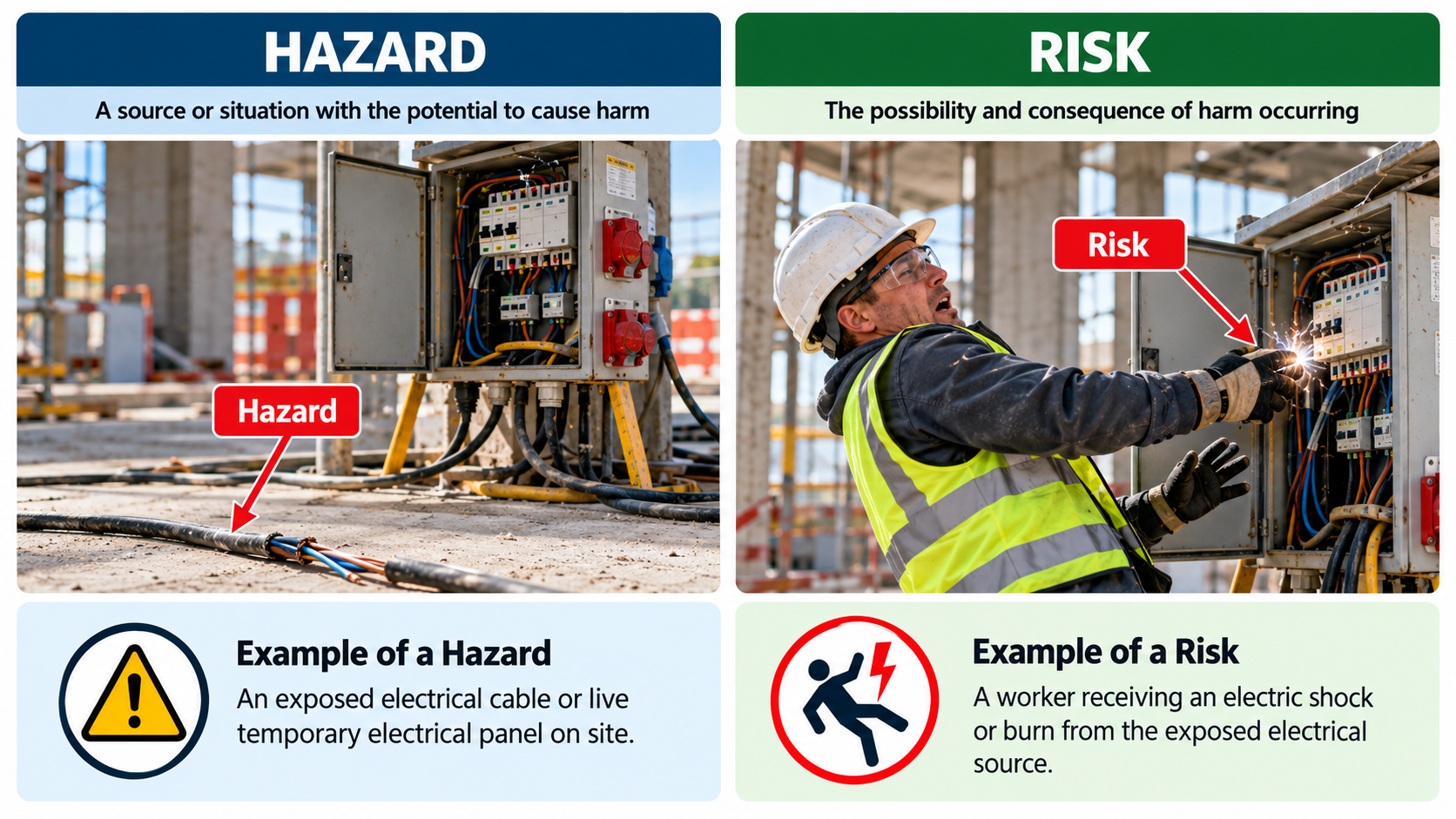
13. What Is the Difference Between Hazard and Risk?
Sample Answer
“A hazard is the source of potential harm, while risk describes the possibility and consequence of that harm occurring.
For example, an open edge on the tenth floor is a hazard.
A worker falling from that edge and suffering a fatal injury represents the risk associated with the hazard.”
14. What Is Risk Assessment?
Sample Answer
“Risk assessment is the structured process of identifying hazards, determining who could be affected, evaluating the level of risk, reviewing existing controls, and deciding whether additional controls are required.
A good risk assessment should also assign responsibility and be reviewed when conditions change.
In my view, a risk assessment should influence the way the work is performed. If nobody looks at it after it is signed, it has little practical value.”
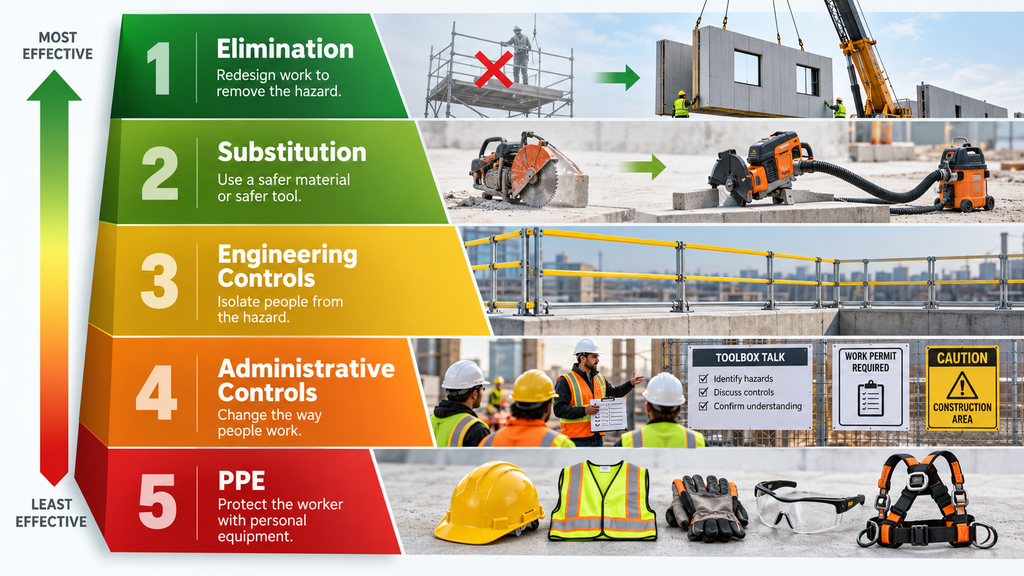
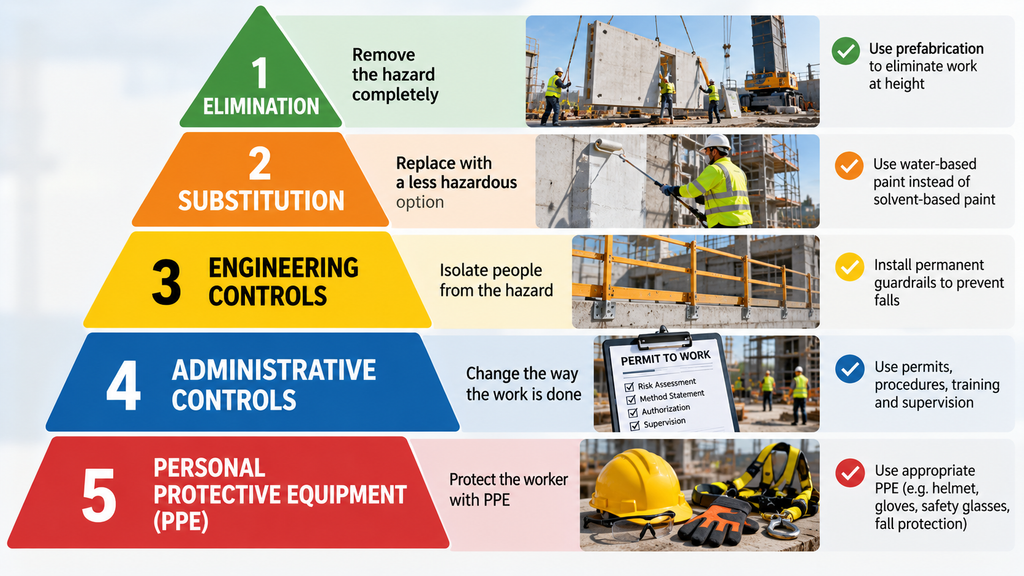
15. What Is the Hierarchy of Controls?
Sample Answer
“The hierarchy of controls provides a preferred order for controlling hazards.
The usual sequence is:
- Elimination
- Substitution
- Engineering controls
- Administrative controls
- Personal protective equipment
I always try to start as high in the hierarchy as reasonably possible.
If somebody is exposed to a fall hazard, for example, installing proper edge protection is generally more reliable than depending entirely on the worker attaching a harness correctly every time.”
16. Why Is PPE Considered the Last Line of Defense?
Sample Answer
“PPE does not normally remove the hazard. It creates a protective barrier between the worker and the hazard.
Its effectiveness can depend on correct selection, fit, maintenance, training, and worker behavior.
That is why I prefer elimination or engineering controls wherever practical before relying solely on PPE.”
17. What Is a JSA or JHA?
Sample Answer
“A Job Safety Analysis or Job Hazard Analysis breaks a job into logical steps, identifies hazards associated with each step, and defines controls before work begins.
I find JSAs particularly useful for activities where several hazards change as the work progresses.
The important part is involving the people performing the work rather than creating the document entirely in an office.”
18. What Is the Difference Between a JSA and a Risk Assessment?
Sample Answer
“A risk assessment can cover a wider activity, location, operation, or process.
A JSA is usually more task-specific and breaks the work into individual steps.
For example, a project may have a general risk assessment for lifting operations, while a particular complex lift may have its own detailed task-specific analysis and lifting plan.”
19. What Is a Near Miss?
Sample Answer
“A near miss is an event that did not result in injury or damage but had the potential to do so.
I consider near-miss reporting extremely valuable because it allows us to learn without somebody first having to get hurt.
For example, if a tool falls from a scaffold and narrowly misses a worker, I would treat that as an opportunity to investigate dropped-object controls before the next event produces an injury.”
20. What Is the Difference Between an Unsafe Act and an Unsafe Condition?
Sample Answer
“An unsafe act relates to behavior, such as removing a machine guard or entering an exclusion zone.
An unsafe condition relates to the physical environment, such as defective scaffolding or an exposed electrical conductor.
However, I would not stop the investigation at that level. I would also ask why the unsafe act or condition was allowed to exist.”
Part 3: Risk Assessment and Hazard Management
21. How Do You Conduct a Risk Assessment?
Sample Answer
“I begin by clearly defining the activity and identifying who could be affected.
Then I identify hazards, review existing controls, evaluate the remaining risk, and determine additional controls using the hierarchy of controls.
I assign each action to a responsible person and establish a completion date.
Finally, I communicate the assessment to the people performing the work and review it whenever conditions change.”
22. How Do You Prioritize Risks?
Sample Answer
“I look at severity, likelihood, exposure, number of people potentially affected, and the reliability of existing controls.
I give particular attention to hazards that could cause fatalities or multiple serious injuries, even if their probability appears relatively low.
High-consequence risks such as lifting failure, confined-space emergencies, falls from height, and electrical contact should never be ignored simply because they have not previously caused an incident.”
23. What Is a Risk Matrix?
Sample Answer
“A risk matrix combines likelihood and consequence to help categorize risks.
It is useful for prioritization, but I do not treat it as a replacement for professional judgment.
Two hazards may receive similar numerical scores while requiring very different management attention depending on the potential consequence and exposure.”
24. What Is Residual Risk?
Sample Answer
“Residual risk is the risk remaining after controls have been implemented.
No control system automatically reduces risk to zero.
The important question is whether the remaining risk is acceptable under the applicable regulations, standards, organizational criteria, and professional judgment.”
25. What Does ALARP Mean?
Sample Answer
“ALARP means reducing risk to a level that is as low as reasonably practicable.
The principle recognizes that risk reduction should continue until further controls would be grossly disproportionate to the additional benefit achieved.
It should never be used as an excuse for avoiding straightforward controls simply because they involve some cost or effort.”
26. When Should a Risk Assessment Be Reviewed?
Sample Answer
“I would review a risk assessment when the work method changes, new equipment or materials are introduced, an incident or near miss occurs, regulatory requirements change, or existing controls are shown to be ineffective.
I would also review higher-risk assessments periodically, even where no obvious change has occurred.”
27. What Is a Dynamic Risk Assessment?
Sample Answer
“A dynamic risk assessment is a continuous assessment of changing site conditions during the work.
For example, a lifting activity may have been properly planned, but if wind conditions suddenly deteriorate, the team needs to reassess whether the lift can continue safely.
It complements formal planning; it should not be used as a substitute for it.”
28. How Do You Identify Hazards That Are Not Obvious?
Sample Answer
“I use several sources rather than relying only on visual inspection.
I speak with workers, review previous incidents and near misses, examine equipment manuals, analyze maintenance records, study changes in work methods, and observe how the task is actually performed.
Workers often know about practical hazards that never make it into formal documentation.”
29. How Do You Manage High-Risk Activities?
Sample Answer
“For high-risk work, I verify that the risk assessment and method statement are appropriate, competent personnel are assigned, required permits and isolations are in place, equipment is inspected, emergency arrangements are established, and supervision is adequate.
I also confirm that workers understand the controls before the activity begins.
For critical activities, I prefer an additional field verification before authorizing work.”
30. When Would You Stop Work?
Sample Answer
“I would stop work when there is an immediate or unacceptable risk that cannot be adequately controlled while the activity continues.
The purpose is not to punish the workforce.
I stop the exposure, understand the problem, establish the required controls, and then allow the activity to restart when the risk is properly managed.”
Part 4: Construction Safety Interview Questions
31. What Are the Main Hazards on a Construction Site?
Sample Answer
“Construction sites contain multiple interacting hazards.
The major ones usually include work at height, lifting operations, moving equipment, excavations, electricity, temporary structures, falling objects, machinery, confined spaces, hot work, hazardous substances, and simultaneous activities.
What makes construction particularly challenging is that site conditions can change every day.”
32. How Do You Manage Work at Height?
Sample Answer
“I start by asking whether the work at height can be avoided.
Where it cannot, I prioritize collective protection such as permanent platforms, scaffolds, guardrails, or suitable elevated work platforms.
If personal fall protection is required, I verify anchorage, equipment compatibility, worker competency, inspection, and rescue arrangements.
A harness without a rescue plan is not a complete fall-protection system.”
33. What Would You Check During a Scaffold Inspection?
Sample Answer
“I would check the foundation and base, standards, ledgers, transoms, bracing, ties, platforms, guardrails, toe boards, safe access, loading, clearances, and any unauthorized modification.
I would also verify whether the scaffold has been inspected by a competent person and whether its status is clearly communicated.
For unusual or heavily loaded scaffolds, I would also confirm that the design requirements are being followed.”
34. What Are the Major Excavation Hazards?
Sample Answer
“The most serious excavation hazard is collapse, but it is not the only concern.
I also look at underground utilities, water ingress, hazardous atmospheres, equipment operating near the edge, unstable spoil piles, unsafe access, and workers or vehicles falling into the excavation.
Excavation conditions can also change after heavy rain or nearby vibration.”
35. How Would You Make an Excavation Safe?
Sample Answer
“I would first verify utility information and ground conditions.
Then I would ensure that an appropriate protective system is provided where required, safe access is available, spoil and equipment are kept at suitable distances, water is controlled, edges are protected, and inspections are carried out by competent personnel.
If atmospheric hazards are possible, I would include gas testing and ventilation requirements.”
36. What Are the Main Hazards During Lifting Operations?
Sample Answer
“The major hazards include crane instability, dropped loads, overloading, incorrect rigging, ground failure, poor communication, personnel entering the lifting zone, contact with nearby structures, and adverse weather.
For complex lifts, I pay particular attention to load weight, crane configuration, lifting radius, ground bearing capacity, rigging arrangement, and exclusion-zone management.”
37. What Is a Lifting Plan?
Sample Answer
“A lifting plan defines how the lift will be performed safely.
It should identify the load, lifting equipment, rigging arrangement, crane configuration, operating radius, capacity, lifting route, ground conditions, environmental limitations, exclusion zone, communication method, and responsibilities of the lifting team.
More complex or critical lifts require greater planning detail.”
38. What Would You Do if You Saw Workers Standing Under a Suspended Load?
Sample Answer
“I would stop the exposure immediately and clear personnel from the lifting zone.
I would then investigate why people were able to enter the area.
The corrective action might involve better barricading, a redesigned lifting route, improved supervision, clearer communication, or changes to the lifting plan.
Simply telling the workers to move does not address the system failure.”
39. How Do You Manage Electrical Safety on a Construction Site?
Sample Answer
“I focus on proper temporary distribution systems, grounding, protective devices, equipment inspection, cable protection, safe isolation, competent electricians, and protection from moisture and mechanical damage.
I also pay close attention to improvised electrical connections because temporary installations can become progressively less controlled as a project develops.”
40. What Is Lockout/Tagout?
Sample Answer
“Lockout/tagout is a system used to control hazardous energy before maintenance or servicing.
Equipment is shut down, energy sources are isolated, stored energy is released or controlled, and locks or tags are applied according to the procedure.
The purpose is to prevent unexpected startup or release of energy while someone is working on the equipment.”
Part 5: Permit-to-Work and High-Risk Operations
41. What Is a Permit-to-Work System?
Sample Answer
“A permit-to-work system is a formal authorization process for controlling specified high-risk activities.
It confirms that the work has been reviewed, hazards identified, precautions established, isolations verified where necessary, and responsibilities assigned before the activity begins.
The permit should support the work—it should never become a paperwork exercise.”
42. What Activities Commonly Require Permits?
Sample Answer
“Depending on the organization and industry, permits may apply to hot work, confined-space entry, excavation, electrical isolation, work at height, line breaking, energized systems, or critical lifting.
The exact permit structure depends on the company’s risk profile and regulatory requirements.”
43. Does a Signed Permit Make the Work Safe?
Sample Answer
“No.
A permit documents authorization and required precautions, but the actual safety comes from implementing those precautions correctly in the field.
I have always considered permit verification important because a perfectly completed permit has very little value if the isolation, barricade, gas testing, or supervision described on it does not actually exist.”
44. What Would You Do if Conditions Changed After a Permit Was Issued?
Sample Answer
“I would stop or suspend the activity and reassess the situation.
If the change affects the assumptions or controls under which the permit was issued, the permit may need to be revised or cancelled and reissued.
A permit should never be treated as valid simply because the expiry time has not yet been reached.”
45. How Do You Control Hot Work?
Sample Answer
“I would inspect the work area, remove or protect combustibles, check for hidden ignition risks, provide appropriate fire-extinguishing equipment, confirm ventilation, and establish a fire watch where required.
In hazardous locations, atmospheric testing and isolation may also be necessary.
I would also ensure that post-work fire monitoring is completed where the risk requires it.”
46. What Is a Confined Space?
Sample Answer
“A confined space is generally an enclosed or partially enclosed area not intended for continuous occupancy that can present serious hazards due to restricted access, atmosphere, engulfment, configuration, or emergency rescue difficulty.
Examples can include tanks, pits, vessels, sewers, and some chambers.”
47. How Do You Manage Confined-Space Entry?
Sample Answer
“I verify the risk assessment, entry permit, isolation, atmospheric testing, ventilation, communication, competent workers, attendant, rescue plan, and required equipment before entry.
One point I consider critical is rescue planning.
It is not enough to say that emergency services will be called. The organization should understand how an incapacitated worker would actually be removed from that specific space.”
48. What Is Gas Testing?
Sample Answer
“Gas testing checks the atmosphere for hazards such as oxygen deficiency or enrichment, flammable gases, and toxic contaminants.
Testing may be required before entry and continuously or periodically during the work depending on the risk.
The person conducting the test should understand the instrument, calibration, sampling technique, and interpretation of results.”
49. What Is Line Breaking?
Sample Answer
“Line breaking involves intentionally opening piping or equipment that may contain hazardous pressure, chemicals, gases, steam, or other energy.
Before the line is opened, I would verify isolation, depressurization, draining, purging where required, PPE, containment arrangements, and the applicable permit process.”
50. How Do You Manage Simultaneous Operations?
Sample Answer
“Simultaneous operations create additional risk because two individually acceptable activities may become unsafe when performed together.
I coordinate the work schedule, identify interaction hazards, define exclusion zones, clarify responsibility, and decide whether activities should be separated by time or location.
Examples include lifting above workers, hot work near flammable materials, or excavation beside moving equipment.”
Part 6: Incident Investigation
51. What Would You Do Immediately After a Serious Incident?
Sample Answer
“My first priority would be emergency response and preventing further harm.
I would ensure medical assistance, make the area safe, control access, and preserve evidence where possible.
Once the immediate situation is stabilized, I would complete the required notifications and initiate a structured investigation.
I would avoid speculation during the early stages.”
52. What Is the Purpose of Incident Investigation?
Sample Answer
“The purpose is to learn why the incident occurred and prevent recurrence.
An investigation should not simply identify who made a mistake.
I want to understand the immediate causes, contributing factors, and deeper management-system weaknesses that allowed the event to occur.”
53. What Is Root Cause Analysis?
Sample Answer
“Root cause analysis looks beyond the visible event and identifies underlying failures in planning, supervision, training, equipment, procedures, communication, or organizational controls.
Correcting only the immediate cause may make the site look better temporarily without preventing the same type of incident from occurring again.”
54. Explain the 5 Whys Method.
Sample Answer
“The 5 Whys method repeatedly asks why an event occurred until the investigation reaches deeper contributing factors.
For example, a worker falls because an edge was unprotected.
Why was it unprotected? Because the guardrail had been removed.
Why was it removed? Because materials had to be moved through that location.
Why was there no controlled access opening? Because material movement had not been considered during planning.
Now the corrective action is much stronger than simply telling workers to be careful.”
55. What Is a Fishbone Diagram?
Sample Answer
“A fishbone or Ishikawa diagram helps an investigation team organize potential causes into categories.
These may include people, equipment, methods, materials, environment, supervision, or management.
I find it useful when an incident has several interacting causes and the team needs to avoid focusing too quickly on one explanation.”
56. What Evidence Would You Collect After an Incident?
Sample Answer
“I would consider photographs, video, CCTV, witness statements, equipment condition, permits, risk assessments, training records, inspection records, maintenance history, work instructions, environmental conditions, and communication records.
The exact evidence depends on the incident.
I also try to collect information quickly because physical conditions and witness memories can change.”
57. How Would You Interview a Witness?
Sample Answer
“I would interview the person as soon as reasonably practical in a calm environment.
I prefer open-ended questions such as:
‘Tell me what you saw from the beginning.’
I avoid leading questions that suggest the answer I want.
The objective is to establish facts, not to make the witness feel accused.”
58. What Is the Difference Between Immediate Cause and Root Cause?
Sample Answer
“The immediate cause is the condition or action directly connected to the event.
The root cause is the deeper reason that condition or action existed.
For example, a missing machine guard may be the immediate cause, while an ineffective maintenance and inspection system may be the deeper cause.”
59. How Do You Ensure Corrective Actions Are Effective?
Sample Answer
“I assign a clear owner and deadline, verify that the action has actually been completed, and then evaluate whether it controls the identified cause.
For significant incidents, I also prefer a later effectiveness review.
An action can be technically ‘closed’ in the register while the original risk still exists.”
60. How Would You Handle a Fatal Incident?
Sample Answer
“I would follow the organization’s emergency response plan and applicable legal requirements.
The immediate priorities are rescue, medical response, preventing further exposure, securing the area, preserving evidence, and ensuring required notifications are made.
The investigation should then be systematic, objective, and respectful.
I would avoid premature blame or public conclusions before the facts have been established.”
Part 7: Inspections, Audits and Compliance
61. What Is the Difference Between an Inspection and an Audit?
Sample Answer
“An inspection generally focuses on workplace conditions, equipment, behaviors, and immediate compliance.
An audit evaluates whether the overall management system is designed and operating effectively.
For example, an inspection might identify missing scaffold guardrails, while an audit may identify that scaffold inspection responsibilities are unclear across the entire project.”
62. How Often Should Safety Inspections Be Conducted?
Sample Answer
“There should not be one universal frequency.
Inspection frequency should depend on risk, project stage, rate of change, legal requirements, and the nature of the activity.
On an active construction project, some critical areas may need daily or even continuous attention, while other systems can be reviewed less frequently.”
63. What Do You Look for During a Site Safety Inspection?
Sample Answer
“I focus first on high-consequence hazards rather than spending the entire inspection on minor housekeeping issues.
I look at work at height, lifting, excavation, temporary electricity, vehicle movement, scaffolding, fire risk, permits, machine safety, access, and ongoing high-risk activities.
I also speak with workers and supervisors because documentation and actual practice are sometimes very different.”
64. How Do You Close Safety Observations?
Sample Answer
“I categorize observations based on risk and assign an appropriate responsible person and deadline.
Critical hazards require immediate correction.
For significant issues, I verify closure in the field rather than accepting only a photograph or written response.
Repeated observations are analyzed for systemic causes.”
65. How Do You Deal With Repeated Safety Violations?
Sample Answer
“I first identify why the violation is recurring.
Repeated noncompliance may indicate poor supervision, lack of resources, weak accountability, inadequate training, unrealistic procedures, or contractor-management problems.
Where deliberate noncompliance exists, disciplinary action may be appropriate, but I would not assume every repeated violation is simply a worker-attitude problem.”
66. How Do You Prepare for a Regulatory Inspection?
Sample Answer
“My preference is to maintain compliance continuously rather than preparing only when an inspector arrives.
I ensure that required records, training, permits, inspection systems, incident documentation, equipment certification, and corrective actions are current and organized.
During an inspection, I would cooperate professionally, provide accurate information, and avoid guessing when I do not know an answer.”
67. What Is a Nonconformity?
Sample Answer
“A nonconformity is a failure to meet a specified requirement.
That requirement may come from legislation, company procedures, standards, client requirements, or the organization’s own management system.
The response should address both the immediate problem and the cause.”
68. What Safety Records Should Be Maintained?
Sample Answer
“Records depend on the organization, but they can include risk assessments, training records, inspections, audits, permits, equipment certification, incident investigations, emergency drills, corrective-action registers, contractor documentation, and occupational-health information where applicable.
Good records should support decision-making, not exist solely to demonstrate compliance.”
69. What Is ISO 45001?
Sample Answer
“ISO 45001 is an international standard for occupational health and safety management systems.
It provides a framework for leadership, worker participation, hazard and risk management, operational controls, performance evaluation, and continual improvement.
I view it as a management framework rather than a checklist.”
70. What Is Continual Improvement in Safety?
Sample Answer
“Continual improvement means regularly evaluating safety performance and making the management system more effective over time.
That can involve learning from incidents, audit findings, worker feedback, technology, operational changes, and performance data.
The objective is not simply maintaining the current level of performance.”
Part 8: PPE and Occupational Safety
71. How Do You Select the Correct PPE?
Sample Answer
“I start with the hazard assessment.
Then I consider the type and level of exposure, applicable standards, fit, compatibility with other PPE, worker needs, environmental conditions, and equipment limitations.
I also verify that workers understand how to inspect, use, maintain, and replace the PPE.”
72. What Would You Do if a Worker Refused to Wear PPE?
Sample Answer
“I would stop the exposure and first understand why the worker is refusing.
Sometimes the problem is incorrect size, discomfort, damaged equipment, heat stress, lack of understanding, or inadequate availability.
If the correct PPE is available and the worker deliberately refuses to comply, I would apply the organization’s disciplinary procedure appropriately.”
73. What Is Respiratory Protection?
Sample Answer
“Respiratory protection protects workers from harmful airborne contaminants or inadequate atmosphere when other controls do not fully eliminate the exposure.
Selection depends on the contaminant, concentration, oxygen level, task, and equipment limitations.
Respiratory programs also require appropriate fit, training, inspection, and maintenance.”
74. How Do You Control Noise Exposure?
Sample Answer
“I first look for engineering solutions such as quieter equipment, isolation, barriers, damping, and distance.
Administrative controls can reduce exposure duration where necessary.
Hearing protection is then used as part of the overall control strategy rather than automatically becoming the only solution.”
75. How Do You Manage Heat Stress?
Sample Answer
“I consider environmental conditions, workload, clothing, acclimatization, hydration, work-rest cycles, shade, and individual susceptibility.
I also ensure supervisors and workers understand early symptoms.
For high-temperature construction environments, planning work timing can sometimes be as important as PPE.”
Part 9: Emergency Management
76. What Is an Emergency Response Plan?
Sample Answer
“An emergency response plan defines how the organization will respond to foreseeable emergencies.
It identifies responsibilities, communication methods, evacuation procedures, rescue arrangements, medical response, emergency equipment, assembly points, and external coordination.
The plan should be based on actual project risks rather than copied from another site.”
77. What Emergencies Should a Construction Site Prepare For?
Sample Answer
“Possible scenarios include fire, fall rescue, structural collapse, excavation collapse, confined-space emergencies, severe weather, electrical incidents, chemical releases, crane incidents, and medical emergencies.
The relevant scenarios depend on the project’s activities and location.”
78. How Often Should Emergency Drills Be Conducted?
Sample Answer
“The frequency should reflect legal requirements, project risks, workforce turnover, and organizational procedures.
I would also vary the scenarios rather than repeatedly conducting exactly the same evacuation drill.
Each drill should produce lessons and corrective actions.”
79. What Do You Evaluate During an Emergency Drill?
Sample Answer
“I look at alarm effectiveness, response time, evacuation behavior, headcount, communications, emergency-team performance, access to equipment, coordination, and whether workers understand their responsibilities.
The most valuable part of the exercise is often the post-drill review.”
80. What Is a Muster Point?
Sample Answer
“A muster point is a designated safe assembly location used during evacuation so personnel can be accounted for.
Its location should not expose people to the emergency itself, emergency traffic, smoke, or other foreseeable hazards.”
Part 10: Safety Training and Communication
81. How Do You Conduct Effective Safety Training?
Sample Answer
“I make the training directly relevant to the workers’ activities.
I use real examples, demonstrations, photographs, scenarios, and discussion rather than relying entirely on slides.
Most importantly, I verify understanding.
Attendance on a training sheet does not prove competency.”
82. What Is a Toolbox Talk?
Sample Answer
“A toolbox talk is a short, focused safety discussion typically delivered around a particular activity, hazard, lesson learned, or changing site condition.
I prefer toolbox talks that connect directly to the work being performed that day rather than repeating generic topics simply to meet a schedule.”
83. How Do You Measure Training Effectiveness?
Sample Answer
“I use questions, demonstrations, observation, assessments, and subsequent workplace behavior.
For practical activities, demonstration is particularly important.
A worker may correctly answer questions about fall protection but still use the equipment incorrectly in the field.”
84. How Would You Train a Multilingual Workforce?
Sample Answer
“I use translated or multilingual materials where appropriate, interpreters or multilingual supervisors, visual aids, demonstrations, pictograms, and practical competency checks.
The key requirement is understanding.
Simply delivering training in one language and collecting signatures from everyone is not an effective system.”
85. How Do You Communicate a Serious Safety Issue to Management?
Sample Answer
“I communicate it clearly and concisely.
I explain the hazard, potential consequence, existing control weakness, required action, accountable owner, and time requirement.
For significant risks, I also explain the operational or legal implications so management can make an informed decision quickly.”
Part 11: Safety Leadership and Culture
86. What Is Safety Culture?
Sample Answer
“Safety culture describes the shared attitudes, behaviors, priorities, and decisions that determine how safety is actually managed.
A strong policy does not automatically create a strong culture.
I pay attention to what happens when production pressure increases because that often reveals the organization’s real safety priorities.”
87. How Would You Improve Safety Culture?
Sample Answer
“I would focus on leadership behavior, supervisor accountability, worker participation, reporting systems, corrective-action quality, consistent standards, and recognition of positive behavior.
Workers need to see that management responds when hazards are reported.
If people report the same issue repeatedly and nothing changes, they eventually stop reporting.”
88. How Do You Gain Management Support for Safety?
Sample Answer
“I communicate safety in terms management understands: risk, people, compliance, operational continuity, cost, reputation, and schedule.
I also avoid presenting management with long lists of minor observations without priorities.
Senior leaders need to know which risks require their intervention and why.”
89. What Would You Do if a Project Manager Pressured You to Ignore a Safety Issue?
Sample Answer
“If the risk were significant, I would not ignore it.
I would explain the hazard, potential consequence, applicable requirement, and practical options for controlling the risk.
My objective would be to find a workable solution, but if unacceptable risk remained, I would use the organization’s escalation process.
A Safety Manager needs enough professional integrity to maintain that position even when schedule pressure exists.”
90. How Do You Balance Safety and Productivity?
Sample Answer
“I do not believe safety and productivity should automatically be treated as competing objectives.
The conflict usually becomes severe when safety is considered only after the work has already been planned.
When hazards are identified during planning, safer methods, equipment, sequencing, and access can be incorporated into the work before the schedule is affected.
Good safety planning often improves productivity rather than reducing it.”
Part 12: Safety Performance and KPIs
91. What Safety KPIs Do You Monitor?
Sample Answer
“I monitor both leading and lagging indicators.
Leading indicators may include inspection performance, high-risk activity verification, corrective-action closure, training, near-miss reporting, leadership engagement, and contractor compliance.
Lagging indicators include injuries, lost-time events, recordable incidents, property damage, and severity.
I avoid relying on one number to judge the entire safety program.”
92. What Is the Difference Between Leading and Lagging Indicators?
Sample Answer
“Lagging indicators measure outcomes that have already happened.
Leading indicators measure activities or conditions intended to influence future performance.
Both are useful, but leading indicators can give management an opportunity to intervene before someone is injured.”
93. Why Is a Zero-Incident Record Not Enough to Prove a Site Is Safe?
Sample Answer
“A site can operate for a period without injuries while still having serious uncontrolled hazards.
Low-frequency high-consequence events may simply not have occurred yet.
That is why I combine incident statistics with proactive information such as high-risk observations, permit performance, inspections, near misses, and corrective-action quality.”
94. How Do You Report Safety Performance to Senior Management?
Sample Answer
“I keep management reporting concise and trend-focused.
I highlight major risks, significant incidents, recurring issues, contractor performance, overdue actions, and areas requiring leadership support.
Charts and dashboards are useful, but every metric should lead to a management question or decision.”
95. What Would You Do if Safety Performance Started Deteriorating?
Sample Answer
“I would first analyze where the deterioration is occurring.
Is it linked to a particular contractor, activity, location, supervisor, shift, or project phase?
Once the pattern is identified, I would investigate the underlying causes and introduce targeted corrective actions.
Simply increasing inspections everywhere may consume resources without addressing the real problem.”
Part 13: Advanced Scenario-Based Safety Manager Questions
96. You Find a Worker at Height Without Proper Fall Protection. What Do You Do?
Sample Answer
“I would stop the exposure immediately and make sure the worker is brought to a safe condition.
Before work restarts, I would determine why the fall-protection system was missing.
Was there no suitable anchor point? Was the access method wrong? Was supervision weak? Was the equipment unavailable?
I would correct the immediate issue but also address the planning failure that allowed the task to begin in that condition.”
97. A Supervisor Says, “We Have Done It This Way for 20 Years and Nothing Has Happened.” What Would You Say?
Sample Answer
“I would explain respectfully that the absence of a previous incident does not prove the method is safe.
Risk should be judged by the hazard and potential consequence, not simply by past luck.
I would then discuss the concern with the supervisor and identify a safer practical method.
My intention would be to bring the supervisor into the solution rather than turning the conversation into an argument.”
98. A Contractor Continues to Violate Safety Requirements. What Would You Do?
Sample Answer
“I would analyze the violations and the contractor’s previous corrective actions.
I would meet with contractor management, clarify expectations, identify the root causes, and establish a documented improvement plan with specific responsibilities and deadlines.
If performance did not improve, I would escalate through the contractual and organizational process.
Repeated serious violations cannot be managed indefinitely through verbal reminders.”
99. Workers Are Not Reporting Near Misses. How Would You Improve Reporting?
Sample Answer
“I would first understand why workers are not reporting.
They may fear blame, think reporting takes too much time, or believe nothing happens after they raise an issue.
I would simplify the reporting process, communicate lessons learned, recognize useful reports, and most importantly demonstrate that reported hazards actually lead to action.
Trust drives reporting.”
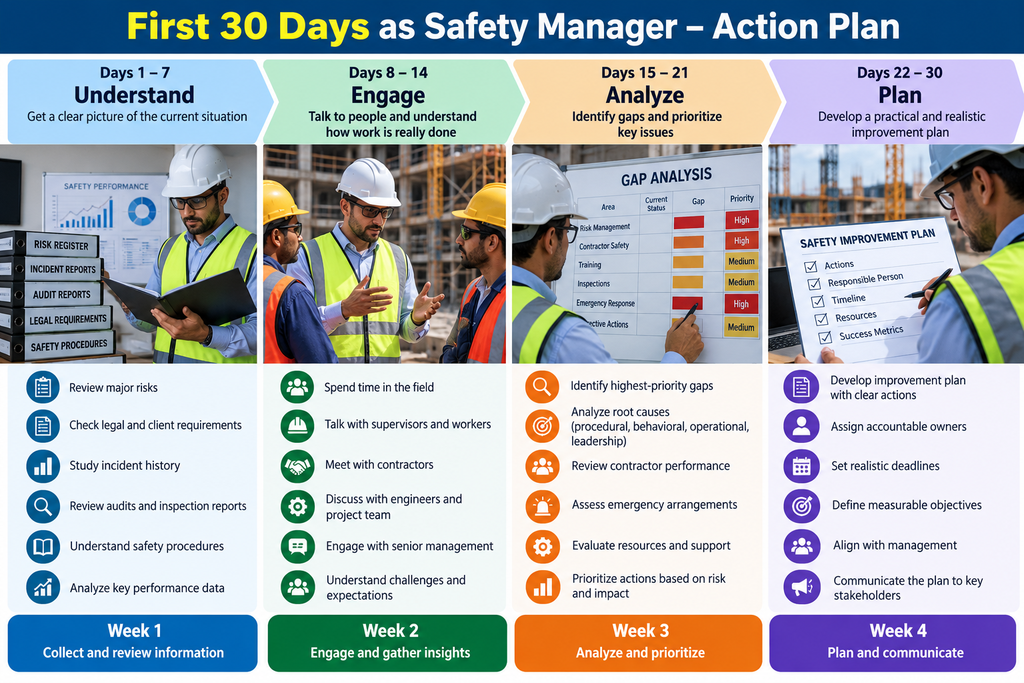
100. What Would You Do During Your First 30 Days as Safety Manager?
Sample Answer
“My first month would focus heavily on understanding before changing.
I would review the organization’s major risks, legal and client requirements, incident history, audits, contractor performance, safety procedures, emergency arrangements, outstanding corrective actions, and key performance data.
I would also spend significant time in the field talking with supervisors, workers, contractors, engineers, and management.
From that information, I would identify the highest-priority gaps and develop an improvement plan with accountable owners, deadlines, and measurable objectives.
I would avoid introducing dozens of new procedures before understanding whether the existing problems are actually procedural, behavioral, operational, or leadership-related.”
How to Answer Safety Manager Scenario Questions Like an Experienced Professional
Scenario questions are where I believe candidates have the greatest opportunity to differentiate themselves.
Consider this question:
A worker is using a damaged electrical tool. What would you do?
A weak answer would be:
“I would tell the worker to stop and provide PPE.”
That is too shallow.
A stronger answer would be:
“I would stop the use of the damaged tool and remove it from service so another worker cannot use it. I would then determine whether similar tools may have the same defect and inspect the relevant equipment.
I would investigate why the damaged tool was not detected during pre-use checks and whether the inspection system is actually working.
The worker would be provided with safe equipment, but I would also correct the underlying weakness that allowed defective equipment to remain available.”
That response demonstrates:
- immediate risk control;
- wider hazard assessment;
- root-cause thinking;
- corrective action;
- prevention.
That is how a manager should think.
Common Safety Manager Interview Mistakes
Memorizing Definitions Without Understanding the Work
Definitions are useful.
But senior interviewers quickly recognize when someone has memorized an answer without understanding how it applies in the field.
Always be ready with an example.
Using PPE as the Answer to Every Hazard
This is one of the most common weak-answer patterns.
If somebody asks how you would manage a fall hazard and your entire answer is:
“I will give him a harness.”
you have skipped most of the hierarchy of controls.
Look first at eliminating the exposure or providing collective protection.
Blaming Workers for Every Incident
Statements such as:
“The worker was careless.”
should immediately lead to another question:
Why did your safety-management system allow that behavior to result in an incident?
Individual accountability is sometimes required, but human error is rarely the only useful conclusion.
Giving Unrealistic Zero-Tolerance Answers
For example:
“If someone violates safety, I will immediately terminate him.”
That may sound strong, but it does not demonstrate mature management.
Understand the circumstances, risk, history, intent, and organizational process.
Serious deliberate violations may justify disciplinary action.
But discipline is not a substitute for good management.
Focusing Only on Compliance
Compliance is essential, but the strongest Safety Managers also understand operational risk.
The ultimate objective is not simply to satisfy an auditor.
It is to prevent people from being injured or becoming ill while allowing the organization to operate effectively.
Questions You Should Ask the Interviewer
At the end of the interview, I would avoid saying only:
“No questions.”
Ask questions that demonstrate management-level thinking.
What Are the Highest-Risk Activities in This Organization?
This helps you understand the actual risk profile.
What Are the Biggest Safety Challenges You Currently Face?
The answer can reveal what your first priorities might be.
How Involved Is Senior Leadership in Safety?
This gives you insight into culture.
How Is Contractor Safety Performance Managed?
Particularly important for construction, infrastructure, oil and gas, manufacturing, and EPC environments.
What Authority Does the Safety Manager Have to Stop Work?
You need to understand the governance model.
What Would You Expect the Person in This Role to Improve During the First Six Months?
I particularly like this question because it tells you what management actually expects from the position.
Frequently Asked Questions
1. What Questions Are Commonly Asked in a Safety Manager Interview?
Common questions cover risk assessment, hazard identification, incident investigation, work at height, lifting, excavation, electrical safety, contractor management, emergency response, audits, training, ISO 45001, KPIs, and leadership.
For senior positions, expect more scenario-based and management questions than simple definitions.
2. How Should I Introduce Myself in a Safety Manager Interview?
Start with your professional role and relevant safety experience.
Then briefly explain the types of operations or projects you have supported, your core responsibilities, and what you can bring to the new role.
Keep the answer structured and relevant rather than narrating your entire employment history.
3. What Is the Best Way to Answer Scenario-Based Safety Questions?
I recommend this sequence:
Make the situation safe → identify the hazard → assess the risk → implement controls → communicate → investigate causes → verify the corrective action.
This approach demonstrates much stronger managerial thinking than jumping immediately to punishment or PPE.
4. Should I Memorize Safety Regulations Before an Interview?
You should understand the major requirements relevant to the role, but memorizing regulation numbers alone will not make you a strong candidate.
Interviewers are usually more interested in whether you understand how those requirements influence actual work.
Never invent a regulation number if you are unsure.
5. Is ISO 45001 Important for Safety Managers?
Yes, particularly where organizations use formal occupational health and safety management systems.
You should understand concepts such as leadership, worker consultation, hazard and risk management, operational controls, performance evaluation, and continual improvement.
6. How Long Should My Interview Answers Be?
Most answers should be concise enough to maintain the interviewer’s attention but detailed enough to demonstrate understanding.
For a standard question, around one to two minutes is usually reasonable.
Complex scenarios may require more explanation.
7. What Should I Say if I Do Not Know an Answer?
Do not invent information.
Explain what you understand about the issue and state how you would verify the requirement using the applicable regulation, company procedure, standard, manufacturer guidance, or competent specialist.
Knowing when to verify something is itself a professional skill.
8. What Makes a Safety Manager Different From a Safety Officer?
A Safety Officer typically focuses more heavily on operational monitoring, inspections, toolbox talks, and day-to-day field compliance.
A Safety Manager generally has wider responsibility for systems, leadership, contractors, audits, incident trends, KPIs, policies, legal compliance, and management reporting.
Exact responsibilities vary between organizations.
9. What Is the Most Important Skill for a Safety Manager?
I would put risk-based decision-making combined with communication near the top.
Technical knowledge helps you identify the problem.
Communication and leadership allow you to get workers, supervisors, contractors, and management to actually control it.
Both are necessary.
10. How Can I Stand Out in a Safety Manager Interview?
Use real, structured examples wherever possible.
Do not simply say:
“I conduct risk assessments.”
Explain how you evaluate hazards, involve workers, prioritize serious risks, assign corrective actions, and verify completion.
The more clearly you demonstrate how you think, the easier it is for the interviewer to imagine you performing the role.
Final Takeaway
A Safety Manager interview should not be approached as an examination where the candidate memorizes 100 perfect sentences.
The real question behind most of the interview is:
Can this person be trusted to make good decisions when people are exposed to risk?
That requires more than technical knowledge.
A strong Safety Manager must be able to:
- identify hazards;
- understand operations;
- prioritize risk;
- communicate clearly;
- challenge unsafe decisions;
- influence workers and management;
- investigate failures;
- develop practical controls;
- verify actions;
- continually improve the system.
If you remember one framework before walking into the interview, remember this:
Identify → Assess → Control → Communicate → Verify → Improve
If you can consistently demonstrate that thought process, you will be able to handle many questions even when the interviewer gives you a scenario you have never seen before.